Treace Medical Concepts (TMCI): supplier posture, public relationships, and what investors should know
Treace Medical Concepts sells orthopaedic implants and surgical solutions to foot and ankle surgeons in the United States and monetizes through product sales delivered via a blended commercial model: a direct sales force for core accounts plus independent sales agencies and public communications to support market access and surgeon adoption. The company outsources production and logistics to third parties, preserving capital efficiency while concentrating operational risk in supplier relationships. For a deeper supplier-risk read, visit https://nullexposure.com/.
Company snapshot: Treace reports roughly $212.7M in trailing revenue with a market capitalization near $91.7M, a gross margin that supports product-level profitability but negative EBITDA driven by commercial investments and SG&A. These financials frame why supplier contracting and go-to-market partners are strategic levers for margin recovery and scaling.
What the public relationships show about Treace’s external partners
Investors evaluating supplier relationships should treat public communications and investor-relations mentions as windows into the company’s preferred external providers. Treace’s press releases list an external firm handling investor contact information, and the company consistently emphasizes third-party manufacturing and transport partners in disclosures.
Gilmartin Group — GlobeNewswire release, March 10, 2026 (preliminary FY2025/FY2026 releases)
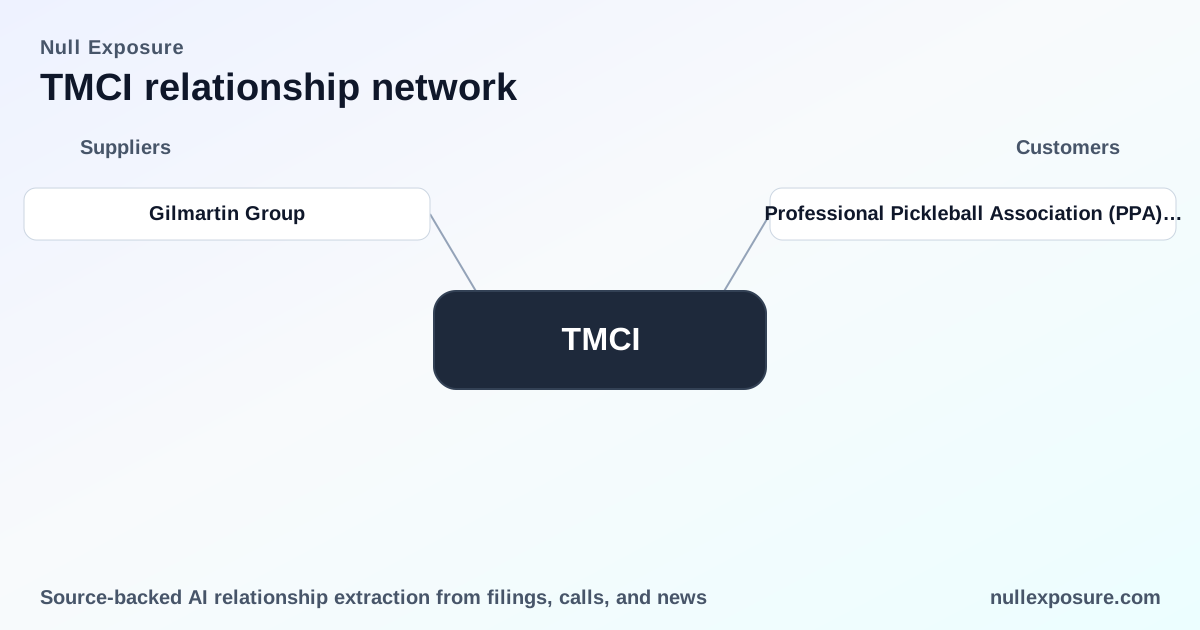
Gilmartin Group is listed as the investor relations contact in Treace’s March 2026 press release announcing preliminary, unaudited fourth-quarter and full-year 2025 revenue, indicating Treace uses Gilmartin for investor communications. According to the March 10, 2026 GlobeNewswire release, Treace directs investors to Gilmartin Group (Philip Trip Taylor, IR@treace.net) for inquiries. Source: GlobeNewswire, March 10, 2026.
Gilmartin Group — GlobeNewswire release, March 10, 2026 (ACFAS 2026 product highlights)
A second GlobeNewswire notice from the same day listing Gilmartin Group as the investor contact accompanies Treace’s conference highlights and clinical-study updates, reinforcing a standing IR relationship for regulatory and scientific announcements. Source: GlobeNewswire, March 10, 2026.
How these relationship mentions should be read by operators and investors
Gilmartin Group’s repeated listing as the investor relations contact signifies that Treace uses an external communications partner for market-facing disclosure and conference management. This is a routine, low-operational-footprint relationship that primarily affects investor perception and information flow rather than product supply. Use this signal to assess the company’s external communications discipline and the cadence of investor outreach.
For a consolidated supplier-risk view across Treace and its partners, see https://nullexposure.com/ in-depth analysis.
Operating model and supplier constraints: the company-level signals
Company disclosures provide clear signals about Treace’s supplier posture:
- Treace leverages third‑party manufacturers for assembly and components rather than owning large-scale manufacturing assets. The company’s cost of goods sold “consists primarily of costs for the purchase of our products from third‑party manufacturers,” which is explicit in filings. This is a deliberate capital‑efficient contracting posture that outsources production scale.
- Treace is also a buyer of finished product and components, reflecting cash flow that is sensitive to vendor pricing and lead times.
- The commercial model is hybrid: the company markets directly and through independent sales agencies, functioning as a reseller of devices when sold via partners or agents.
- Treace relies on transport and logistics providers for point‑to‑point delivery and tracking—these services are operationally critical for surgical timing and inventory control.
- Direct manufacturing costs are itemized as raw materials plus assembly markups, indicating that the company pays supplier markups that scale with volumes.
Interpretation of these signals for investors and operators:
- Contracting posture: Outsourced manufacturing reduces fixed capital intensity but increases supplier negotiation and continuity risk; procurement strategy becomes a core value driver.
- Concentration and criticality: The filings do not enumerate the number of contract manufacturers, so supplier concentration risk is an unresolved variable; however, manufacturing and transport are clearly critical functions for product availability.
- Maturity and scalability: Using third‑party assembly and outsourced logistics supports rapid scale-up if commercial demand rises, but margin capture requires tight supplier terms and volume discounts.
Financial context that amplifies supplier importance
Treace’s gross profit ($169.8M TTM) shows product-level economics that are valid, while negative EBITDA (approximately -$44.5M) indicates that the company’s path to operating profitability depends on controlling SG&A and preserving gross margin as sales grow. Given a price-to-sales ratio near 0.43 and a relatively low market cap versus revenue, improvements in supplier terms, reductions in transport costs, or improved channel economics could be meaningful stock catalysts.
Practical investor takeaways and operational actions
- Supplier negotiation is a strategic priority. With manufacturing outsourced, Treace’s margin expansion will track supplier pricing and logistics efficiency. Investors should monitor any disclosures of contract-manufacturer consolidation or long-term supply agreements.
- Communications partnerships are standardized but informative. Gilmartin Group’s role demonstrates a controlled investor-communications strategy that supports transparency around product launches and clinical data—use the cadence of releases to time diligence windows.
- Logistics continuity matters for commercial execution. Transport providers are operationally critical for surgical timing; any disruptions would quickly affect revenue realization and surgeon relationships.
- Scale economics must be proven in subsequent quarters. The company’s gross margin is supportive; converting that into positive EBITDA requires disciplined supplier management and scalable sales productivity.
For a centralized view of supplier relationships and risk signals across healthcare suppliers, visit https://nullexposure.com/.
Final synthesis and action items
Treace Medical Concepts operates a capital‑light manufacturing posture and relies on external partners for investor communications and logistics. The most consequential supplier risks for investors are manufacturing concentration and logistics continuity, while IR relationships such as Gilmartin Group affect information flow and market perception rather than product delivery. Investors and operators should prioritize vendor disclosure, the structure of manufacturing agreements, and any move toward vertical integration or multi-sourcing that would de-risk supply continuity.
If you need supplier-level diligence or a comparative supplier-risk benchmark across medical-device companies, start your research at https://nullexposure.com/.