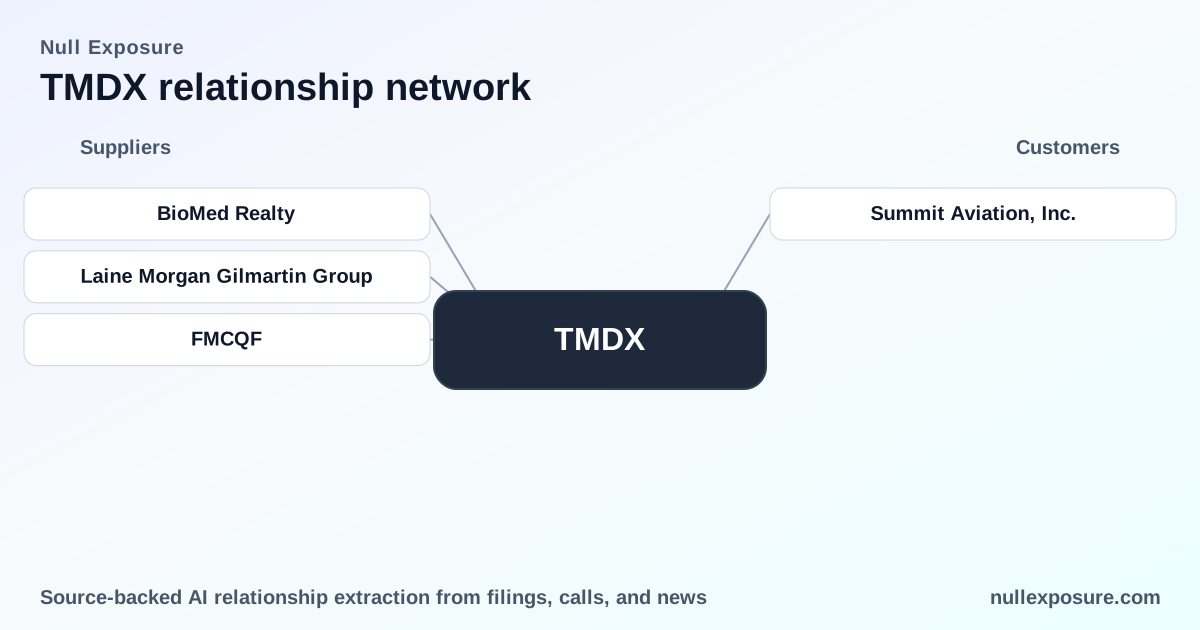
TransMedics (TMDX): Supplier relationships, contracts, and what investors should price in
TransMedics monetizes by selling clinical-grade organ preservation systems and the recurring consumables and services that support transplant procedures; revenue is driven by hardware sales, disposables (OCS Solutions), and aftermarket service. The company’s economics combine steady per-procedure consumable sales with capital intensity for production capacity and logistics, which creates concentrated supplier and real-estate exposures that directly affect margin durability and growth cadence. For investors evaluating counterparty risk and supplier strategy, focus on single-source consumable arrangements, long-term purchase commitments, and capacity commitments tied to real estate.
Explore more supplier intelligence at https://nullexposure.com/ for diligence and monitoring tools.
The headline relationships every investor needs to know
BioMed Realty — a full-building lease for scale in Somerville
TransMedics signed a full-building, 498,000 square-foot lease at Assembly Innovation Park developed by BioMed Realty, signaling a large-scale expansion of lab, manufacturing, or distribution capacity in Somerville, MA (NEREJ, March 10, 2026). This lease materially increases the company’s fixed-cost footprint and will be a driver of near-term capital and operating commitments.
Laine Morgan Gilmartin Group — investor relations contact
TransMedics lists Laine Morgan Gilmartin Group as its investor relations contact, with Brian Johnston named and a company investor email provided in late February 2026, indicating established external IR engagement for investor communications (press release distributed Feb 27, 2026). This clarifies the company’s investor outreach channel for earnings and corporate updates.
Fresenius — single-source supplier for OCS Solutions
TransMedics sources its OCS Solutions using proprietary formulas from third-party suppliers and identifies Fresenius as the single-source supplier of OCS Solutions for OCS Lung and OCS Heart in its FY2024 filings, reflecting a critical supplier concentration for core consumables (TransMedics Form 10‑K, FY2024). The supply arrangement is a strategic dependency that investors must treat as a material operational risk.
How the filings and disclosures shape the operating model
TransMedics’ public disclosures describe a contracting posture skewed toward long-term commitments for key inputs and real estate, combined with pockets of short-term leases and cancellable professional services. The company has several multi-year obligations and purchase commitments that create predictable spend but also lock in exposure to supplier performance and real-estate costs.
- The company disclosed an unconditional $9.5 million purchase commitment entered in January 2021 with specified annual minimums through December 2029 and a remaining commitment of about $5.0 million as of December 31, 2024, which signals multi-year procurement obligations in the $1–10 million spend band.
- TransMedics also acquired a 20-year operating lease (with a 10-year renewal option) tied to the Summit acquisition for aircraft hangar space, reflecting long-dated infrastructure commitments.
- Separately, a short-term lease in Dallas expires June 30, 2027, with fixed monthly payments totaling roughly $1.7 million over the three-year term, showing a mixed maturity profile across facilities.
- The company explicitly calls out single-source and sole-source components in its supply chain and cites concentration in aircraft manufacturers and spare parts as a material operating risk. These references are company-level signals drawn from the FY2024 Form 10‑K.
Taken together, these disclosures create a clear picture: TransMedics operates with material concentration and long-duration contractual commitments where continuity of supply and facility availability are critical to revenue delivery.
Key risk and opportunity implications for investors
- Concentration risk is tangible and actionable. The Fresenius single-source relationship for OCS Solutions is a direct operational dependency for core recurring revenue; any disruption to that supply chain affects per-procedure revenue and utilization rates. (TransMedics Form 10‑K, FY2024.)
- Real-estate expansion increases operating leverage. The 498,000 s/f lease with BioMed Realty introduces significant fixed-cost leverage that accelerates scale if commercialization proceeds on plan and depresses margin if utilization lags. (NEREJ, March 10, 2026.)
- Contract maturities are staggered. Multi-year purchase commitments and long-term leases reduce near-term renegotiation risk but raise exposure to mispriced commitments over a longer horizon; shorter-term leases provide tactical flexibility.
- IR and communications are centralized. Active engagement with an external IR firm improves transparency and reduces execution risk around market expectations. (Press release distributed Feb 27, 2026.)
Use these points to stress-test models and scenario analyses: price in potential supply disruption windows around Fresenius renewals, and run utilization scenarios for the Somerville facility build-out.
For deeper supplier and counterparty surveillance, visit https://nullexposure.com/ for continuous monitoring and analytics.
Practical next steps for investors and operators
- Monitor Fresenius contract renewal timing and termination notice windows and map those dates to revenue sensitivity for OCS Lung and OCS Heart procedures. The FY2024 filing documents extension mechanics and the single-source status.
- Track milestone updates on the Somerville Assembly Innovation Park build-out and the timing of equipment and staffing ramp to understand when fixed-cost leverage converts to incremental margin. (NEREJ coverage, March 2026.)
- Validate spare-parts and aircraft manufacturer exposure in operations due to cited reliance on a single aircraft model and multi-year warranties expiring; quantify replacement and spare-parts sourcing alternatives in scenario work.
Final read: what to price into the multiple
TransMedics combines healthy unit economics—reflected in the company’s stated gross profit margin and operating margin metrics—with concentrated supplier risk and large fixed-cost commitments that justify a premium only if execution on scale and uninterrupted supply are certain. Investors should price in a probability-weighted haircut for supplier disruption and lower-than-expected facility utilization while giving credit to recurring consumable sales that support long-term revenue per procedure.
For a systematic supplier-risk scorecard and ongoing alerts tied to TransMedics counterparties, go to https://nullexposure.com/ and sign up for tailored monitoring.
Key takeaway: supply concentration with Fresenius and the large Somerville lease are the dominant operational levers that will determine whether TransMedics converts current margin profiles into durable, scalable cash flow.