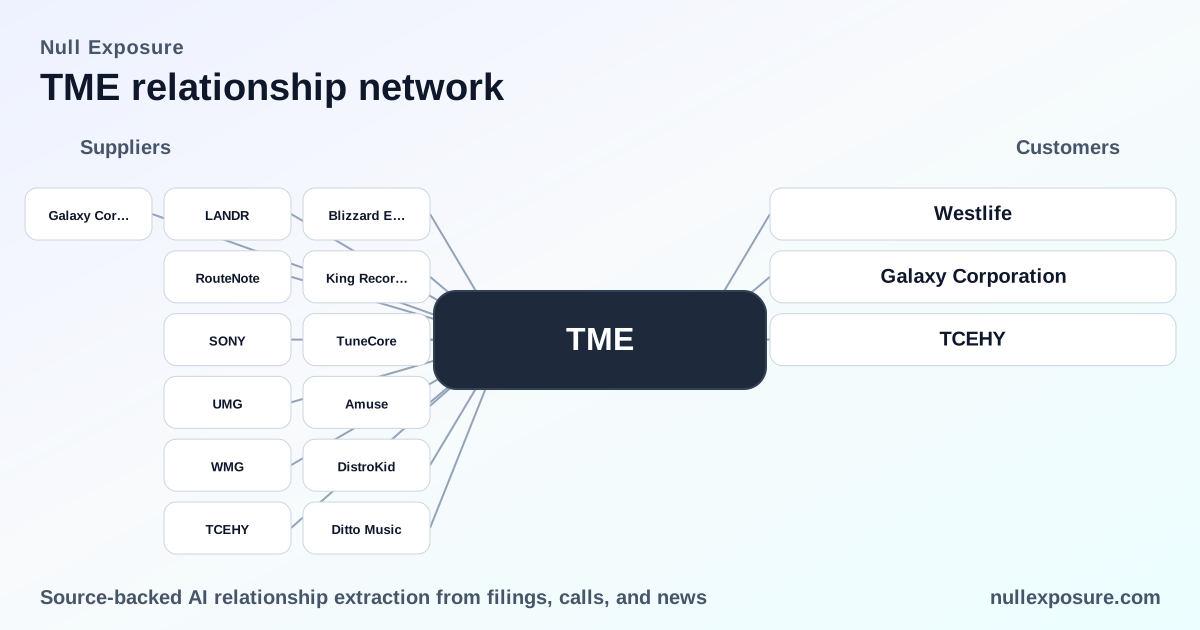
Tencent Music Entertainment Group (TME): Supplier Map and Strategic Implications for Investors
Thesis: Tencent Music Entertainment Group operates China's dominant online music ecosystem by licensing large-scale catalogs from global and regional record labels while aggregating indie content through digital distributors, and it monetizes that catalog via subscription streaming, online karaoke, and live streaming services. Revenue depends on a two-sided model — paid users and in-app monetization on one side, content suppliers (labels and distributors) on the other — which makes supplier relationships a core commercial and risk vector for investors. For a quick, consolidated view of TME’s supplier exposures and how they translate into commercial leverage, visit https://nullexposure.com/.
How TME’s content supply chain drives value
TME’s product is content: tracks, soundtracks, and live performances that power engagement across streaming, karaoke, and virtual live experiences. Access to major label catalogs underpins scale and churn control, while relationships with indie aggregators expand breadth and niche genres. The company captures revenue through subscriptions, advertising and virtual goods tied to live/interactive features, and it pays royalties under license agreements and distribution arrangements. Institutional ownership above 67% and positive profitability metrics (operating margin ~29% TTM) signal that TME is a mature commercial operator with consolidated bargaining power in China’s music market.
Early reading: explore supplier tracking and relationship signals at https://nullexposure.com/.
The supplier map — partner-by-partner, what matters now
Below I cover every supplier relationship referenced in recent company materials and reporting. Each entry is a concise, plain-English summary with source context.
Blizzard Entertainment
TME collaborated with Blizzard Entertainment to introduce 50 original soundtracks from major game titles including World of Warcraft and Hearthstone, expanding game music inventory on TME platforms. This was disclosed on TME’s 2025 Q3 earnings call (reported March 2026).
King Records
TME established strategic partnerships with Japanese ACG label King Records to enrich anime and K-pop categories, signaling a push into high-engagement niche genres favored by youth audiences. Management discussed this in the 2025 Q3 earnings call (March 2026).
TuneCore
TME relies on distributors such as TuneCore to onboard independent artists and widen catalog breadth, enabling unsigned musicians to publish directly across TME’s services. A Hypebot feature on China’s streaming landscape (Dec 2025) lists TuneCore among key indie distributors supporting TME.
Amuse
Amuse is named among the indie distributors that feed content into TME’s platforms, providing another channel for indie artist ingestion and long-tail catalog expansion. Hypebot coverage (Dec 2025) references Amuse’s role in the distributor mix.
DistroKid
DistroKid supplies independent artist uploads to TME, contributing to the platform’s volume of user-generated and indie tracks that boost discovery and long-tail engagement. This was noted in a Hypebot article on streaming in China (Dec 2025).
Ditto Music
Ditto Music appears in the set of distributors that allow indie musicians to publish on TME’s services, supporting catalog diversity outside major-label channels. Hypebot’s December 2025 piece includes Ditto Music in the distributor list.
LANDR
LANDR is listed among the distributor partners enabling independent releases to reach TME’s platforms, reinforcing TME’s approach of combining major-label exclusives with aggregator-fed indie supply. Hypebot referenced LANDR in December 2025.
RouteNote
RouteNote is cited as one of the indie distribution partners that supply content to TME, underlining the company’s reliance on multiple aggregator relationships to scale niche and independent content. A Hypebot article (Dec 2025) mentions RouteNote specifically.
Sony Music
Global labels such as Sony Music have formal licensing deals with Tencent that grant TME playback rights to large artist catalogs — a critical supply pillar for mainstream engagement and subscription conversion. The BBC reported on these label deals in context of Tencent’s streaming arrangements (FY2025 coverage).
Universal Music
Universal Music is another major label with licensing arrangements that provide TME with access to thousands of artist catalogs, essential for mainstream content breadth and churn reduction. BBC reporting (FY2025) cites Universal among the global labels that struck deals with Tencent.
Warner Music
Warner Music’s catalog is licensed to Tencent’s streaming platforms, reinforcing the company’s access to the three dominant global music groups and securing mainstream content supply. This relationship is documented in BBC coverage (FY2025).
Tencent Games
TME co-produced a theme song with Tencent Games — “Atlas of Tomorrow” performed by JJ Lin for Honor of Kings — demonstrating internal cross-company content synergies within Tencent’s ecosystem and a source of exclusive, platform-differentiating content. Management described this on the 2025 Q3 earnings call (March 2026).
Galaxy Corporation
Galaxy Corporation’s Greater China World Tour contract with TME indicates deeper collaboration on K-pop content and live experiences, suggesting live-event and promotional synergies that extend monetization beyond streaming. This was reported by Simply Wall Street in FY2026 coverage.
Operating model signals and contracting posture
No explicit contracting constraints were provided in the available supplier data, which itself is an informative company-level signal. From the disclosed relationships we can extract operating characteristics:
- Contracting posture: TME runs a mixed contracting model — long-term strategic licenses with global majors (critical, high-maturity contracts) and flexible aggregator/distributor arrangements for indie content (scalable, transactional). Major-label deals are foundational to the service’s value proposition.
- Concentration and criticality: Access to Universal, Sony, and Warner catalogs creates high single-point criticality where negotiating terms or renewals with these labels materially impact content availability and operating economics.
- Maturity: Presence of formal label partnerships, cross-group synergies with Tencent Games, and institutional investor ownership reflect commercial maturity; the company is past early-market product fit and is now optimizing licensing and monetization.
- Flexibility: Multiple indie distributors reduce concentration risk on the long tail of content, enabling breadth without heavy capital commitments to catalog acquisition.
Investment implications — what investors should watch
- Revenue defensibility: Major-label licenses are a moat for mainstream listener retention; losing access to those catalogs would be immediately revenue-dilutive. Monitor renewal terms and royalty rate trends.
- Growth levers: Exclusive game soundtracks and K-pop/live-event partnerships (Tencent Games, Galaxy Corporation, King Records) are clear levers for engagement-driven monetization.
- Cost pressure: Royalty and licensing costs are the largest variable; margin sensitivity to label economics is the primary operating risk even as TME’s profitability metrics remain solid.
- Diversification: The reliance on multiple indie aggregators (DistroKid, TuneCore, etc.) is a strategic hedge that broadens catalog at low incremental cost.
Midway action: if you want structured supplier intelligence and contract monitoring, start with https://nullexposure.com/ to build a watchlist.
Final takeaway and next steps
TME’s supplier base is intentionally hybrid: large, strategic label contracts secure mainstream appeal while a broad set of indie distributors supplies niche and long-tail content. For investors, that combination supports both scale and experimentation — but it also concentrates risk in major-label renewals and royalty terms. Track upcoming license renewals, label negotiation outcomes, and new exclusives from internal Tencent units and regional partners as the primary value drivers.
For ongoing supplier tracking and tailored exposure analysis, visit https://nullexposure.com/ — the platform provides consolidated relationship views and monitoring suited to investment due diligence.