Taylor Morrison Home (TMHC) — Supplier relationships that shape operational leverage
Taylor Morrison Home Corporation builds and sells homes across the United States and monetizes through unit sales, land development gains and a growing portfolio of third-party-supported rental projects; the company captures margin through scale in finished-home construction, land banking and fixed-price subcontracting while financing working capital and growth through secured credit arrangements and capital partnerships. Investors evaluating TMHC supplier relationships should focus on the company’s credit counterparties and its land/partner capital structure, because those relationships drive both liquidity and inventory economics.
Explore TMHC supplier exposure and signals at https://nullexposure.com/.
A compact financial and strategic snapshot
Taylor Morrison is a large public homebuilder with $8.12 billion in trailing revenue and roughly $5.78 billion market capitalization. Profitability metrics show ~9.6% net margin and an operating margin near 12.3%, while leverage and liquidity are managed through bank facilities and third‑party land arrangements. The company operates as general contractor and land acquirer: it books home sales, realizes land gains, and outsources construction execution to subcontractors under primarily fixed‑price contracts.
How Taylor Morrison’s operating model turns suppliers into vectors of margin
Taylor Morrison’s business converts raw parcels into finished homes and, increasingly, rental inventory supported by third‑party capital. The company’s land banking and lot acquisition strategy is a core value driver: control of developed lots and closed home sales produces top‑line revenue and gross profit, while subcontractor cost control and fixed‑price contracting preserve operating margin. On the capital side, credit facilities and strategic capital partners provide leverage for land purchases and bridge financing for development.
- Construction execution is outsourced. Subcontractors perform the physical build under fixed‑price contracts, making subcontractor cost control central to margin stability.
- Land is both inventory and financial leverage. Land purchases are a primary cash outflow and a source of future margin, often financed by credit facilities or partner capital.
- Credit relationships matter for liquidity. Bank administrative agents and lending syndicates set covenants and capacity that influence growth pacing.
For direct supplier insight and alerting, visit https://nullexposure.com/ to see how counterparties feed into TMHC’s operational picture.
Contracting posture, concentration and criticality explained
Taylor Morrison operates with a general-contractor posture: it remains the primary contracting entity to the end customer while subcontracting build and development work. That posture creates two structural characteristics:
- Concentration risk in subcontracting execution. Fixed‑price subcontracts concentrate execution risk into the supply chain; adverse cost inflation or contractor performance issues directly compress margins.
- Capital counterparty criticality. Banking agents and capital partners control access to liquidity for land acquisition and development — a critical input to inventory conversion and revenue timing.
- Maturity and institutionalization. The company runs a mature, repeatable platform: standardized lot acquisition processes, recurring subcontractor relationships, and institutional lender engagements support scale and predictability in operations.
Counterparties on the public record
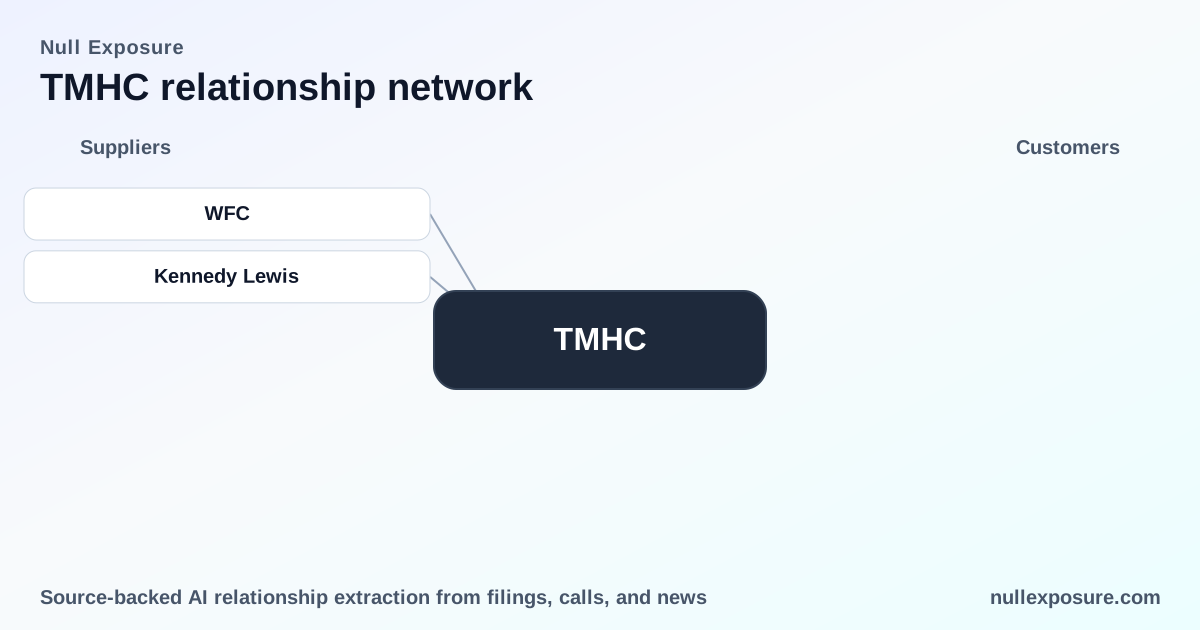
Wells Fargo — credit administrative agent
Taylor Morrison signed an amended credit agreement in which Wells Fargo acted as Administrative Agent for a lending syndicate, securing operating liquidity and working capital capacity in FY2025. This formal lending role makes Wells Fargo a primary counterparty for TMHC’s short‑to‑medium-term financing needs (TradingView news item reporting the amended agreement, March 10, 2026: https://www.tradingview.com/news/tradingview:065182ee7e1ef:0-taylor-morrison-signs-amended-credit-agreement-with-wells-fargo/).
Kennedy Lewis — land bank and capital partner for rental platform
Taylor Morrison's Yardley rental initiative is supported by a roughly $3 billion land bank underwritten with Kennedy Lewis, backing about 10,400 home sites across nine markets and enabling the company to scale a unique rental offering while keeping most units off the balance sheet (earnings-call transcript coverage, InsiderMonkey, March 10, 2026: https://www.insidermonkey.com/blog/taylor-morrison-home-corporation-nysetmhc-q4-2025-earnings-call-transcript-1694444/).
What the constraints tell investors about supplier dynamics
Company-level signals show two consistent operational constraints:
- Taylor Morrison operates as a buyer of land and lots through purchase, option and land‑bank arrangements — the company actively acquires inventory and commits capital up front. Evidence excerpt: "In the ordinary course of business, we enter into land purchase contracts, lot option contracts and land banking arrangements in order to procure land or lots for the construction of homes."
- Taylor Morrison functions as a service integrator/prime contractor while relying on subcontractors for construction and development under fixed‑price contracts; this both stabilizes unit economics when execution is tight and concentrates downside when input costs rise. Evidence excerpts: "Subcontractors perform all home construction and land development, generally under fixed-price contracts." and "We are the general contractors for all real estate projects and engage subcontractors for home construction and land development."
Taken together, these constraints show a company that controls inventory acquisition and resale economics while outsourcing execution, which concentrates operational risk in subcontractor execution and financial risk in capital counterparties.
Investment implications — what to watch in supplier relationships
- Liquidity providers are systemically important. The Wells Fargo‑led facility is central to near‑term liquidity and covenant profile; changes to facility capacity or terms would directly affect land purchasing and lot development cadence.
- Strategic partners de‑risk balance-sheet deployment. Kennedy Lewis’s capital for Yardley shifts inventory economics and reduces direct balance-sheet exposure for rental inventory, improving capital efficiency and optionality.
- Execution risk is concentrated in subcontracting. Fixed‑price subcontracts protect upside but transmit cost shocks directly to margins; monitor labor and material cost trends and subcontractor performance metrics.
For granular counterparty monitoring tied to these implications, see the supplier analysis hub at https://nullexposure.com/.
Bottom line and actionable next steps
Taylor Morrison’s supplier landscape is defined by two structural axes: capital counterparties that enable land acquisition and partner‑capital programs, and a subcontractor base that executes construction under fixed pricing. Investors should treat bank facilities and partner arrangements as core risk factors and track subcontractor cost trends as margin drivers.
- Review lending covenants and facility maturity schedules to assess liquidity runway.
- Monitor partner‑funded land banks to evaluate how much inventory sits off‑balance‑sheet versus owned inventory.
- Track subcontractor cost trends and any disclosure of fixed‑price contract bandwidth.
For continued monitoring and supplier-centric exposure analysis, visit https://nullexposure.com/ for curated counterparty intelligence and alerts.