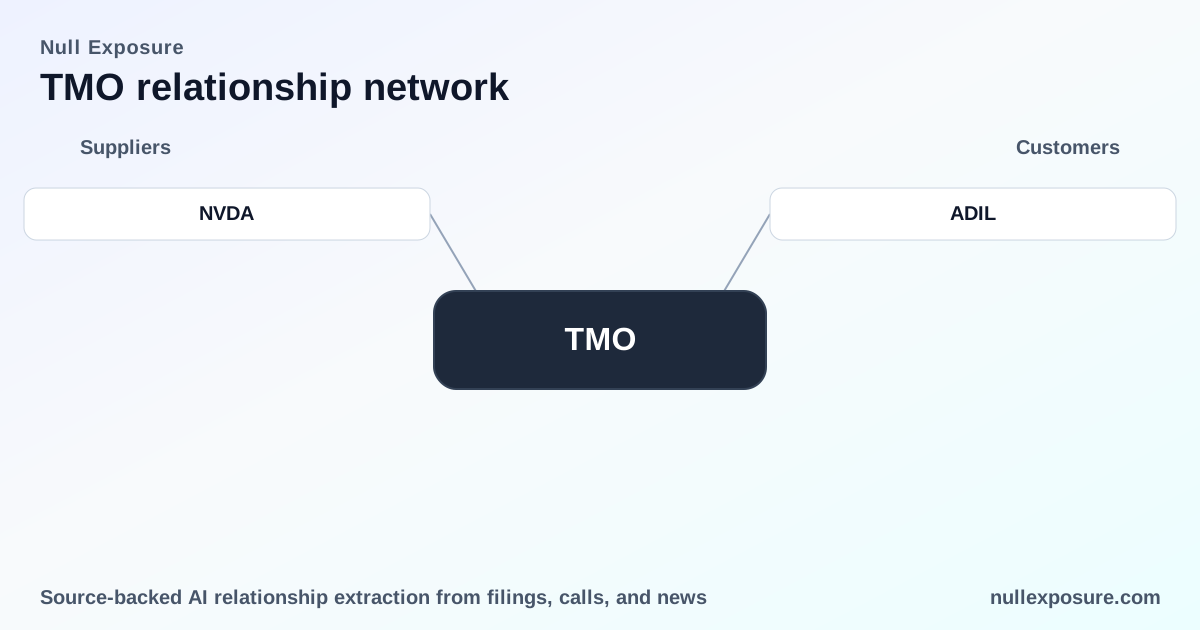
Thermo Fisher Scientific Inc (TMO): Supplier relationships, constraints, and what the NVIDIA link means for investors
Thermo Fisher Scientific sells laboratory instruments, reagents, consumables, software and services to healthcare, academic and industrial labs and monetizes through a blend of high-margin consumables, recurring service contracts, and capital equipment sales. The company's economics hinge on recurring consumable demand and software/service attachments to instruments, while strategic supplier and technology partnerships shift operating leverage toward higher-margin solutions. For investors and operators evaluating Thermo Fisher's supplier posture, the mix of in-house manufacturing, third‑party private‑label sourcing, and targeted technology alliances defines both resilience and dependency. Learn more at https://nullexposure.com/.
A concise investor thesis up front
Thermo Fisher converts installed capital into recurring revenue by tying consumables and services to instruments; strategic partnerships that embed software or automation into workflows accelerate that monetization. Supplier relationships therefore matter less as raw spend and more as enablers of recurring attach rates, regulatory compliance, and speed-to-market for high-value solutions.
The NVIDIA relationship entries — what the market noted
- Thermo Fisher announced a partnership with NVIDIA to develop AI-powered laboratory solutions and automation that leverage NVIDIA’s AI platform to improve lab efficiency and accuracy, according to a March 10, 2026 news post on Bitget. (Bitget news, March 10, 2026 — https://www.bitget.com/news/detail/12560605235008)
- The same announcement was carried in an AMP variant of the Bitget posting on March 10, 2026, reiterating the collaboration to integrate NVIDIA’s AI platform into Thermo Fisher lab automation and analytics capabilities. (Bitget AMP, March 10, 2026 — https://www.bitget.com/amp/news/detail/12560605235008)
Both entries describe the same commercial initiative: Thermo Fisher is partnering with NVIDIA to introduce AI-driven automation and analytic layers across laboratory workflows. These notices signal a strategic push to embed third‑party AI technology into Thermo Fisher’s product and service stack.
Why a single technology partner matters for a hardware-led company
Thermo Fisher’s business model is hardware anchored, software enhanced. Bringing NVIDIA into the stack does three things for investors and operators:
- It accelerates the shift from one‑time instrument sales toward recurring software and analytics revenue through higher-value attachments and managed services.
- It reduces time‑to‑value for customers by embedding pre‑built AI models and compute infrastructure rather than building those capabilities purely in‑house.
- It raises integration and procurement complexity because high‑performance compute and software licensing introduce new supplier dependencies into regulated workflows.
A mid-report action: if you are monitoring supplier concentration and strategic technology partners, track announcements and filings at https://nullexposure.com/.
Company-level constraints that shape procurement posture
The public record gives clear company-level signals about Thermo Fisher’s supplier and contracting posture.
- No single supplier is material overall, but Thermo Fisher acknowledges that certain materials or components are sourced from a single supplier or a limited number of suppliers when quality, regulatory or uniqueness dictates. This is a company-level statement about concentration and criticality rather than a relationship-specific finding.
- Thermo Fisher discloses unconditional purchase obligations totaling $2.20 billion as of December 31, 2024, with the majority expected to be settled in 2025, which demonstrates an active procurement pipeline and a firm buyer posture toward suppliers. (Company filing, Dec 31, 2024)
- The company both manufactures products directly and sources third‑party products (private‑label and branded) for resale, which indicates a hybrid manufacturing model that mitigates single-mode risk but increases supplier management needs.
- The procurement scale places Thermo Fisher in a >$100M+ spend band, signifying high-volume contracting and bargaining leverage but also meaningful exposure if a critical supplier disrupts a regulated product flow.
Taken together, those constraints imply a procurement organization that negotiates at scale, manages a mix of in‑house and external production, and accepts limited single‑source relationships where regulation and design require it. Concentration risk is controlled at the portfolio level but cannot be eliminated for certain regulatory or proprietary components.
Operational implications for procurement, R&D and compliance
Embedding NVIDIA technology into instruments and lab workflows changes sourcing and compliance responsibilities in practical ways:
- Procurement must manage licensing, hardware acceleration (GPUs or cloud compute) and integration contracts that differ materially from commodity reagent purchases.
- R&D and regulatory teams must validate AI models and compute stacks as part of regulated device workflows, increasing certification complexity but creating stickier product offerings.
- Service and field operations will need new skill sets to deploy and maintain AI-enabled solutions, which raises both operating expense and potential margin on higher-value services.
These are positive drivers for recurring revenue but create near-term operational costs and supplier governance requirements that operators must plan for.
Investment implications — risks and opportunities
- Opportunity: AI partnerships create a pathway to higher-margin, recurring software and analytics revenue via attachments and managed services. Successful integration with NVIDIA could accelerate monetization and raise analyst upside.
- Risk: Increased dependence on third‑party compute and software providers introduces non-traditional supplier risk—licensing, supply of specialized GPUs, and model‑validation obligations within regulated workflows.
- Operational: Procurement scale and disclosed unconditional purchase obligations reflect disciplined contracting but require active mitigation for single-source critical components.
For a concise set of actions for investors and operators:
- Monitor announcement cadence and product roadmaps tied to the NVIDIA collaboration for commercialization milestones.
- Track filings and supplier disclosures for any named single-source suppliers or escalating purchase obligations.
- Assess service margin trends to see whether software/AI attachments drive recurring revenue as projected.
You can access a consolidated view of supplier relationships and constraints at https://nullexposure.com/ to stay ahead of these developments.
Final takeaways and next steps
Thermo Fisher is structurally positioned to convert instrument installs into higher-margin recurring revenue; strategic technology partnerships such as the one with NVIDIA are a lever to accelerate that transition. Company-level disclosures show meaningful procurement commitments ($2.20B in unconditional purchase obligations at year-end 2024) and a hybrid manufacturing model that balances in-house production with third‑party sourcing. Investors should treat the NVIDIA relationship as a commercial enhancement that elevates integration complexity and supplier governance needs, while offering clear upside to software and services revenue if successfully monetized.
For ongoing monitoring of Thermo Fisher’s supplier relationships and constraint signals, visit https://nullexposure.com/ and subscribe for updates.