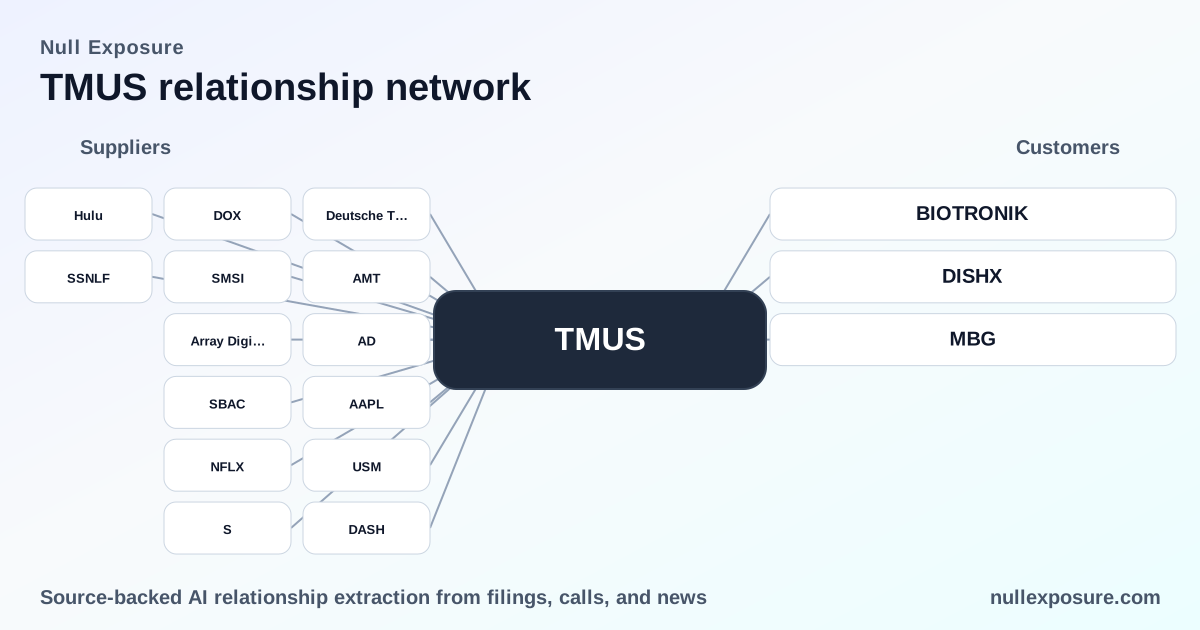
T-Mobile US (TMUS) — Supplier relationships, strategic posture, and what investors should know
T-Mobile operates as a national wireless carrier that monetizes primarily through wireless service revenue (postpaid and prepaid subscriptions), device financing and promotions, and spectrum and infrastructure investments that reduce long-term operating costs and increase capacity. The company layers device and content partnerships to drive ARPU and retention, while large one-off spectrum and network transactions shape capital intensity and supplier exposure. For investors evaluating TMUS supplier relationships, the core thesis is: T-Mobile’s supplier ecosystem is a mix of long-term infrastructure landlords and strategic technology/content partners, with occasional large spectrum purchases that materially affect capital deployment and operating leverage. Learn more about supplier signals and structured exposure at https://nullexposure.com/.
How T-Mobile contracts and where the money flows
T-Mobile’s operating model balances ongoing, repeatable supplier commitments (tower leases, software and content partnerships) with episodic, large-value spectrum transactions and asset acquisitions. From a contracting posture perspective, T-Mobile:
- Uses long-term site leases and tenant agreements with tower companies to underpin nationwide coverage and continuity of service.
- Executes sizable spectrum licensing and purchase transactions that are capital-intensive and deterministic for future network capacity.
- Engages ecosystem partnerships with device OEMs and content providers to differentiate offers and push ARPU through bundled services.
The company filing and corporate disclosures signal that supplier engagement is both strategic and scale-driven: there are high-dollar, infrequent acquisitions (spectrum, business purchases) alongside recurring, mission-critical service contracts (towers, billing/OSS vendors, and content). For more detailed supplier intelligence, visit https://nullexposure.com/.
Company-level constraint signals (what the filings say)
- Licensing & spectrum purchases are material to strategy. T-Mobile disclosed a 600 MHz license purchase (August 8, 2022) for $3.5 billion, which demonstrates an appetite for one-time, high-value spectrum deals that alter capacity and coverage economics.
- Supplier governance is formalized. The company’s Supplier Code of Conduct and procurement language indicate a deliberate vendor management posture that treats suppliers as an extension of corporate conduct and compliance.
- Transaction scale is large and concentrated. The company’s May 24, 2024 agreement to acquire substantially all of UScellular’s wireless operations and spectrum for roughly $4.4 billion (cash plus assumed debt) confirms the spend band for certain supplier/transaction counterparts exceeds $100 million — a material, credit-sensitive exposure.
These are company-level signals about maturity, criticality, and concentration rather than metrics tied to any single vendor.
The supplier map — who T‑Mobile contracts with and why that matters
Below I cover every relationship in the available results with a concise, plain-English takeaway and a short source note.
-
Deutsche Telekom (DT)
T‑Mobile’s largest shareholder and strategic parent through Deutsche Telekom, which benefits from an FCC declaratory ruling enabling up to 100% ownership; this ownership structure underpins capital and governance alignment. According to T‑Mobile’s 2025 Form 10‑K filing, DT’s ownership posture is explicitly referenced in governance disclosures (FY2025, 10‑K). -
American Tower Corporation (AMT)
American Tower is a major landlord that leases tower space to T‑Mobile; these site leases represent recurring, inflation-linked operating costs that are critical to network availability. A FinancialContent industry piece (March 2026) described AMT’s role leasing tower capacity to carriers including T‑Mobile. -
Array Digital Infrastructure (AD)
Array sold spectrum assets and conveyed a portion of its spectrum holdings to T‑Mobile as part of its repositioning toward tower operations; these spectrum transfers were structured as multi-part transactions totaling roughly $178 million in additional sales. Multiple reports (AlphaStreet, The Globe and Mail, InsiderMonkey — March 2026) document Array’s sales and the transfer of spectrum to major carriers including T‑Mobile. -
Apple Inc. (AAPL)
Apple is a strategic device partner: T‑Mobile bundled iPhone 17e promotions and integrated device financing and marketing to drive new activations and retention. Market coverage of T‑Mobile’s spring promotions (MarketMinute and AI Journ, March 2026) describes the joint promotional programs. -
United States Cellular Corporation (USM / UScellular)
T‑Mobile completed a transformational acquisition of substantially all of UScellular’s wireless operations and spectrum for approximately $4.4 billion, a transaction that shifts spectrum ownership and market footprint and underscores large-capital vendor-style exposure. The transaction details were disclosed in T‑Mobile’s corporate filings and related May 2024 agreements referenced in company disclosures (FY2025 constraint evidence). -
DoorDash (DASH)
DoorDash is used as a logistics partner for same‑day device delivery in promotional rollouts, enabling rapid device fulfillment for promotional activations. AI Journ coverage (March 2026) described same‑day iPhone delivery through DoorDash. -
Amdocs Limited (DOX)
Amdocs renewed a five‑year contract with T‑Mobile, reinforcing the role of large OSS/BSS suppliers in billing and customer-care functionality and the durability of those service-provider relationships. SimplyWallSt reported on the Amdocs renewal and investor reaction (2026 coverage). -
Smith Micro Software, Inc. (SMSI)
Smith Micro is referenced as a product partner working on enhanced feature sets for family-segment offerings, indicating incremental software/service revenue opportunities in device or family plans. InsiderMonkey’s Q4 2025 earnings coverage highlights the partnership outlook (Q4 2025). -
SBA Communications Corp (SBAC)
SBA derives significant site-leasing revenue from wireless tenants including T‑Mobile; these third-party landlords are revenue-stable suppliers whose pricing and occupancy dynamics feed directly into T‑Mobile’s network OPEX profile. SBA’s SEC/10‑K reporting (March 2026 coverage via TradingView) lists T‑Mobile among its major tenant segments. -
Netflix (NFLX)
Netflix is part of T‑Mobile’s bundled entertainment offerings included in select plans, used to increase the perceived value of subscriptions and reduce churn. AI Journ coverage (March 2026) documents Netflix inclusion in T‑Mobile’s “Best Entertainment Bundle” offers. -
Hulu
Hulu participates alongside Netflix in T‑Mobile’s content bundles aimed at raising ARPU and differentiating plan tiers. Promotional materials and media reports (AI Journ, March 2026) describe Hulu as a component of these bundles. -
Sprint (S)
Sprint legacy assets — notably mid‑band 2.5 GHz spectrum acquired through the Sprint merger — continue to be foundational to T‑Mobile’s 5G deployment and capacity strategy. Market commentary (TradingView / Zacks coverage, March 2026) references ongoing use of Sprint-derived spectrum for 5G rollout. -
Samsung (SSNLF)
Samsung is a device OEM partner engaged in device promotions (e.g., Galaxy S26 Ultra offers) that T‑Mobile uses to incentivize activations and upgrades. Trading and press coverage (TradersUnion, March 2026) noted promotional device giveaways tied to subscriber eligibility.
Investment implications — risk, resilience, and runway
- Infrastructure dependency is durable and predictable. Tower leases and large landlords (AMT, SBA) are recurring, long‑dated obligations that drive predictable OPEX; these are operationally critical but contractually mature.
- Spectrum purchases are episodic and capital‑intensive. The 600 MHz purchase and the UScellular transaction illustrate that T‑Mobile uses large one-off purchases to secure long-term capacity, which compresses free cash flow in the near term but improves capacity-driven revenue potential.
- Ecosystem partnerships drive ARPU and retention. Device OEMs and content bundles (Apple, Samsung, Netflix, Hulu) are less capital‑intensive but essential to competitive differentiation and customer lifecycle economics.
- Concentration and counterparty exposure exist at two layers: large vendors/landlords for network access, and a handful of device/content partners for customer acquisition and retention; both layers are consequential to financial modeling and operational continuity.
If you want deeper, transaction‑level exposure maps and counterparty risk scoring for TMUS supplier relationships, review our supplier intelligence and exposure tools at https://nullexposure.com/.
Bottom line and investor action
T‑Mobile runs a hybrid supplier model: recurring, contractually stable infrastructure relationships combined with occasional, high‑ticket spectrum and business acquisitions that materially shift capacity and capital allocation. For investors, that means modeling should stress recurring tower lease escalation, one-time spectrum cash outlays, and the revenue upside from device/content bundles.
For tailored supplier risk assessments and to track emerging counterparty events tied to TMUS, explore our platform at https://nullexposure.com/.