Tennant Company (TNC): How supplier relationships shape credit profile and operational risk
Tennant Company designs, manufactures and sells industrial floor‑cleaning equipment and related parts and services worldwide, monetizing through equipment sales, consumables and recurring service and parts revenue. The business combines capital equipment margins with annuity‑like parts and service flows, underpinned by outsourced manufacturing and a material credit facility that shapes liquidity and procurement behavior. For investors evaluating supplier exposure and counterparty risk, the mix of long‑dated financing, outsourced production relationships and meaningful purchase commitments defines where operational leverage and vendor concentration sit. Learn more about supplier-level implications and partner signals at https://nullexposure.com/.
Snapshot: financial context that frames supplier reliance
Tennant is a mid‑cap industrial specialist (market cap roughly $1.12bn, FY‑TTM revenue $1.2035bn, EBITDA $133.4m). The company runs modest net margins (profit margin ~3.6%) and a forward multiple that compresses to ~13x forward P/E, implying market expectations for margin recovery and cash‑flow stabilization. Tennant disclosed an Amended and Restated Credit Agreement dated August 7, 2024 that provides a secured revolving facility through August 7, 2029 — a structural feature that both supports working capital and signals reliance on institutional lending. According to public filings, the company had $197.5m of outstanding borrowings under the facility as of December 31, 2024, with contractual purchase obligations of approximately $62m for 2025.
These capital and contractual lines create two investor realities: a material lender relationship that reduces short‑term liquidity risk but raises leverage sensitivity, and meaningful committed spend that anchors supplier negotiation leverage and concentration risk. For further corporate relationship intelligence, visit https://nullexposure.com/.
How Tennant organizes supply and manufacturing
Tennant operates a hybrid production model: core engineering and product design sit in‑house, while certain heavy‑duty components and whole product families are produced under contract by third parties. Tennant explicitly uses a dedicated third‑party plant in Germany to manufacture heavy‑duty stainless steel scrubbers and sweepers to specific designs, and it sources various component parts, electronics and services from multiple external suppliers. Those disclosures position Tennant as a design‑owner with outsourced manufacturing execution for selected product lines, and as a buyer of critical electronic and component inputs that feed global production.
Company filings also disclose the long‑dated credit facility with JPMorgan Chase Bank, N.A. as administrative agent; this adds a lender as a significant stakeholder in capital structure decisions through 2029. These are company‑level signals drawn from Tennant’s public disclosures and notes to the financial statements.
What that operating model means for investors (constraints as structured signals)
- Contracting posture and maturity: The presence of a multi‑year, senior secured revolving facility through 2029 indicates longer‑term financing stability but also a creditor influence on covenant and liquidity management. Company disclosures around the August 7, 2024 agreement are the basis for this signal.
- Spend concentration and criticality: The disclosed $62m of contractual purchase obligations for 2025 and prior borrowings (~$197.5m) place procurement in a mid‑to‑high spend band; this creates meaningful counterparty exposure to large suppliers and to manufacturing partners that execute critical product lines.
- Outsourcing and single‑site production risk: Reliance on a dedicated German plant for heavy‑duty stainless steel scrubbers and sweepers is operationally critical for those product segments, elevating the impact of any supplier disruption in Europe.
- Supplier mix and flexibility: The company’s sourcing of component parts and electronics from third parties shows modular supply relationships rather than full captive vertical integration, giving Tennant flexibility but also exposure to input cost and lead‑time volatility.
Each of these constraints is presented as a company‑level signal drawn from Tennant’s disclosures; none is attributed to a specific supplier unless explicitly named in the source text.
Relationship coverage: do not miss this legal adviser engagement
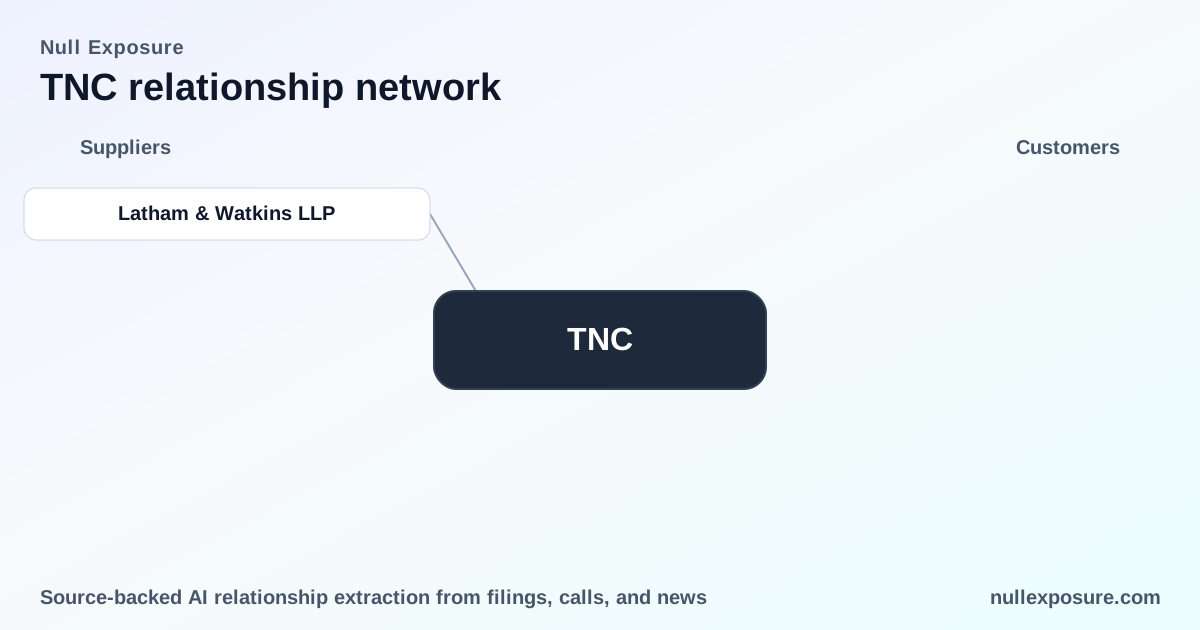
Latham & Watkins LLP
Latham & Watkins acted as legal counsel to Tennant in connection with an agreement involving Vision One, with the firm’s Shareholder Activism & Takeover Defense team leading the engagement. This was a transaction‑level advisory role tied to corporate governance and activist negotiation dynamics, reported in March 2026 by Latham & Watkins’ news release. (Source: Latham & Watkins press release, March 10, 2026 — lw.com.)
This legal advisory relationship is a governance‑side supplier engagement rather than an operational vendor, but it signals elevated investor activism and attendant strategic risk that can alter supplier and financing dynamics going forward.
Implications for credit, procurement and operational risk
- Credit and covenant sensitivity: With nearly $200m drawn on the revolver and a secured structure to 2029, Tennant’s financing posture sets the marginal economics for supplier payment terms and capital expenditure cycles. Investors should track borrowings relative to covenant thresholds and any amendments to the credit agreement disclosed in future filings.
- Vendor concentration risk in product lines: The dedicated German plant is a single‑point provider for specific heavy‑duty products; any disruption there would force production shifts or inventory drawdowns and could pressure revenue recognition in those segments.
- Procurement negotiating posture: Contractual purchase obligations near $62m for a single year indicate meaningful, committed spend that gives counterparties scale and bargaining power; Tennant’s ability to flex orders or switch suppliers will determine margin resilience in a higher‑inflation environment.
- Strategic risk from activism: The engagement of a top‑tier firm for shareholder activism work reflects heightened governance pressure that could accelerate strategic moves (M&A, asset sales, cost programs) with direct implications for supplier contracts and capital allocation.
For an integrated view of supplier counterparty risk alongside these commercial drivers, see our platform at https://nullexposure.com/.
What investors should monitor next
- Quarterly updates to outstanding borrowings and covenant language under the 2024 credit agreement.
- Any changes to the German manufacturing arrangement or disclosures that expand or limit single‑site production reliance.
- Shifts in contractual purchase obligations and supplier payment terms, which reveal procurement flexibility.
- Public developments related to Vision One or other activist activity, and any subsequent strategic actions that would re‑price supplier relationships.
Conclusion: practical read for portfolio risk
Tennant’s model combines capital‑goods margins with recurring parts and service revenue, supported by outsourced manufacturing and a secured revolving facility that anchors liquidity through 2029. Key investor takeaways are the materiality of committed procurement spend, the operational importance of the dedicated German plant, and the governance overlay introduced by recent activist‑related legal advisory activity. These elements determine where supplier risk concentrates and how quickly management can respond to supply‑side shocks.
For deeper supplier mapping and to monitor these counterparty signals continuously, visit https://nullexposure.com/.