Tandem Diabetes Care (TNDM): Supplier relationships that shape operational risk and product rollout
Tandem Diabetes Care designs, manufactures and markets insulin delivery systems and related consumables, monetizing through device sales, recurring consumable revenue (infusion sets and cartridges) and platform integrations with continuous glucose monitors. The company generated approximately $1.014 billion in trailing revenue while operating at a loss on a per-share basis (TTM diluted EPS -$3.04), which makes access to reliable supply chains and financing critical to sustaining growth and product launches. For a granular supplier-risk view and to track counterparty exposures, run supplier intelligence at https://nullexposure.com/.
Why suppliers matter for Tandem’s business trajectory
Tandem’s business model combines hardware dependency with recurring consumable monetization. That creates two structural supplier imperatives: first, single-source or concentrated suppliers for critical consumables amplify operational risk; second, external manufacturing relationships and cross-vendor integrations directly affect commercial rollout timing and customer retention. Public filings and disclosure language underline these imperatives: Tandem purchases certain inventory from a contract manufacturer in Mexico and depends on a limited number of third‑party suppliers for components and products, meaning supplier failures would cause immediate operational and revenue disruption.
These characteristics produce a contracting posture that is supplier-dependent and operationally interlinked — the company is simultaneously a buyer of critical consumables and a contract manufacturer’s customer. This strategic posture elevates counterparty criticality and requires robust contingency planning and working-capital flexibility.
If you evaluate supplier risk across medical-device portfolios, you can get a deeper view of Tandem’s counterparties and contractual posture at https://nullexposure.com/.
What the public relationships tell investors
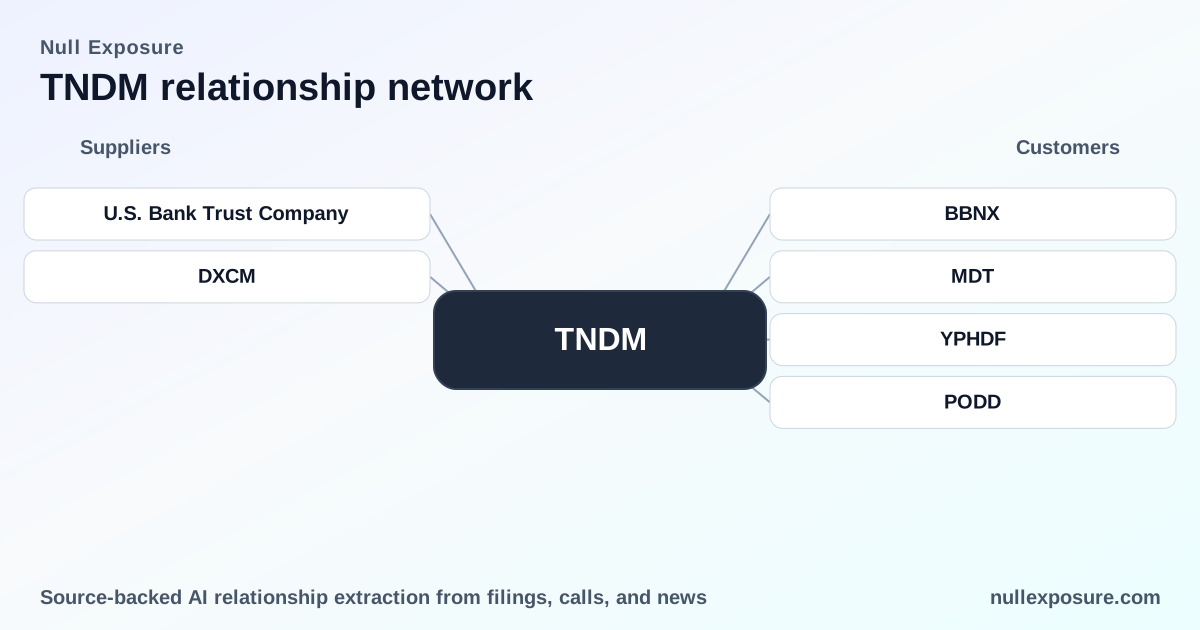
U.S. Bank Trust Company — trustee for convertible debt issuance
Tandem used U.S. Bank Trust Company as the trustee on a financing that raised $300 million of zero-percent convertible notes, with capped calls included to limit dilution. According to a TradingView report dated March 10, 2026, U.S. Bank Trust Company acted as trustee for that convertible note issuance, a financing move that strengthens liquidity but also introduces a future capital-structure lever. (TradingView, March 10, 2026)
Dexcom — continuous glucose monitor integration partner
Tandem continues to integrate Dexcom’s sensors into its pump ecosystem as part of product launches. During the Q4 2025 earnings call, management highlighted a Mobi integration with FreeStyle Libre 3 Plus in the U.S. and Dexcom’s 15‑day sensor integration across pumps and platforms globally, signaling strategic reliance on CGM partners to broaden product utility and stickiness. (InsiderMonkey transcript of Tandem Q4 2025 earnings call, March 2026)
How these relationships affect operating constraints and execution
Tandem’s disclosures produce several company-level signals that define supplier risk and contracting maturity:
- Geographic concentration of manufacturing: Tandem purchases inventory from a contract manufacturer located in Mexico. That geographic concentration creates a supply-line single point of failure that increases political, logistics and tariff exposure for devices and consumables.
- Supplier concentration and materiality: The company explicitly depends on a limited number of third‑party suppliers for components and products, meaning supplier disruptions would have material financial and operational consequences.
- Buyer and contract-manufacturer roles: Tandem purchases all currently marketed infusion sets from a third‑party supplier and uses third‑party service providers for contract manufacturing, hosting, and other functions—indicating a hybrid model where Tandem is both a brand-owner and a purchaser of key finished goods.
- Maturity and outsourcing posture: Reliance on contract manufacturing and third‑party service providers suggests a maturing outsourcing model: Tandem focuses on product design and commercialization while outsourcing manufacturing and infrastructure, which can accelerate scaling but increases dependency on partner operational discipline.
These signals combine into a clear operating constraint profile: concentration-driven criticality with moderate contractual maturity (outsourced manufacturing arrangements but limited supplier diversification).
Investment implications: what to watch for next
- Execution on CGM integrations is a revenue and retention lever. Integrations with Dexcom and FreeStyle Libre strengthen the product proposition and recurring revenue potential through ecosystem stickiness; monitor shipment cadence and software compatibility milestones mentioned in quarterly calls.
- Supply continuity is a short-term operational risk. The Mexico-based contract manufacturing relationship and single‑supplier infusion set posture create vulnerability to local disruptions; investors should watch inventory disclosures, supplier contingency language, and any supply‑chain KPIs disclosed in quarterly filings.
- Capital structure management influences dilution and runway. The $300 million convertible notes transaction (trustee: U.S. Bank Trust Company) improves near-term liquidity but introduces potential future equity dilution dynamics controlled in part by capped-call structures; track debt conversion mechanics and the company’s cash‑use narrative.
Key takeaways:
- Supplier concentration is material and near-term operationally critical.
- CGM partnerships are strategic revenue multipliers and commercial enablers.
- Financing moves have reduced immediate liquidity pressure but add capital structure complexity.
Explore a detailed counterparty map and supplier risk scoring for this profile at https://nullexposure.com/.
Tactical checklist for investors and operators
- Demand clear supplier diversification timelines and ramp schedules in investor updates.
- Confirm end‑to‑end validation and inventory buffers for Mexico-based manufacturing.
- Require disclosure of contract terms for infusion sets and other single-source consumables.
- Track integration milestones with Dexcom and FreeStyle Libre for proof-of-concept commercialization.
If you want a consolidated, supplier-centric risk view across Tandem’s counterparties and financing channels, review the platform at https://nullexposure.com/.
Bottom line and recommended next steps
Tandem’s product-led strategy is commercially sound: hardware sales plus recurring consumables and CGM integrations drive growth, but supplier concentration and outsourced manufacturing introduce concrete operational risk that is material to near-term execution. Financing actions such as the convertible notes transaction reduce immediate liquidity strain but add capital-structure complexity that investors must monitor alongside supplier performance.
For operators and investors, the immediate priorities are: verify supplier diversification plans, monitor CGM integration delivery, and track the impact of financing instruments on dilution and cash runway. For ongoing supplier surveillance and a deeper counterparty view, start with the centralized coverage at https://nullexposure.com/.