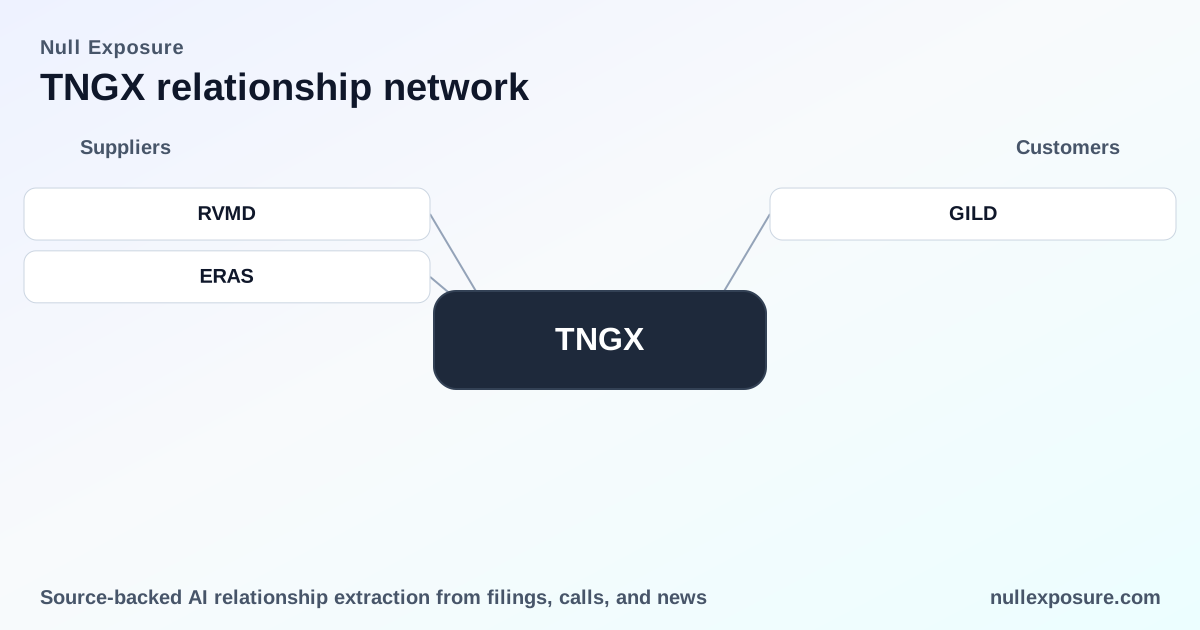
Tango Therapeutics (TNGX) — supplier relationships that shape execution risk and optionality
Tango Therapeutics operates as a clinical‑stage precision oncology company developing synthetic‑lethality therapies and monetizes primarily through collaborative clinical programs, supply agreements and milestone/licensing upside ahead of any product sales. Revenue to date is concentrated in partnership and research support receipts while the company outsources virtually all manufacturing and trial operations — a model that amplifies scientific optionality but concentrates operational risk in a small set of external suppliers and CRO/CDMO partners.
Explore supplier and counterparty risk for Tango on the NullExposure homepage: https://nullexposure.com/
Why supplier relationships matter for a clinical‑stage biotech investor
Tango’s business model is deliberately asset‑light: it does not own manufacturing capacity and relies on external development partners for combination trials and drug supply. That structure gives the company flexibility to progress multiple programs in parallel, but creates single‑point failures that are material to timelines and cash flow. Key operating characteristics investors must price include concentration of supply, geographic exposure, and the degree to which external partners are integrated into clinical programs and data generation.
- Contracting posture: Tango uses clinical trial collaboration and supply agreements to access third‑party molecules and reduce cash outlays for combination studies.
- Concentration & criticality: The company identifies sole‑source CDMOs for APIs and drug product; losing one supplier would be disruptive to timelines and regulatory plans.
- Geographic footprint and regulatory exposure: Manufacturing operations include at least one China‑located CDMO and clinical conduct spans EMEA jurisdictions such as France and Spain.
- Service maturity: Reliance on CROs, medical institutions and contract labs is the baseline for clinical execution; those relationships are operationally critical rather than peripheral.
These company‑level signals should guide due diligence when evaluating TNGX as a supplier counterparty or equity investment. For operational teams, contract terms that lock in supply continuity and data ownership are the priority.
Explore supplier intelligence and counterparty profiles at NullExposure: https://nullexposure.com/
Active supplier and collaboration relationships investors should know
Revolution Medicines — clinical combination partner for RAS(ON) inhibitors
Tango is running Phase 1/2 combination trials pairing vopimetostat with Revolution Medicines’ RAS(ON) inhibitors (including daraxonrasib and zoldonrasib), with initial safety and efficacy readouts expected in 2026 and strong ongoing enrollment cited by management. According to the company’s FY2025/2026 business update posted in March 2026, these combination trials are a focal point of near‑term clinical milestones (Sahm Capital press summary and GlobeNewswire corporate release, January–March 2026).
Erasca, Inc. — clinical supply partner providing ERAS‑0015 for combo studies
Tango entered a clinical trial collaboration and supply agreement with Erasca under which Erasca will provide its pan‑RAS agent ERAS‑0015 at no cost for the combination study evaluating vopimetostat plus the pan‑RAS glue. Media coverage and Tango’s investor communications in March 2026 note the supply and collaboration terms explicitly, highlighting the cost‑sharing nature of the arrangement (Mugglehead and Sahm Capital reporting, March 2026; SimplyWall.St recap, March 2026).
Operational constraints and what they imply for timelines and valuation
The company’s public disclosures and risk excerpts lay out a clear operational blueprint that investors must incorporate into scenario models.
- Geographic concentration signal (APAC exposure): Tango sources certain drug product and a sole API supplier out of China, and at least one CDMO operates in China. This creates exposure to tariffs, export controls and geopolitical supply disruption — a material execution risk referenced directly in company filings.
- EMEA clinical footprint: Trials are active in France and Spain, which adds regulatory complexity but diversifies patient enrollment pathways.
- Sole‑source manufacturing: The company states it relies on third‑party CDMOs as sole sources for APIs and drug product; losing a supplier would significantly harm timelines and could impose rapid, expensive remediation options.
- Service provider reliance: Tango depends on CROs, clinical investigators and contract labs to run trials and handle data, making service quality and vendor compliance central to regulatory and commercial plans.
- Segment concentration in manufacturing: Outsourced manufacturing is core to the go‑to‑market plan — this is not ancillary but fundamental to any future commercialization.
These constraints are not abstract — they are operational levers that determine the pace at which Tango can convert clinical signals into value. Investors should price a premium for scientific optionality and a discount for concentrated manufacturing risk.
How to monitor these relationships and what to watch next
For investors and operators, actionable monitoring should focus on contract durability and execution milestones.
- Watch enrollment and readout timelines for the Revolution combinations and any updates on safety/efficacy communicated in 2026 corporate releases.
- Track supply continuity notices from Erasca and any amendments to the clinical supply agreement that change cost sharing or delivery commitments.
- Monitor regulatory filings and CDMO disclosures for any supply interruptions or geographic re‑routing of manufacturing.
- Confirm data rights and IP provisions in collaboration announcements; control of combination data will dictate partnership optionality and licensing leverage.
Key risk‑reward takeaway: Tango’s partnership model de‑risks near‑term cash burn through supplied combination agents and collaborative trials, but value realization depends on uninterrupted supply and vendor execution — both of which are currently concentrated and material.
Explore detailed supplier profiles and ongoing monitoring at NullExposure: https://nullexposure.com/
Investment implications and recommended next steps
Tango is positioned as a high‑optional‑return, high‑operational‑risk company. Investors who prioritize upside from clinical validation should value the company’s collaboration pipeline and the potential upside from combination signals with Revolution and Erasca. Operational investors and procurement teams evaluating supplier relationships should insist on:
- Redundant supply arrangements and contractual remedies for sole‑source vendors.
- Clear SLA and audit rights with CDMOs and CROs to limit execution risk.
- Geographic risk mitigation plans to address APAC supply exposure.
For equity investors, place heavier weight on clinical readouts and supply continuity announcements than on short‑term revenue trends; for strategic partners, prioritize negotiation of robust supply and data terms that protect development timelines.
Final thought: Tango’s science creates optionality; its supplier posture creates execution risk — both are investable if managed with rigorous contracting and active monitoring.
Learn more about supplier risk and counterparty analytics at NullExposure: https://nullexposure.com/