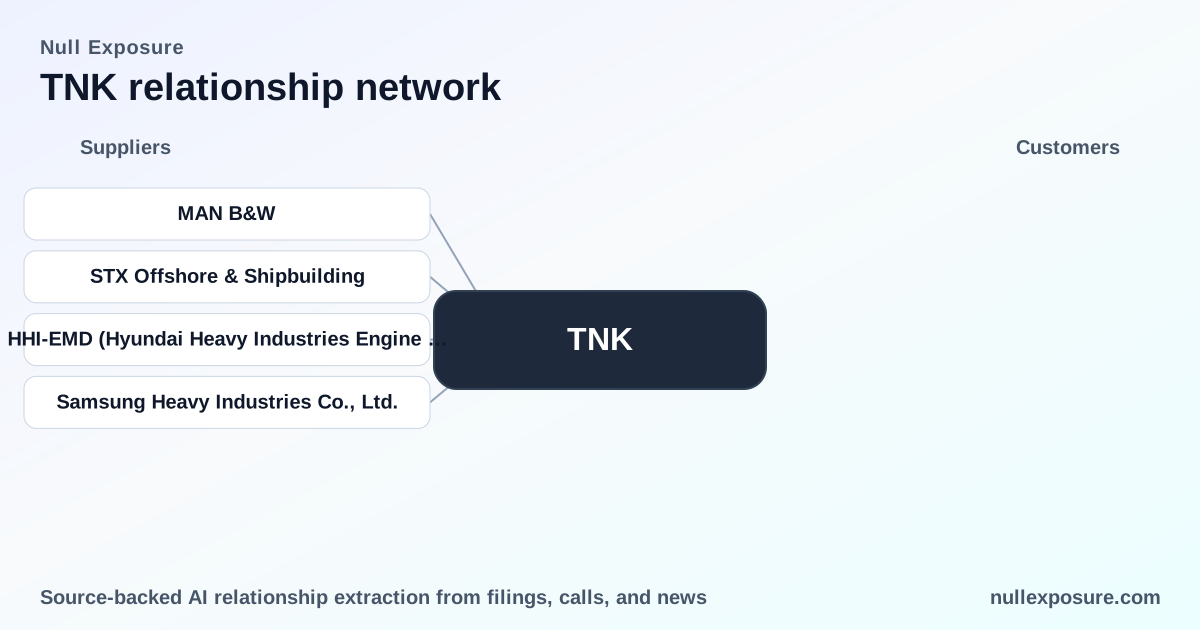
Teekay Tankers (TNK) — supply relationships that shape a capital-intensive shipping operator
Teekay Tankers operates and monetizes by owning and operating crude and product tankers that provide ocean freight to oil producers, traders, and refiners; revenue is generated through time charters and voyage contracts while profitability is driven by fleet utilization, freight rates and a disciplined newbuilding and engine procurement posture. TNK’s balance sheet and margins reflect a mature, asset-heavy model: $952m in trailing revenue, EBITDA of $280m and strong profitability (operating margin ~34%, net margin ~37%) — a profile that makes supplier selection for hull construction and propulsion equipment a strategic determinant of cost structure, environmental compliance and time-to-service. For deeper supplier intelligence on TNK, visit the NullExposure homepage: https://nullexposure.com/.
How TNK’s supplier footprint fits its business model
Teekay Tankers’ business requires long lead-time, high-value capital goods: tankers, engines and retrofit solutions to meet IMO standards. That combination creates a distinctive supplier posture:
- Contracting posture: TNK contracts with shipyards and engine OEMs on multi-year build programs and engine deliveries; those contracts lock in capex timing and technical standards that affect fuel efficiency and compliance costs.
- Concentration and criticality: The supplier set is concentrated among a handful of global yards and low-speed engine manufacturers; these suppliers are operationally critical because propulsion and hull design directly determine voyage economics.
- Maturity and longevity: Historical records of newbuild orders and engine deliveries show relationships extending back through the 2010s, indicating established procurement patterns with major Korean and European marine suppliers.
- Operational implications: For investors, this means capex timing, yard capacity constraints and OEM technology choices are second-order drivers of TNK’s forward margins and residual asset value.
These are company-level signals about TNK’s operating model rather than assertions tied to a single supplier. For a consolidated view of supplier exposures and to monitor changes, check the NullExposure homepage: https://nullexposure.com/.
What the reporting shows about TNK’s supplier relationships
Below I summarize every supplier relationship captured in public reporting for TNK in the available results. Each entry is presented in plain English with a direct source reference.
MAN B&W — powerplant choice for newbuild program (FY2013)
Teekay Tankers selected the MAN B&W G60ME-C engine for a newbuilding program, highlighting a procurement choice that balances IMO environmental standards and fuel efficiency. This was reported in a MarineLink article covering the engine selection for the tanker newbuilds in 2013 (https://www.marinelink.com/news/chooses-tanker-engine354496).
STX Offshore & Shipbuilding — shipyard contract for LR2 product tankers (FY2013)
STX Offshore & Shipbuilding signed a contract on April 8, 2013 to build four 113,000-dwt LR2 product tankers for Teekay Tankers with options for up to 12 additional vessels, signaling a sizeable newbuild pipeline and reliance on Korean shipyard capacity. See the MarineLink report dated April 2013 for the contract detail (https://www.marinelink.com/news/chooses-tanker-engine354496).
HHI-EMD (Hyundai Heavy Industries Engine & Machinery Division) — delivery of Tier-II compliant engine (FY2010)
Hyundai Heavy Industries’ engine division completed the first Tier-II compliant MAN B&W unit earmarked for a shuttle tanker ordered by Teekay, showing early compliance investments and coordination between engine OEMs and Korean builders in 2010. MarineLink covered the delivery readiness in 2010 (https://www.marinelink.com/news/delivery-tierii-engine333548).
MAN B&W — Tier-II engine production linked to Teekay newbuild (FY2010)
MAN B&W’s low-speed, two-stroke 6S50ME-C7 engine, representing the early Tier-II compliant units, was produced for a Teekay-ordered shuttle tanker under construction — a clear example of TNK’s specification-driven engine procurement tied to emissions regulation timelines. The MarineLink article from 2010 provides the coverage (https://www.marinelink.com/news/delivery-tierii-engine333548).
Samsung Heavy Industries Co., Ltd. — hull construction for shuttle tanker (FY2010)
Samsung Heavy Industries constructed the hull (noted as hull number 1749) for a shuttle tanker ordered by Teekay, illustrating TNK’s use of major Korean yards across multiple programs and the segmentation of hull and engine suppliers. The assembly and construction linkage was reported in 2010 by MarineLink (https://www.marinelink.com/news/delivery-tierii-engine333548).
What these supplier ties imply for investors
Collectively, the reporting constructs a clear picture: TNK sources hulls and propulsion from established Korean yards and European engine manufacturers under multi-year programs, and this procurement strategy anchors both cost competitiveness (through efficient engines) and regulatory compliance (Tier-II/IMO standards). Key investment implications:
- Capex and delivery risk: Newbuild schedules at STX and Samsung and engine delivery timelines from MAN B&W and HHI-EMD directly affect fleet growth timing and charter revenue realization.
- Differentiated operating margins: Engine model choices like the G60ME-C and 6S50ME-C7 influence fuel consumption curves; even small efficiency gains compound across fleet utilization to impact EBITDA.
- Regulatory resilience: Demonstrable early adoption of Tier-II-compliant equipment signals proactive compliance capacity, reducing retrofit shocks and stranded-asset risk.
If you are evaluating TNK as a counterparty or an investment, this supplier mapping is a practical input to underwriting delivery schedules and lifecycle operating costs. For more supplier intelligence and ongoing coverage, visit the NullExposure homepage: https://nullexposure.com/.
Risks and monitoring priorities for operators and investors
Focus due diligence on three monitorable vectors:
- Yard and OEM capacity constraints: Korean yards experience cyclical capacity pressure; delays compress revenue timelines.
- Technology lock-in: Engine and hull specifications chosen today determine fuel bills and retrofit costs for years.
- Counterparty concentration: A small number of large suppliers increases negotiation leverage for yards and OEMs and elevates supply-chain concentration risk.
Each of these is directly tied to the supplier evidence noted above and to TNK’s capital-intensive operating model.
Final takeaways and next steps
Teekay Tankers runs a classic asset-heavy shipping model where supplier relationships with shipyards and engine OEMs are strategic levers of margin, compliance and fleet growth timing. Investors should treat shipyard delivery schedules and engine OEM commitments as primary drivers of forward revenue and capital deployment. For a centralized, investor-ready view of TNK’s supplier exposures and to receive updates as relationships evolve, visit the NullExposure homepage: https://nullexposure.com/.
If you want a tailored supplier risk brief for TNK or a comparative supplier exposure across tanker peers, reach out via NullExposure and we’ll assemble a focused memo.