Tenon Medical (TNON) — supplier posture, recent deals, and what investors should price in
Tenon Medical markets and sells surgical implant systems for sacroiliac (SI) joint fixation and fusion, monetizing primarily through device sales and intellectual property consolidation. The company operates a capital-light manufacturing model—outsourcing production to multiple contract manufacturers and selling a mix of legacy and newly acquired implant technologies—while supplementing commercial reach through investor communications firms. With trailing revenue of roughly $2.95 million and a market capitalization near $10.2 million, Tenon is an early-stage medical-device vendor whose supplier relationships are operationally critical despite being contractually lightweight. Explore a full supplier profile at Null Exposure: https://nullexposure.com/
How Tenon makes money and why suppliers matter to the P&L
Tenon derives revenue from the sale of SI joint implants and associated surgical systems, and from building an IP and product pipeline through strategic asset acquisitions. The company’s economics are asymmetric: low revenue base, negative EBITDA, and high fixed R&D and commercialization leverage, so supplier reliability and the product mix from recent acquisitions materially affect near-term revenue realization and margin recovery. Fiscal metrics: Revenue TTM ~$2.95M, EBITDA -$12.6M, market cap ~$10.15M (latest quarter June 30, 2025).
Relationship inventory — the record, item by item
Below are all supplier- and partner-related items surfaced in the available results. Each entry is a concise, plain-English read of the relationship as reported.
-
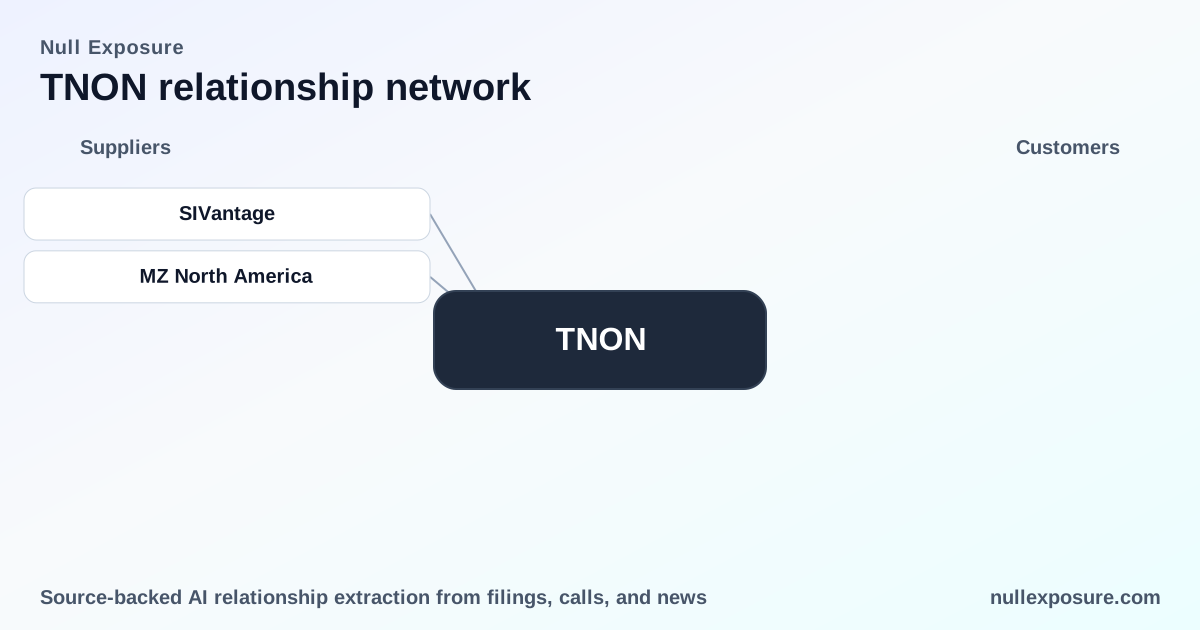
SIVantage — Tenon acquired SIVantage’s SImmetry and SImmetry+ lateral SI joint fusion systems as a strategic asset, adding revenue-generating technologies and active clinical cases to Tenon’s portfolio. According to an Accesswire release dated March 10, 2026, the acquisition is presented as a diversification of Tenon’s intellectual property and product set. Source: Accesswire (Mar 10, 2026) — https://www.accessnewswire.com/newsroom/en/healthcare-and-pharmaceutical/tenonr-medical-strengthens-intellectual-property-portfolio-with-strat-1138459
-
MZ North America — Listed repeatedly as Tenon’s investor relations contact, MZ North America functions as the company’s external IR and communications vendor, providing contact details and managing press distribution for financial disclosures. This is visible in multiple press releases and investor notices published in early 2026. Source: ADVFN/press distribution (2026) — https://br.advfn.com/noticias/ACCESS/2025/artigo/97231082
-
SiVantage (duplicate reporting of SIVantage) — Corporate disclosures state the SiVantage portfolio acquisition delivered active clinical cases and an expanded development pipeline, explicitly tying the purchase to near-term commercial ramp opportunities for Tenon’s sales organization. This phrasing comes from Tenon’s shareholder letter/press release used in investor communications. Source: The Globe and Mail press release (Mar 10, 2026) — https://www.theglobeandmail.com/investing/markets/stocks/TNON-Q/pressreleases/37273756/tenonr-medical-issues-shareholder-letter-and-provides-preliminary-revenue-for-the-fourth-quarter-and-full-year-2025/
-
MZ North America (press date announcement) — Tenon used MZ North America to announce dates for earnings and disclosure events, signaling continued reliance on an external PR/IR firm to coordinate investor-facing timelines and press distribution. Source: Accesswire (Mar 2026) — https://www.accessnewswire.com/newsroom/en/healthcare-and-pharmaceutical/tenon-medical-inc.-sets-date-for-fourth-quarter-and-full-year-2025-ea-1133858
-
MZ North America (FY2025 IR contact) — Earlier FY2025 filings and notices list Shannon Devine of MZ North America as the IR contact, reinforcing that Tenon outsources investor relations and external communications to this vendor. Source: ADVFN/press distribution (2026) — https://br.advfn.com/noticias/ACCESS/2025/artigo/97378059
Operating model signals and supplier constraints — what they mean for investors
Tenon’s vendor posture is defined by several company-level constraints surfaced in filings and disclosures.
-
Contracting posture: spot purchase orders. Tenon does not maintain long-term manufacturing agreements; production is managed through purchase orders with contract manufacturers. This setup creates operational flexibility but also places execution risk on vendor availability and PO fulfillment.
-
Concentration: not currently material. The company states that no single contract manufacturer is material to its business, which reduces single-vendor concentration risk on paper, but the commercial reality of relying on a small set of specialized vendors still creates operational fragility.
-
Role delineation: manufacturers and service providers. Tenon uses five contract manufacturers to produce implants, instruments, and sterilization trays and outsources significant elements of IT infrastructure to third-party service providers. These vendors are functionally critical: manufacturing vendors deliver the physical product sold to hospitals and clinics, while IT vendors maintain order processing, regulatory documentation, and commercial systems.
-
Maturity and scale signal. The combination of outsourced manufacturing, IR firm dependence, and small revenue base signals a lean, early-stage medical device company still building commercialization scale; supplier reliability will therefore disproportionately affect revenue volatility and timing.
These constraints collectively indicate a supplier model that is flexible and low-commitment but operationally critical — a profile common to small medtech companies transitioning from development to revenue.
If you want a deeper read on Tenon’s supplier map and vendor concentration analysis, view the full profile at Null Exposure: https://nullexposure.com/
How the recent relationships change the investment case
The SIVantage/SiVantage acquisition is the most consequential supplier-related event on record: it immediately broadens Tenon’s product catalog with revenue-generating implants and active clinical cases, which improves the company’s ability to convert procedure volume into sales. This is material for a company at Tenon’s scale because each incremental product line can lift short-term revenue recognition and improve utilization of existing commercial channels.
By contrast, the MZ North America entries are operationally secondary but strategically important: outsourced IR compresses internal headcount while ensuring professional investor communications, but it also signals that Tenon relies on third parties to manage market perception and disclosure cadence.
From a risk perspective, the absence of long-term manufacturing contracts reduces balance-sheet commitments but increases exposure to supply chain interruption and price variability. For investors, the valuation for TNON must price both the potential upside from acquired product lines and the execution risk embedded in a spot, outsourced vendor model.
Actionable monitoring checklist for investors
- Track integration progress and early surgical case conversion from the SImmetry portfolio in quarterly updates and physician case counts. The degree to which those assets contribute to reported revenue will be a leading indicator of commercial traction.
- Watch procurement and manufacturing notices for any shift from purchase-order relationships to formal long-term contracts; a move to longer agreements would reduce execution risk.
- Monitor cash runway and EBITDA trajectory—current figures show negative EBITDA (~-$12.6M) against low revenue, so supplier delays can quickly stress liquidity.
For a full, sourced supplier and risk profile, visit Null Exposure: https://nullexposure.com/
Bottom line
Tenon’s supplier picture is straightforward: a small medtech operating on outsourced, spot-based manufacturing with a recent acquisition that meaningfully expands its product portfolio, and an ongoing reliance on an external IR firm for investor communications. The acquisition of the SImmetry platforms is the primary upside catalyst; supplier execution and integration are the primary operational risks. Investors should weigh the upside from incremental device revenue against the execution and liquidity risks inherent in a lean, outsourced operating model.
To examine Tenon’s vendor relationships and comparable supplier profiles, go to Null Exposure: https://nullexposure.com/