Who runs TNUK and how they get paid: a supplier map for investors
TNUK is structured as an ETF vehicle: shares are issued by a trust/issuer, investment strategy is executed by an advisor that earns management fees, and distribution and share placement are handled by a distributor. For investors evaluating counterparty exposure, the critical relationships are the issuer (legal sponsor), the advisor (investment manager), and the distributor (sales and placement). Revenue for the sponsor/advisor is generated through fund-level fees and the advisor’s management contract; distribution is a fee-and-service relationship that affects retail and institutional flows. If you want a concise supplier-risk snapshot, start with the issuer–advisor–distributor triad. For a deeper supplier map and supplier risk scoring, visit https://nullexposure.com/.
The short list: roles you need to watch
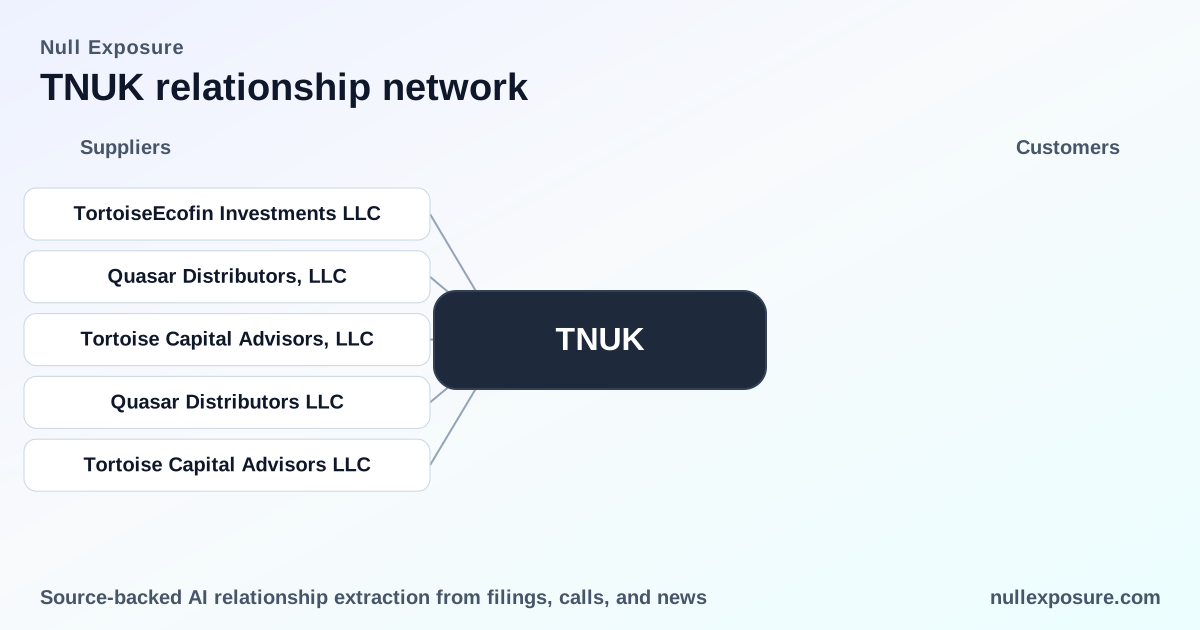
The public record for TNUK identifies three functional counterparties: TortoiseEcofin Investments LLC as issuer, Tortoise Capital Advisors, LLC as advisor, and Quasar Distributors (LLC) as distributor. Each plays a distinct operational role: legal ownership and NAV mechanics rest with the issuer, portfolio construction and trade execution rest with the advisor, and placement and retail/institutional distribution rest with Quasar. A clear governance framework—management agreements, distributor agreements and service-level provisions—determines the contracting posture and operational control.
Visit https://nullexposure.com/ for a supplier-oriented due diligence checklist that maps these contracts to investor risk.
TortoiseEcofin Investments LLC — the issuer
TNUK shares are issued by TortoiseEcofin Investments LLC, which serves as the legal fund issuer responsible for share creation/redemption processes and fund governance. According to TradingView’s AMEX-TNUK listing (first noted March 10, 2026), the issued shares identify TortoiseEcofin Investments LLC as the fund vehicle. (TradingView AMEX-TNUK, March 10, 2026 — https://www.tradingview.com/symbols/AMEX-TNUK/)
Quasar Distributors, LLC — distribution noted in news release
Public reporting identifies Quasar Distributors, LLC in the fund’s disclosure language as the distributor responsible for share distribution and certain investor communications; standard fund disclaimers listing Quasar are present in the March 10, 2026 press coverage. (Yahoo Finance, March 10, 2026 — https://finance.yahoo.com/news/tortoise-capital-launches-actively-managed-133000540.html)
Tortoise Capital Advisors, LLC — the portfolio manager
Tortoise Capital Advisors, LLC is named as the advisor to the Tortoise Nuclear Renaissance ETF and therefore is the primary manager responsible for implementing strategy and receiving management fees. A March 10, 2026 investor release and fund disclosures identify Tortoise Capital Advisors as the advisor. (Yahoo Finance, March 10, 2026 — https://finance.yahoo.com/news/tortoise-capital-launches-actively-managed-133000540.html)
Quasar Distributors LLC — duplicate mention in market listings
The TradingView market listing for AMEX-TNUK also lists Quasar Distributors LLC as the fund’s distributor, confirming the distribution role across multiple public information sources. (TradingView AMEX-TNUK, March 10, 2026 — https://www.tradingview.com/symbols/AMEX-TNUK/)
Tortoise Capital Advisors LLC — repeated advisory reference
TradingView’s AMEX-TNUK page similarly lists Tortoise Capital Advisors LLC as the fund’s primary advisor, corroborating the advisor role reported in the press release. (TradingView AMEX-TNUK, March 10, 2026 — https://www.tradingview.com/symbols/AMEX-TNUK/)
What this supplier map tells investors about operating model and risk
From a contracting and operational perspective, several company-level signals flow from the supplier list:
- Contracting posture: The fund follows a standard ETF contracting model—an issuer/administrator holds legal title and provides fund infrastructure, the advisor contracts to manage assets under a management agreement, and a distributor handles placement under a distribution agreement. These contracts are the primary levers that define service levels and fees.
- Concentration risk: With a small set of named counterparties, counterparty concentration is material; the advisor and distributor are essential single points of service for investment decisioning and flow management. That concentration magnifies vendor risk if either counterparty changes terms or capacity.
- Criticality: The advisor is critical for strategy execution and fee capture; the distributor is critical for onboarding and liquidity provisioning in retail channels. Loss or material change in either role would directly affect performance, flows, and potentially the expense and tax reporting mechanics of the fund.
- Maturity and governance: Public disclosures show standard fund governance—issuer, advisor, distributor—but do not, by themselves, reveal the maturity of operational arrangements such as multi-year service agreements or contingency arrangements. Investors should confirm contract tenors, termination clauses and service continuity plans during diligence.
How to turn this into actionable due diligence
- Verify management agreements and expense arrangements directly in fund prospectus filings and confirm termination/change clauses for advisor and distributor.
- Map operational dependencies: portfolio execution, prime broker ties, NAV and transfer agent services should be cross-checked to ensure there are no hidden single points of failure beyond the three named suppliers.
- Stress test distribution risk: given Quasar’s role, model scenarios where flows slow or accelerate and confirm whether distribution economics align with long-term shareholder value.
If you want an operational supplier scorecard that maps these items into invest/avoid signals, start here: https://nullexposure.com/.
Final takeaways for investors and operators
- Issuer = TortoiseEcofin Investments LLC; Advisor = Tortoise Capital Advisors; Distributor = Quasar Distributors. These three relationships define legal control, investment execution and market access for TNUK. (Sources: TradingView and Yahoo Finance, March 10, 2026.)
- Concentration and criticality are the dominant operational risks. The small set of counterparties implies that changes in any one relationship will have direct and immediate effects on fees, flows and execution.
- Confirm contract tenor and continuity provisions in prospectus and adviser/distributor agreements before allocating capital.
For a supplier-focused operational due diligence template and to see how TNUK’s counterparties score on continuity and concentration, visit https://nullexposure.com/.