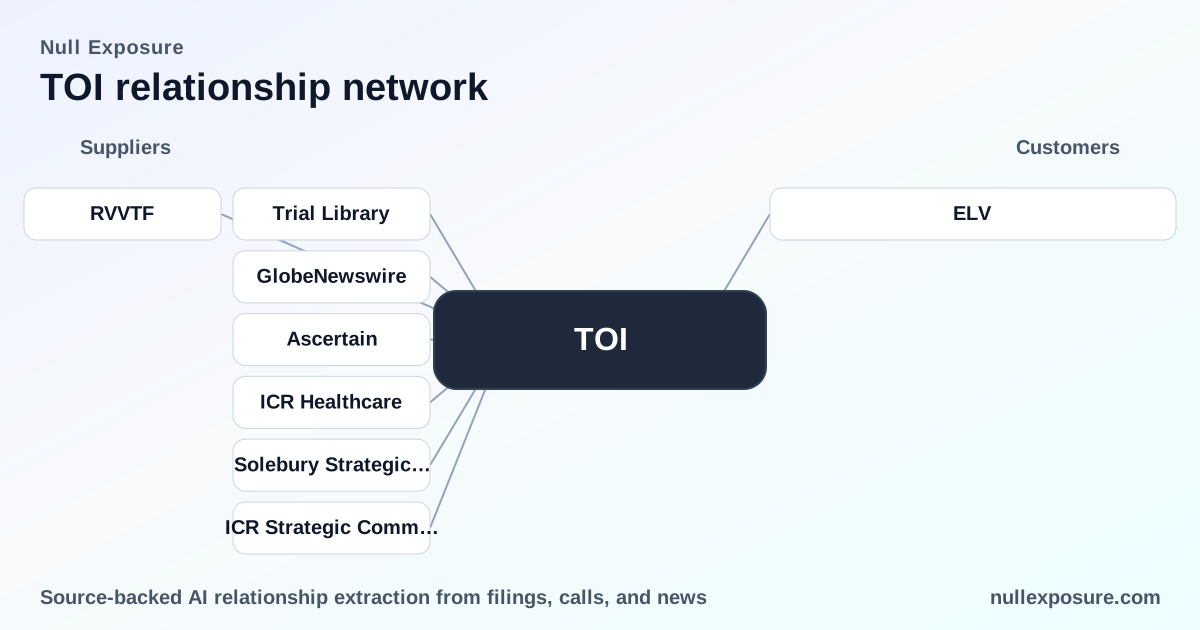
The Oncology Institute (TOI): supplier relationships and operational constraints that matter to investors
The Oncology Institute (TOI) operates and monetizes as a value-based oncology services provider: it runs a network of specialized clinics, bills payers and patients for treatment and care coordination, and supplements clinical operations with partnerships and technology integrations that drive patient access and administrative efficiency. Revenue is clinic-driven and drug-intensive — roughly 45% of TOI PCs’ total costs are drug purchases — so supplier dynamics and contracting posture directly affect margins and continuity of care. For investors evaluating TOI supplier exposure, the mix of long- and short-term leases, concentrated drug sourcing, and a pattern of technology and PR partnerships define both upside (operational leverage, scale) and downside (single-source risk, fixed obligations).
If you want a concise supplier-risk report tailored for investor diligence, start here: https://nullexposure.com/
How TOI’s commercial model makes supplier relationships strategic, not peripheral
TOI generates revenue by delivering oncology treatments and related services through clinic networks and care programs. The company’s cost base is heavily weighted toward drug purchases and facility leases, so supplier agreements for pharmaceuticals, clinic real estate, and outsourced services (technology, security, PR/IR) are core to operating continuity and margin stability. Investor-facing communications and technology co-developments represent monetizable operational improvements that can reduce administrative cost and expand trial access, but the balance-sheet impact depends on contract length and price exposure.
Snapshot: every supplier relationship surfaced in public reporting
Below are the supplier/partner relationships identified in the available public items, each with a short plain-English description and a source reference.
-
Trial Library — Trial Library provides a technology platform intended to help TOI identify more patients eligible for clinical trials, supporting enrollment and equity of access. (PR Newswire announcement, FY2023: https://www.prnewswire.com/news-releases/trial-library-and-the-oncology-institute-partner-to-improve-equity-in-clinical-trial-access-301831409.html)
-
GlobeNewswire (press distribution / financial release channel) — A GlobeNewswire-distributed release (summarized by QuiverQuant) covered TOI’s Q3 2025 financial results and conference call logistics, indicating use of national wire services for investor communications. (QuiverQuant summary of a GlobeNewswire release, FY2025: https://www.quiverquant.com/news/The+Oncology+Institute%2C+Inc.+Announces+Release+Date+for+Q3+2025+Financial+Results+and+Conference+Call+Details)
-
Ascertain — Ascertain entered a co-development partnership with TOI to create “near-touchless” administrative workflows designed to reduce manual interactions between providers and payers, signaling a strategic push to automate revenue-cycle and authorization processes. (GlobeNewswire release, Nov 13, 2025 / FY2025: https://www.globenewswire.com/news-release/2025/11/13/3187816/0/en/Ascertain-and-The-Oncology-Institute-Co-Develop-Touchless-AI-Automation-for-Oncology-Administration.html)
-
ICR Healthcare — ICR Healthcare appears repeatedly as TOI’s investor-relations and media contact across fiscal periods, supporting earnings releases, leadership announcements, and board communications. This indicates an established PR/IR relationship used for regulatory and investor outreach. (GlobeNewswire and related press placements, FY2025–FY2026: e.g., https://www.globenewswire.com/news-release/2026/01/09/3216036/0/en/the-oncology-institute-announces-leadership-promotions.html)
-
ICR Strategic Communications — ICR Strategic Communications is listed in media placements for TOI’s third-quarter 2025 results, reinforcing ICR’s role in external communications and investor engagement. (Finance/Yahoo placement referencing ICR, FY2025: https://finance.yahoo.com/news/oncology-institute-reports-third-quarter-210500391.html)
-
Solebury Strategic Communications — Solebury is named as an investor-contact on a corrected press release for TOI’s 2022/2023 financial results, indicating prior engagement with external communications advisors. (GlobeNewswire correction release, FY2023: https://www.globenewswire.com/news-release/2023/03/17/2629256/0/en/CORRECTION-The-Oncology-Institute-Reports-Updated-Fourth-Quarter-and-Full-Year-2022-Financial-Results-and-Guidance-for-2023.html)
-
Revive (RVVTF) — Revive is listed as a media contact (Michael Petrone) in the same corrected FY2023 release, showing TOI has worked with multiple PR agencies historically. (GlobeNewswire correction release contact block, FY2023: https://www.globenewswire.com/news-release/2023/03/17/2629256/0/en/CORRECTION-The-Oncology-Institute-Reports-Updated-Fourth-Quarter-and-Full-Year-2022-Financial-Results-and-Guidance-for-2023.html)
Each of these relationships is functional: technology partners like Trial Library and Ascertain aim to expand patient access and lower administrative cost; PR/IR firms and wire distributors support capital markets visibility; and the listed agencies surface in multiple filings and releases across FY2023–FY2026.
Explore deeper supplier intelligence and model-driven risk scoring at https://nullexposure.com/
What the disclosed constraints reveal about TOI’s supplier posture
Public excerpts and filings create a coherent picture of TOI’s procurement posture and financial commitments:
-
Mixed lease profile (long- and short-term): The company uses both non-cancellable leases extending through June 2033 and operating leases with initial terms of 1–10 years that include free-rent periods and renewals. This indicates a hybrid real-estate strategy that balances fixed-location stability with flexibility to optimize clinic footprint.
-
High supplier concentration and criticality: TOI is substantially dependent on a single drug supplier and reports that drug purchases account for approximately 45% of the TOI PCs’ total costs for 2024. This concentration is a core operational risk that directly affects service delivery and margin volatility.
-
Outsourced security and cloud services: The company engages external service providers for penetration testing, MSSPs, and cloud hosting for critical infrastructure. That pattern signals reliance on third-party cyber and hosting providers as operationally critical service suppliers rather than ad-hoc vendors.
-
Meaningful lease-level commitments (spend band): Future lease payments and the present value of lease liabilities are disclosed at levels that support a $10m–$100m spend band signal for facilities commitments, indicating non-trivial fixed-cost exposure even before drug-cost concentration is considered.
Collectively, these constraints show a company with mature contracting in real estate, concentrated vendor risk in pharmaceuticals, and a reliance on external technology and security vendors to run clinical and administrative systems.
Investment implications: where supplier facts intersect with value and risk
-
Margin sensitivity is real. With nearly half of clinical costs tied to drugs from a single source, any price shifts, supply disruption, or loss of purchasing leverage will immediately compress margins and undermine revenue-to-cost convertibility. This is the single largest supplier-related risk.
-
Fixed-cost runway is constrained by leases. Long-term leases provide operational stability for clinic locations but lock TOI into fixed commitments that amplify downside if patient volumes drop or reimbursement deteriorates.
-
Outsourced tech partnerships are value levers. Partnerships with Trial Library and Ascertain target patient access and revenue-cycle automation, offering paths to lower acquisition and administrative costs and improve utilization — these are positive, actionable levers investors should monitor for execution and contract economics.
-
PR/IR relationships reduce information risk. Frequent use of ICR, Solebury, Revive and national wire services supports disciplined investor communications, which lowers information asymmetry for public investors but does not materially change supplier risk on the operating side.
If you’re building a conviction model, incorporate supplier concentration, lease duration schedules, and progress on Ascertain/Trial Library integrations as primary drivers. Learn more about supplier-driven valuation adjustments at https://nullexposure.com/
Bottom line and next steps for due diligence
TOI’s supplier landscape is a mix of strategic partnerships (tech and automation), routine investor-communications vendors, and a material single-source drug exposure that defines downside risk. For investors and operators, the priority is monitoring drug-supply contracts, execution milestones on automation partnerships, and lease maturity schedules. These inputs determine whether revenue growth translates into sustainable margin improvement or exposes the company to supply-driven shocks.
For a tailored supplier-risk assessment and ongoing monitoring solutions, visit https://nullexposure.com/ and request a vendor concentration analysis.