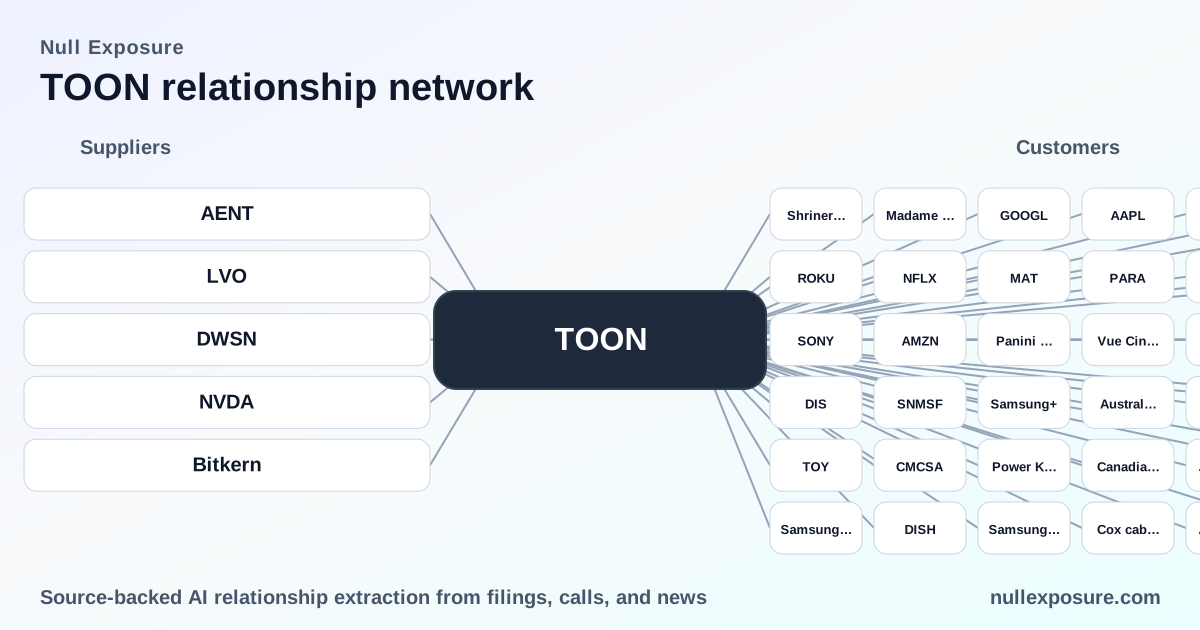
Kartoon Studios (TOON) — Supplier Map and Operational Signals for Investors
Kartoon Studios operates as a content and brand management company that creates, produces, licenses and distributes animated children’s content globally, monetizing through content licensing, distribution deals, retail and merchandising programs, and ancillary media services (including music publishing). The business shows growing top-line activity — Revenue TTM ~$39.1M — but remains unprofitable at the operating and net levels, which frames supplier relationships as both a cost center and a channel to accelerate IP monetization. Investors evaluating supplier exposure should read supplier ties as both production enablers and commercialization partners. Learn more and drill into supplier disclosures at https://nullexposure.com/.
How Kartoon’s supplier posture drives economics and risk
Kartoon runs a classic creative-services supply model: it purchases animation and production services, then leverages the finished IP across licensing, distribution and retail channels. The company’s revenue sources and cash dynamics imply three operating truths:
- Production is outsourced and payment-driven: Direct operating costs are concentrated in animation production and creative fees, so supplier terms and working capital for production materially affect margin and cash flow.
- Partnerships are commercialization multipliers: Retail distribution and music publishing partners translate content into recurring licensing and product revenue, lifting lifetime value of IP.
- Scale and leverage are immature: With negative EBITDA and high volatility in margins, supplier flexibility and short-term financing posture are strategic levers for execution.
Financial context: Market capitalization is roughly $28.6M with Revenue TTM of $39.1M and negative EBITDA (-$10.1M). Beta is elevated (2.25), signaling operating and execution sensitivity to execution of supplier and partner agreements.
Explore a deeper supplier scorecard at https://nullexposure.com/ for decision-ready summaries.
Company-level constraints that matter to counterparties
Filings and management commentary reveal company-level supplier and financing constraints that shape counterparties’ negotiating leverage:
- Short-term contracting posture: Production facilities are structured for financing specific productions and are generally repayable on demand; interest is tied to bank prime plus 1.00%–1.25% (company filings through FY2024). This creates cash sensitivity around production cycles and gives counterparties visibility into potential working-capital stress.
- Buyer orientation: Kartoon is predominantly a buyer of creative and production services; Direct Operating Costs explicitly include licensing, profit-sharing, post-production and creative talent compensation. That makes the company operationally dependent on stable vendor relationships to maintain content pipelines.
- Recent terminations and cleaning up legacy facilities: The company terminated a New Jersey office lease (effective Aug 1, 2023) and closed a revolving demand facility on Dec 19, 2024, while equipment lease lines were also wound down in early 2024—actions consistent with cost rationalization and balance-sheet simplification.
- Service segment concentration: Direct operating costs are dominated by animation production services (Wow and Frederator employees), so service-provider continuity is a critical operating input rather than an ancillary expense.
These constraints suggest a contracting posture that is short-dated, concentrated on services, and operationally critical but still immature—counterparties should price for payment timing risk and potential renegotiation over production cycles.
Supplier and partner map — what every listed relationship means for investors
This section covers each relationship identified in public reporting and press coverage.
-
Alliance Entertainment — Alliance is named as the distributor for a global retail program tied to Kartoon’s Winnie‑the‑Pooh product launch, indicating a merchandising retail channel that can expand IP monetization through physical product distribution. A Yahoo Finance report covering the March 10, 2026 announcement described Alliance Entertainment’s role in distributing the initial retail product line (Yahoo Finance, Mar 10, 2026: https://finance.yahoo.com/news/kartoon-studios-launch-winnie-pooh-140000191.html).
-
LiveOne — Kartoon partnered with LiveOne to handle production, publishing and distribution of music for its Winnie‑the‑Pooh films and series, which positions music publishing as an ancillary revenue stream and content lifecycle driver. The collaboration is documented in a company press release on March 31, 2025 (GlobeNewswire, Mar 31, 2025: https://www.globenewswire.com/news-release/2025/03/31/3052371/0/en/Kartoon-Studios-Reports-Strong-Business-Results-with-8-2-Sequential-Revenue-Growth-for-Q4-2024-Marking-Third-Consecutive-Quarterly-Increase.html).
-
Dawson James Securities, Inc. — Dawson James acted as placement agent for a $7.3M financing priced at market, signaling reliance on capital markets intermediaries to fund near-term operations or growth initiatives; placement-agent roles also indicate potential future capital access. Globenewswire’s October 20, 2025 announcement details the financing and Dawson James’ role (GlobeNewswire, Oct 20, 2025: https://www.globenewswire.com/news-release/2025/10/20/3169464/0/en/Kartoon-Studios-Announces-7-3-Million-Financing-Priced-at-Market-with-Single-Institutional-Investor.html).
-
Nvidia — Nvidia is referenced as an original collaborator on STAN A.I., Kartoon’s animation acceleration platform, which is positioned to reduce cost-per-minute and speed production timelines by enabling automation from pre-production through delivery. The OpenPR release recounts the Nvidia collaboration and the STAN A.I. initiative (OpenPR, 2025 coverage: https://www.openpr.com/news/4278848/kartoon-studios-nyse-toon-accelerates-growth-across).
-
Bitkern — Kartoon partnered with Bitkern, a Switzerland-based bitcoin miner with Austrian roots, on the multi-platform children’s project "Bitcoin Brigade" using AI-driven animation; this indicates experimental cross-industry partnerships that broaden monetization but also introduce non-traditional counterparties for a media company. Animation Magazine covered the partnership in August 2025 (Animation Magazine, Aug 2025: https://www.animationmagazine.net/pt/2025/08/Kartoon-Studios-lan%C3%A7a-projeto-multiplataforma-da-s%C3%A9rie-infantil-Bitcoin-Brigade-com-anima%C3%A7%C3%A3o-de-IA/).
These relationships show a mix of commercial distribution partners, media services providers, capital markets advisers, technology collaborators and experimental brand partners, each serving distinct roles across the content value chain.
Discover a consolidated supplier risk dashboard and downloadable profiles at https://nullexposure.com/ to support due diligence.
Investment implications and operational checklist
For investors and operators weighing TOON supplier exposure, the following actionable takeaways emerge:
- Supplier payment terms and working capital are central — short-term finance structures and production-payable profiles mean counterparties and lenders have leverage in production cycles.
- Technology partnerships can compress unit economics — Nvidia-backed automation (STAN A.I.) is a positive signal for future cost reduction per finished minute, but timing and adoption will determine realized benefit.
- Commercial partners extend IP reach while adding concentration risk — Alliance and LiveOne broaden retail and music channels, but reliance on a handful of commercialization partners increases counterparty concentration.
- Capital-market dependence persists — use of placement agents and market financings indicates recurring capital needs until the company achieves sustainable positive operating cash flow.
Use this checklist when modeling TOON: invoice payment lags, seasonal production funding needs, commercialization royalty ramps, and sensitivity of margins to technology-driven cost savings.
Final read: where supplier relationships leave the company
Kartoon’s supplier universe is a hybrid of traditional media services and non‑traditional partners, anchored by short-term production financing and service-heavy cost structures. The company’s path to durable profitability depends on scaling distribution revenues and realizing cost efficiencies from technology partners while managing working-capital risk. For investors focused on supplier exposure, the combination of short-term finance, buyer-heavy contracting, and service concentration should be priced into both credit and equity scenarios.
If you need a compact vendor risk brief or comparative supplier benchmarking for TOON, start here: https://nullexposure.com/.