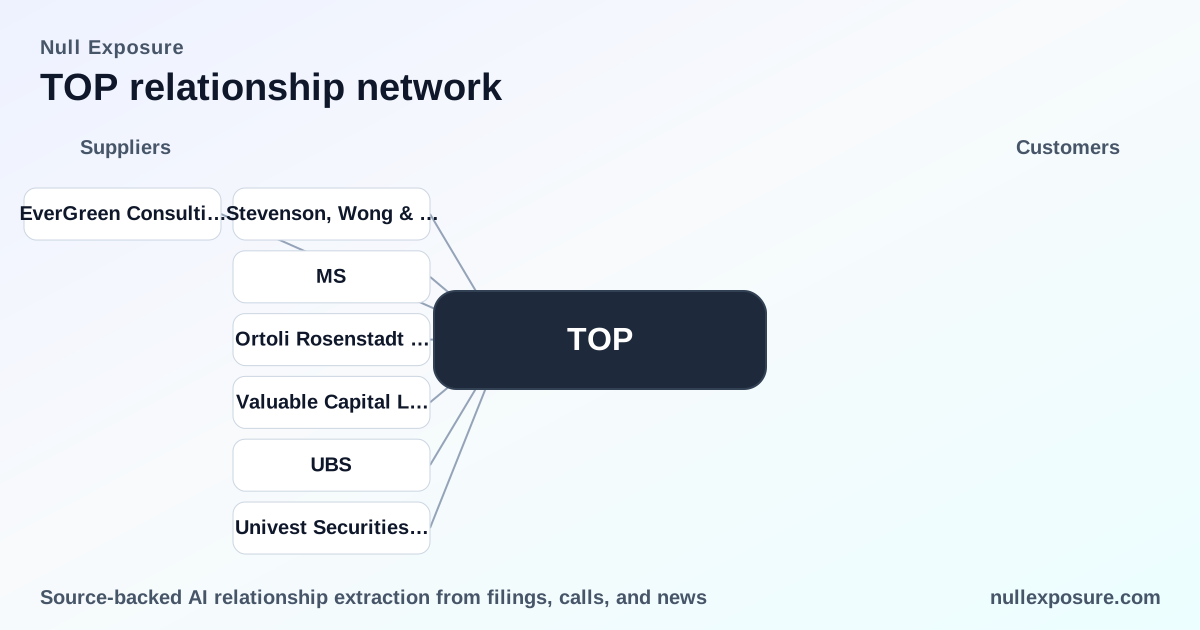
Zhong Yang Financial Group (TOP): Supplier map, operational signals, and investor checklist
Zhong Yang Financial Group operates as a Hong Kong-focused, diversified financial services firm that monetizes through advisory fees, asset-management income, and the development of trading products such as CFDs by connecting to external liquidity providers. The company's capital markets activity — notably its IPO and bookrunning relationships — is a core distribution and funding channel that underpins product rollouts and market access. For investors evaluating supplier relationships, the practical question is whether these counterparties give Zhong Yang durable access to liquidity, compliance capacity, and distribution in higher-margin trading products.
Explore a supplier-focused view at https://nullexposure.com/.
Why suppliers define TOP's operating runway
Zhong Yang’s supplier roster captured at the time of its IPO is concentrated and transaction-focused: legal counsel, underwriters/bookrunners, investor-relations advisers, and counterparties for CFD liquidity. That structure signals a contracting posture oriented around capital markets transactions and third-party market access rather than vertically integrated execution. With a small public float and heavy insider ownership, these external partners are critical for raising capital, establishing product credibility, and scaling distribution.
Supplier-by-supplier: what investors need to know
Stevenson, Wong & Co.
Stevenson, Wong & Co. acted as Hong Kong counsel to Zhong Yang in connection with its IPO, providing local legal services needed for regulatory clearance and transaction documentation. This role is documented in the company’s IPO announcement released June 1, 2022 via GlobeNewswire.
Morgan Stanley
Morgan Stanley is referenced as a top CFD liquidity provider Zhong Yang intends to connect with as part of developing its CFD products and services, positioning Morgan Stanley as a strategic market-access counterparty for trading product liquidity (GlobeNewswire, June 1, 2022).
UBS
UBS is similarly named alongside Morgan Stanley as a primary CFD liquidity provider Zhong Yang targeted to support its Hong Kong and global CFD initiatives, indicating reliance on established prime liquidity relationships for product credibility (GlobeNewswire, June 1, 2022).
Ortoli Rosenstadt LLP
Ortoli Rosenstadt LLP served as counsel to the company in the IPO process, a role that complements local and international legal coverage and supports the company’s cross‑jurisdictional capital markets activity (GlobeNewswire, June 1, 2022).
Valuable Capital Limited
Valuable Capital Limited acted as a joint book runner on Zhong Yang’s offering, providing underwriting and distribution support alongside the lead manager; this places Valuable Capital in the center of the IPO syndicate that established Zhong Yang’s initial market float (GlobeNewswire, June 1, 2022).
Univest Securities, LLC
Univest Securities, LLC served as the lead book-running manager for the offering, responsible for primary placement, pricing, and stabilization activity during the IPO — a core supplier relationship for initial market liquidity (GlobeNewswire, June 1, 2022).
EverGreen Consulting Inc.
EverGreen Consulting Inc. is listed as the company’s investor-relations adviser, indicating an outsourced approach to retail and institutional communications and post‑IPO market engagement (GlobeNewswire, June 1, 2022).
Operational constraints and company-level signals
There are no itemized external constraint excerpts tied to individual suppliers in the record; however, the company-level financial and ownership signals deliver a cohesive picture of operational constraints:
- Control concentration: Insiders hold roughly 74% of shares, while institutional ownership is ~0.7%, which creates a tight governance structure, limited free float, and potential principal-agent dynamics for minority holders.
- Scale and liquidity: Market capitalization is ~$37 million with only 7 million shares floatable against 37 million shares outstanding, producing thin secondary-market liquidity and heightened price volatility.
- Profitability and growth profile: Latest reported TTM revenue is $4.36 million with gross profit $2.20 million, but EPS is -0.14 and profit margin is -122.4%, indicating the business is operationally unprofitable while delivering strong quarter-over-quarter revenue and earnings growth (quarterly revenue growth +55.7%, quarterly earnings growth +89.7%).
- Valuation posture: Price-to-sales of 8.51 and price-to-book ~1.07 reflect a premium relative to current revenue scale; this valuation depends on successful product launches (CFDs) and capital markets access.
- Product strategy constraint: The explicit intent to connect CFD products to top liquidity providers identifies third-party liquidity dependence as a structural operating constraint: product execution is contingent on counterparties supplying pricing and credit lines.
These signals together indicate a company in early growth stage with outsized reliance on a small set of capital-markets suppliers and on concentrated shareholder control.
Explore how supplier concentration affects risk-adjusted returns at https://nullexposure.com/.
Investment implications — checklist for operators and investors
- Concentration and governance risk: High insider ownership compresses float and amplifies control; monitor for related-party transactions and minority-holder protections.
- Counterparty dependency: The business plan’s reliance on UBS and Morgan Stanley for CFD liquidity is strategic but non‑integrated — verify contractual terms, exclusivity, and credit support before pricing upside into models.
- Execution and compliance: Legal counsel and bookrunners performed IPO functions; confirm continued engagement or replacement plans as product rollout moves from capital markets to trading operations.
- Liquidity and valuation sensitivity: With a small market cap and elevated P/S, share price will be sensitive to execution beats/misses and to changes in free-float.
- Operational runway: Given negative margins and limited cash-scale signals, follow-up capital raises or revenue acceleration are necessary to justify current valuations.
Bottom line and next steps
Zhong Yang’s supplier roster reflects a company built around capital-market access and third-party liquidity rather than internal market-making infrastructure. That model can scale if contractual access to liquidity providers like UBS and Morgan Stanley is secured and if distribution via underwriters translates into sustained revenue growth; however, control concentration, limited float, and current unprofitability are material risks that investors must price.
For investors and operators focused on supplier risk, governance, and capital‑markets dependencies, consult the supplier intelligence and relationship dossiers at https://nullexposure.com/ to prioritize due diligence and counterparty confirmations.
Take action: review the supplier profiles and contract‑dependency overlays at https://nullexposure.com/ before adjusting exposure.