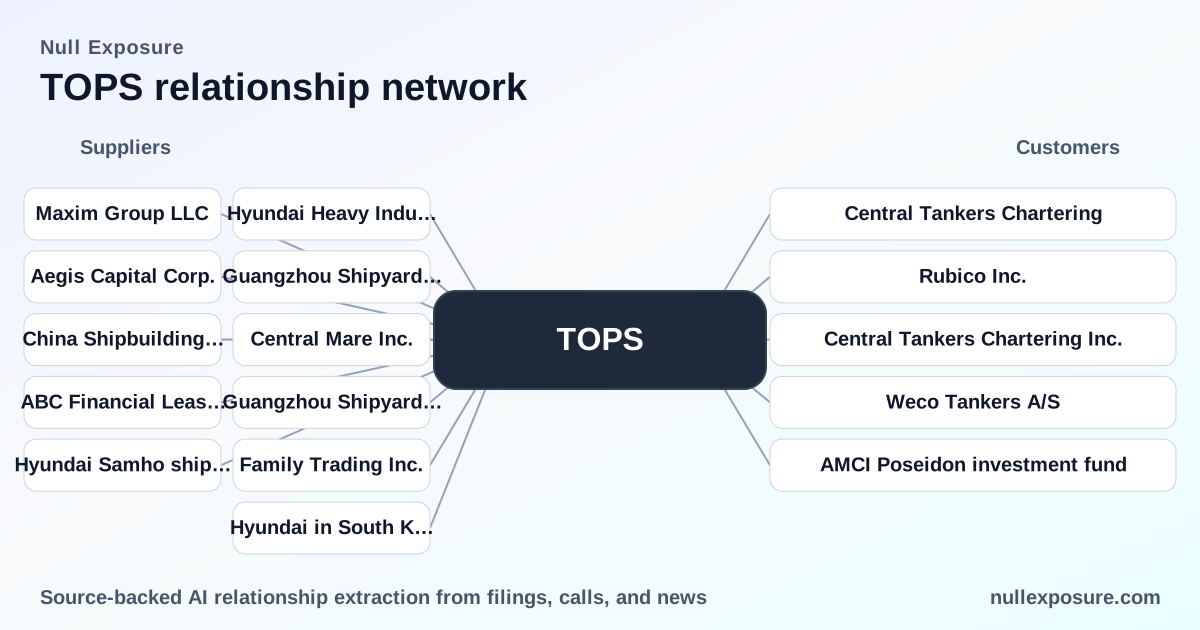
TOP Ships Inc. — supplier relationships and where shareholder risk concentration lives
TOP Ships Inc. owns and operates modern tanker vessels and monetizes primarily through time charters and vessel sales while growing capacity via newbuilding acquisitions. The company expands its revenue backlog by acquiring special-purpose companies that hold shipbuilding contracts and supports those deals with lease financing and corporate guarantees—a model that converts future charter revenues into near-term asset growth but concentrates counterparty, builder and financing risk. For further supplier and counterparty intelligence, visit https://nullexposure.com/.
How TOPS runs the business and earns cash
TOP Ships operates as an asset-heavy shipping owner-operator: it orders newbuilds, takes delivery of modern ECO tankers, and places those vessels on time charters to generate predictable revenue streams. The company funds growth through a mix of equity offerings, lease/ship-finance structures arranged with external lessors, and directed credit facilities tied to insiders—a capital structure that increases operational leverage and shifts execution risk to shipyards and leasing counterparties.
Key company-level signals:
- High insider control: insiders own roughly 73% of shares, leaving a thin public float and limited institutional participation (about 1.5%), which concentrates governance and exit risk.
- Small market capitalization and elevated volatility: market cap is roughly $15.1M with a beta above 2.4, implying high sensitivity to freight rates and sentiment.
- Profitability levered to chartering: TOPS reports positive operating margins and EBITDA but grows through long-dated newbuild commitments that extend cash flow timing into 2028–2029. These signals define TOPS as a high-concentration, asset-dependent operator whose execution hinges on shipbuilder and leasing counterparties rather than on diversified capital markets access.
Supplier and counterparty map — what each relationship means for investors
Hyundai Heavy Industries
TOP Ships has repeatedly taken delivery of large newbuilds constructed at Hyundai Heavy Industries yards in South Korea, including VLCCs and ECO-design vessels that form the company’s core modern fleet. Sources: VesselFinder (Jan 2022 delivery) and MarineLink (Jan 2022 reporting).
Hyundai Samho shipyard
TOP Ships took delivery of Suezmax ECO vessels constructed at the Hyundai Samho shipyard, reflecting the company’s reliance on South Korean builders for mid-sized crude tanker capacity. Source: MarineLink (2019 delivery).
Hyundai in South Korea (general references)
TOPS engaged in financing discussions tied to vessels delivered from Hyundai yards, indicating ongoing commercial and financing interactions with Hyundai-built tonnage. Source: MarineLink (FY2018 reporting on financing terms).
Guangzhou Shipyard International Company Limited
TOP Ships is acquiring SPVs that hold contracts for nine 47,499 dwt ECO MR product/chemical tankers built by Guangzhou Shipyard International, signaling major near-term exposure to Chinese shipbuilding delivery schedules for 2028–2029. Source: Globenewswire press release (Feb 23, 2026) and EnergyDigital coverage (2026).
Guangzhou Shipyard International (alternate reporting)
Multiple outlets report the same multi-vessel shipbuilding relationships with Guangzhou Shipyard International as the named builder for the nine ECO MR newbuilds, reinforcing the yard’s central role in TOPS’ growth pipeline. Source: ShippingTelegraph (Feb 2026).
China Shipbuilding Trading Co., Ltd.
The SPVs that TOPS agreed to acquire also have shipbuilding contracts with China Shipbuilding Trading Co., Ltd., identifying an additional Chinese commercial counterparty layered into the newbuild procurement chain. Source: ShippingTelegraph (Feb 3, 2026 shipbuilding contracts).
Central Mare Inc.
TOP Ships entered into a share purchase agreement with Central Mare Inc., an affiliate of the CEO, to acquire 100% of issued shares of nine Marshall Islands SPVs holding the newbuild contracts—this is a related‑party acquisition that materially increases TOPS’ booked backlog. Source: ShippingTelegraph (Feb 18, 2026) and company disclosures reported by press.
ABC Financial Leasing Co., Ltd.
TOPS disclosed that the SPVs are finalizing lease financing with two major Chinese leasing companies, one being ABC Financial Leasing, which would cover most of the contract price for the nine vessels and requires a corporate guarantee from TOPS. Source: Globenewswire (Feb 23, 2026) and Bitget news summary (2026).
Family Trading Inc.
Historical reporting shows Family Trading Inc., an affiliate of TOPS’ CEO, has been used for credit facilities and intra-group financing, highlighting recurring related‑party funding channels. Source: MarineLink (FY2018 report on credit facility).
Maxim Group LLC
TOP Ships terminated an at-the-market equity distribution agreement with Maxim Group LLC, removing a public equity issuance channel used previously to raise growth capital. Source: MarineLink (FY2018).
Aegis Capital Corp.
Aegis Capital Corp. previously acted as the sole book-running manager in a public offering, indicating that TOPS has used small-cap boutique underwriters for equity raises in past cycles. Source: RTT News (FY2014).
Why these relationships change the risk-reward calculus
The supplier and financing set-up creates concentrated contractor and financier exposure: TOPS is locking in growth through specific shipyards and Chinese leasing houses and simultaneously increasing balance-sheet contingent liabilities via corporate guarantees. The Central Mare related‑party purchase converts seller-arranged financing into TOPS’ asset base, which raises execution and governance scrutiny because a single executive-affiliate transaction materially alters backlog and leverage.
At the same time, TOPS’ use of ECO-design newbuilds and long-term time charters represents high operational cashflow optionality if charter rates remain supportive and deliveries occur as scheduled. Investors must balance the backlog upside (potentially $679m of gross revenue cited in press) against delivery risk, shipyard schedule slippage and financing completion risk given the corporate guarantee requirement. For deeper counterparty exposure analysis, see https://nullexposure.com/.
Practical takeaways for investors and operators
- Related‑party transactions are material: management‑affiliate SPV purchases directly increase TOPS’ booked fleet and require governance oversight. Source: ShippingTelegraph (Feb 2026).
- Financing concentration carries conditional liabilities: lease financings arranged by sellers and requiring TOPS guarantees shift execution risk onto the corporate balance sheet. Source: Globenewswire (Feb 23, 2026).
- Builder and delivery schedules matter: reliance on Guangzhou Shipyard International and Chinese trading firms roots growth timing into 2028–2029 milestones that affect cash flow ramp and refinancing windows. Source: multiple Feb 2026 press reports.
If your model depends on delivery timing, charter coverage, or counterparty credit, incorporate these supplier relationships explicitly. For a practical counterparty map and alerts, visit https://nullexposure.com/ to see how these links affect portfolio exposure.
Final assessment and recommended next steps
TOP Ships is executing a capital‑intensive expansion financed through a mix of lease arrangements, equity actions and related‑party purchases. The strategic upside is a meaningful charter backlog and a modern ECO fleet; the principal downside is concentrated counterparty risk (builders, lessors) and governance concentration driven by insider control and related‑party transactions.
Actionable next steps:
- Monitor shipyard delivery notices and lease financing close conditions tied to the nine MR vessels.
- Demand enhanced disclosure on the Central Mare transaction and any corporate guarantees associated with ABC Financial Leasing.
- Model scenarios with delayed deliveries and increased financing spreads given the company’s small public float and high beta.
For ongoing supplier relationship monitoring and tailored exposure reports, check https://nullexposure.com/ — we map counterparties, financing links and delivery schedules so investors can price TOPS’ growth versus execution risk.