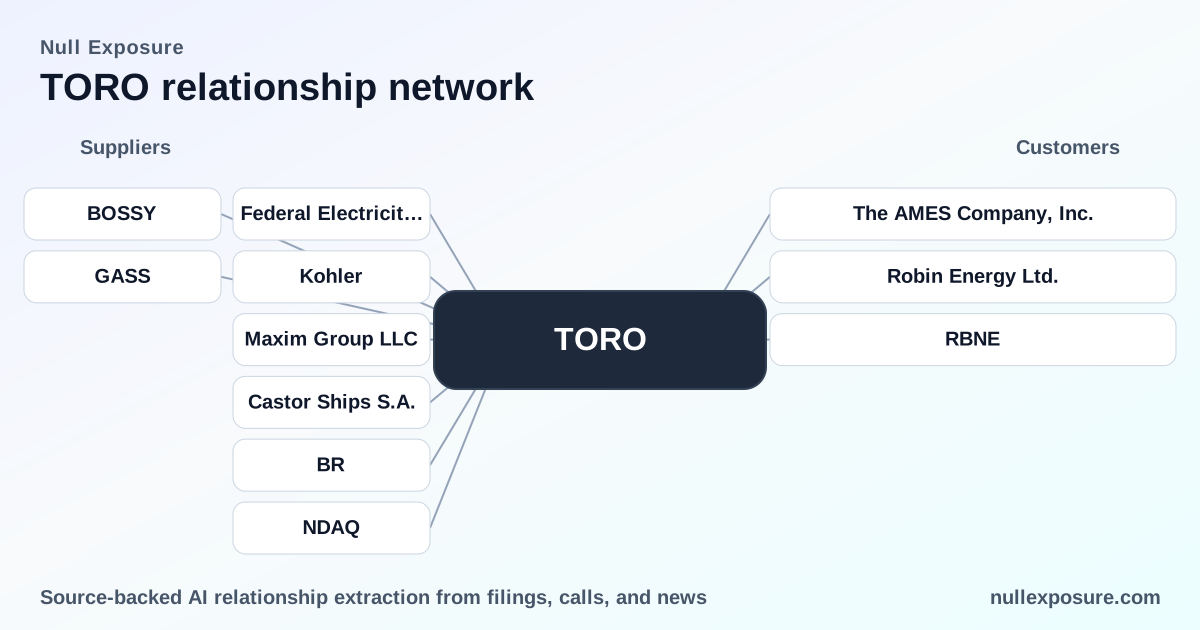
Toro Ltd (TORO) — Supplier Relationships and Investment Implications
Toro Ltd is a small-cap energy midstream operator that generates revenue from vessel ownership and management fees tied to gas carriers and related maritime assets, and supplements liquidity through occasional equity-at-the-market (ATM) placements. The company monetizes cash flow from ship operations and management contracts, with periodic capital-market activity to support balance-sheet flexibility. For investors evaluating supplier exposure, the relationship set reflects operational ties to port power providers, engine and equipment vendors, ship managers and capital markets service providers—each relationship carrying specific operational or liquidity implications. Learn more about how we map supplier exposure at https://nullexposure.com/.
Quick read: why these supplier ties matter to investors
Toro’s supplier footprint is not broad, but it is concentrated on maritime operating partners and capital-market service providers, which makes operational continuity and capital access the principal vectors of risk and value. High insider ownership (about 59%) and minimal institutional ownership increase governance concentration and the importance of bilateral commercial agreements. Operational partners that control fuel, power, vessel management and trading infrastructure therefore have outsized influence over near-term cash flow and transfer pricing.
Explore deeper supplier analytics on the homepage: https://nullexposure.com/
What the company’s relationships reveal — every listed tie, one by one
Federal Electricity Commission (CFE)
A Ciudad Juárez governor’s office intermediary arranged a meeting between Toro executives and Mexico’s Federal Electricity Commission to secure the electricity supply for an industrial expansion project in that region. This indicates direct engagement with national power utilities where onshore energy and logistics capacity are relevant to Toro’s industrial footprint. Source: Mexico Now news report, March 2026 (https://mexico-now.com/cfe-and-maquiladora-industry-seek-to-guarantee-electricity-supply-in-juarez/).
Kohler
A product article from FY2020 describes a Toro-branded swivel mud buggy powered by a 25-hp Kohler Confidant engine, highlighting a vendor relationship for powerplants inside specific equipment lines. This points to component-level supplier links for engine supply on Toro-branded equipment used in construction or marine support contexts. Source: ForConstructionPros equipment article (product page, FY2020) (https://www.forconstructionpros.com/concrete/equipment-products/buggies-conveyors-misc-placing/product/21201663/the-toro-company-toro-swivel-mud-buggy).
Maxim Group LLC
Toro has an ATM selling agreement with Maxim Group under which Maxim acts as sales agent for up to $12.5 million of common shares, signaling active equity liquidity programs and reliance on an investment-banking counterparty for capital raises. This is a clear operating lever for funding and share issuance. Source: Toro press release on GlobeNewswire, December 5, 2025 (https://www.globenewswire.com/news-release/2025/12/05/3200725/0/en/Toro-Corp-Reports-Net-Income-of-1-3-Million-for-the-Three-Months-Ended-September-30-2025-and-4-3-Million-for-the-Nine-Months-Ended-September-30-2025.html).
Castor Ships S.A.
An amended master management agreement raised per-vessel management fees, with management fees recorded at $0.5 million for recent quarters and a fee step-up to $1,100 per vessel per day effective July 1, 2025. That indicates ongoing vessel-management outsourcing and contract re-pricing that materially affects operating margins on the fleet. Source: Toro financial release on GlobeNewswire, December 5, 2025 (https://www.globenewswire.com/news-release/2025/12/05/3200725/0/en/Toro-Corp-Reports-Net-Income-of-1-3-Million-for-the-Three-Months-Ended-September-30-2025-and-4-3-Million-for-the-Nine-Months-Ended-September-30-2025.html).
Broadridge Corporate Issuer Solutions, LLC
Broadridge acted as the election agent for a special dividend payment and served as the contact point for registered shareholders querying the dividend—demonstrating use of a major proxy and dividend-processing vendor to execute shareholder distributions. This is a liquidity- and governance-facing service relationship. Source: GlobeNewswire shareholder announcement, January 16, 2026 (https://www.globenewswire.com/news-release/2026/01/16/3220559/0/en/Toro-Corp-Announces-Shareholder-Election-Results-and-Payment-of-Special-Dividend.html).
Nasdaq
Nasdaq provided trading guidance for shares with due bills around a special dividend and set the ex-dividend mechanics in December 2025–January 2026, reflecting exchange-level operational coordination for corporate actions and market settlement. This is a standard but critical market infrastructure relationship. Source: GlobeNewswire shareholder announcement, January 16, 2026 (https://www.globenewswire.com/news-release/2026/01/16/3220559/0/en/Toro-Corp-Announces-Shareholder-Election-Results-and-Payment-of-Special-Dividend.html).
BOSS
A FY2020 product news item notes BOSS blade attachments adding snow and ice management capabilities to the Toro Dingo line, indicating third-party attachment suppliers for equipment sold under the Toro brand—a revenue and aftermarket-servicing vector for small equipment operations. Source: ForConstructionPros product article (FY2020) (https://www.forconstructionpros.com/concrete/equipment-products/buggies-conveyors-misc-placing/product/21201663/the-toro-company-toro-swivel-mud-buggy).
StealthGas
A Tradewinds article notes Toro purchased a gas carrier from StealthGas seven years prior, and the ship was later sold to a spin-off, underlining secondary-market vessel acquisitions from specialist owners and active asset rotation within the fleet strategy. This highlights the capital-intensity of Toro’s asset base and the role of specialized sellers in fleet composition. Source: Tradewinds, report on vessel sale (FY2025) (https://www.tradewindsnews.com/tankers/toro-corp-offloads-second-gas-carrier-to-spin-off-robin-energy/2-1-1873782).
Operating-model constraints and what’s not disclosed
The available supplier-relationship references do not include any explicit contractual constraints or escalation clauses. There are no supplier-level constraints disclosed in the reviewed materials, which is itself a company-level signal: governance and continuity risks are best evaluated through public filings and contract exhibits rather than press summaries alone. Critical operating-model characteristics for investors:
- Contracting posture: Reliant on external vessel managers and capital-market agents; contracts drive variable fees and influence margins.
- Concentration: Supplier footprint is concentrated (vessel managers, engine/attachment vendors, capital markets providers), increasing counterparty exposure.
- Criticality: Vessel management and port/power access are critical to revenue; disruptions to these services directly affect cash flow.
- Maturity: Relationships combine long-lived maritime contracts and standard capital-market service engagements, reflecting mixed maturity and re-pricing potential.
If you need a granular counterparty risk report, start your review at our homepage: https://nullexposure.com/
Investment implications and closing view
Key investor takeaways: Toro’s economics are driven by fleet utilization, management-fee structures, and occasional equity liquidity programs. Counterparty concentration—especially in vessel management and market services—creates asymmetric operational risk that is amplified by the company’s small market capitalization and high insider ownership. Short-term performance hinges on fleet utilization and management-fee terms; medium-term outcomes depend on the company’s capital access through ATM arrangements and its ability to rotate vessels profitably.
For a tailored supplier-risk brief or to track evolving counterparty disclosures for small-cap energy names, visit https://nullexposure.com/ for our premium analysis and monitoring tools.