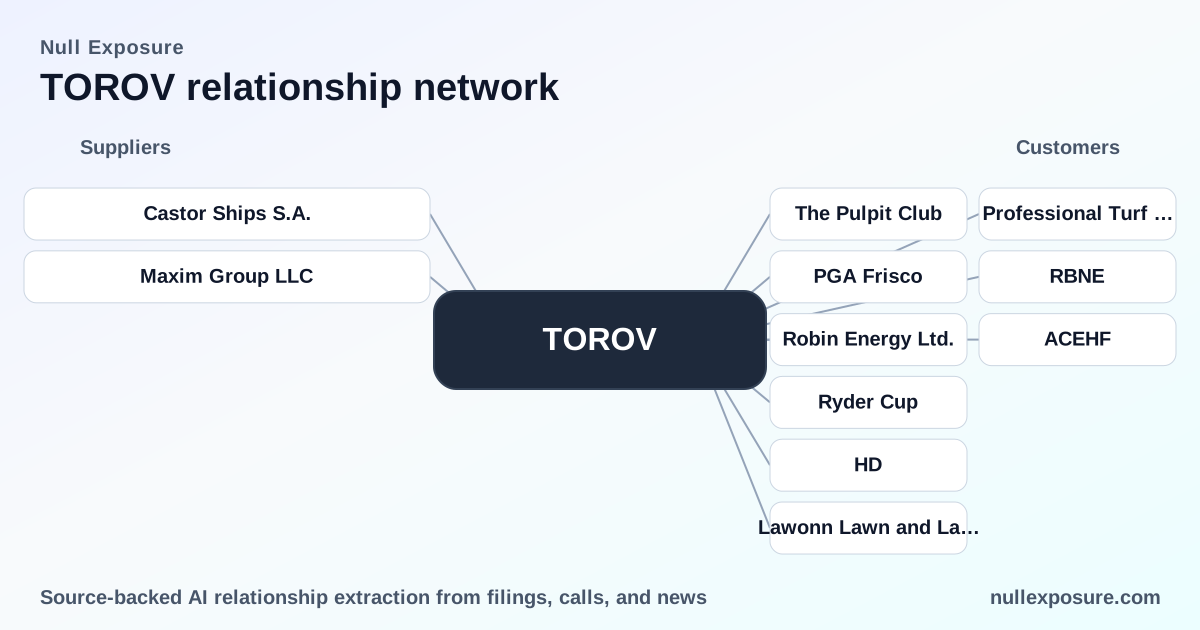
TOROV — Supplier map and investment implications for Toro Corp.
Thesis: Toro Corp. operates as a marine shipping concern that monetizes through vessel ownership and management arrangements and supplements balance-sheet flexibility with equity market programs; revenue drivers in the near term include management-fee income tied to vessel ownership days and access to capital via an at‑the‑market equity facility. Investors should value the company on cash flow from vessel management and the capacity to raise incremental equity quickly under an ATM structure. For more supplier intelligence and relationship mapping, visit https://nullexposure.com/.
How Toro monetizes: fleet economics plus capital markets access
Toro’s commercial model blends traditional shipping economics — day rates, ownership days, and third‑party management fees — with opportunistic equity issuance to fund operations or growth. Management fees are explicit, indexed to vessel ownership days and contractual per‑vessel daily rates; when ownership days decline, fee income contracts unless offset by negotiated rate increases. Separately, the company uses an “at‑the‑market” (ATM) sales agreement to convert equity into cash over time, which provides immediate liquidity but introduces share‑count dilution risk. The two relationship types disclosed — a ship management counterparty and a capital markets agent — capture the core of Toro’s near‑term revenue and financing levers. Learn more about supplier relationships at https://nullexposure.com/.
The counterparties named in public disclosures
Castor Ships S.A.
Toro’s master management agreement with Castor Ships S.A. sets daily management fees per vessel and governs how management income tracks ownership days; Toro negotiated an increase from $1,071 to $1,100 per vessel per day effective July 1, 2025. Management fees from continuing operations were reported at $0.5 million for each three‑month period ended September 30, 2025 and 2024. These provisions show that third‑party ship management contributes measurable recurring fee income and is contractually adjustable. According to a Toro FY2025 disclosure reported by Yahoo Finance (March 10, 2026), the amended agreement and fee figures were explicitly described in Toro’s financial commentary.
Maxim Group LLC
On November 13, 2025, Toro entered an ATM offering agreement with Maxim Group LLC under which Toro can, from time to time, sell common shares having an aggregate offering value of up to $12.5 million through Maxim as sales agent. This arrangement gives Toro an on‑demand equity distribution channel to raise capital without a single large underwritten offering, trading off immediacy for potential dilution and market‑price dependency. A Yahoo Finance report summarizing Toro’s FY2025 disclosures (March 10, 2026) records the ATM terms and cap.
Company‑level operating signals and practical constraints
No explicit operational constraints were reported in the supplier relationship data set. That absence itself is a signal: public disclosures name only select counterparties rather than a broad supplier roster, implying focused counterparties for critical functions.
- Contracting posture: The mix of a master management agreement and an ATM demonstrates a pragmatic contracting posture — operational tasks are delegated under a formal, adjustable services agreement while financing is maintained through flexible capital‑markets mechanisms.
- Concentration: The disclosed relationships are narrow in scope (one management counterparty and one sales agent), indicating concentration in critical functions: vessel management and equity distribution. Concentration increases dependency risk if counterparties change terms or service quality declines.
- Criticality: Management agreements are operationally critical — day‑rate and ownership‑day mechanics directly affect revenue recognition. The ATM is strategically critical for liquidity management and financing alternatives.
- Maturity: The management agreement has been amended and restated, and the ATM is a standard capital markets tool; both indicate contractual maturity consistent with an operating company that negotiates routine commercial and financing arrangements.
These are company‑level signals derived from the public relationship set rather than constraints tied to any single counterparty.
Financial and risk implications for investors
Investors should treat these relationships as dual levers that influence Toro’s near‑term valuation:
- Revenue sensitivity: Management fees are susceptible to fleet utilization (ownership days). The disclosed increase to $1,100/day offsets some utilization decline, but overall fee income will track fleet deployment and chartering outcomes.
- Funding and dilution: The $12.5 million ATM with Maxim provides ready access to capital but creates potential dilution; the cost of raising equity under an ATM is a function of market execution and share price.
- Counterparty concentration risk: With a small number of named partners, operational disruption at the management level or loss of a sales agent relationship would have outsized effects on operations or capital access.
- Contract flexibility: The amended management agreement shows room to renegotiate commercial terms; this flexibility is constructive, as it allows Toro to adjust fee economics in response to market conditions.
Investors should monitor quarterly disclosures for changes in ownership days, management‑fee run‑rates, and any utilization metrics that affect management income. Also track ATM usage and share issuance notices to quantify dilution and net proceeds.
What to watch next — catalysts and data points
- Quarterly statements on ownership days and aggregate management fees; a sustained decline in ownership days will depress fee revenue unless offset by higher negotiated rates.
- Notices of share sales under the Maxim ATM and the total proceeds realized; regular use of the ATM signals ongoing funding needs.
- Any expansion of the supplier map — new management counterparties, charter agreements, or underwriters — which would meaningfully change concentration and counterparty risk.
For a deeper view of how these supplier relationships influence enterprise value and operational resilience, visit https://nullexposure.com/ for full supplier mapping and analysis.
Bottom line
Toro’s public relationship disclosures present a clear operational duo: third‑party vessel management as a revenue engine and an ATM equity facility as a liquidity engine. Each relationship exerts material influence on cash flow and capital structure. Investors should weight management‑fee trends against ATM utilization when modeling near‑term dilution and liquidity. For ongoing updates and a structured supplier risk score, see https://nullexposure.com/.