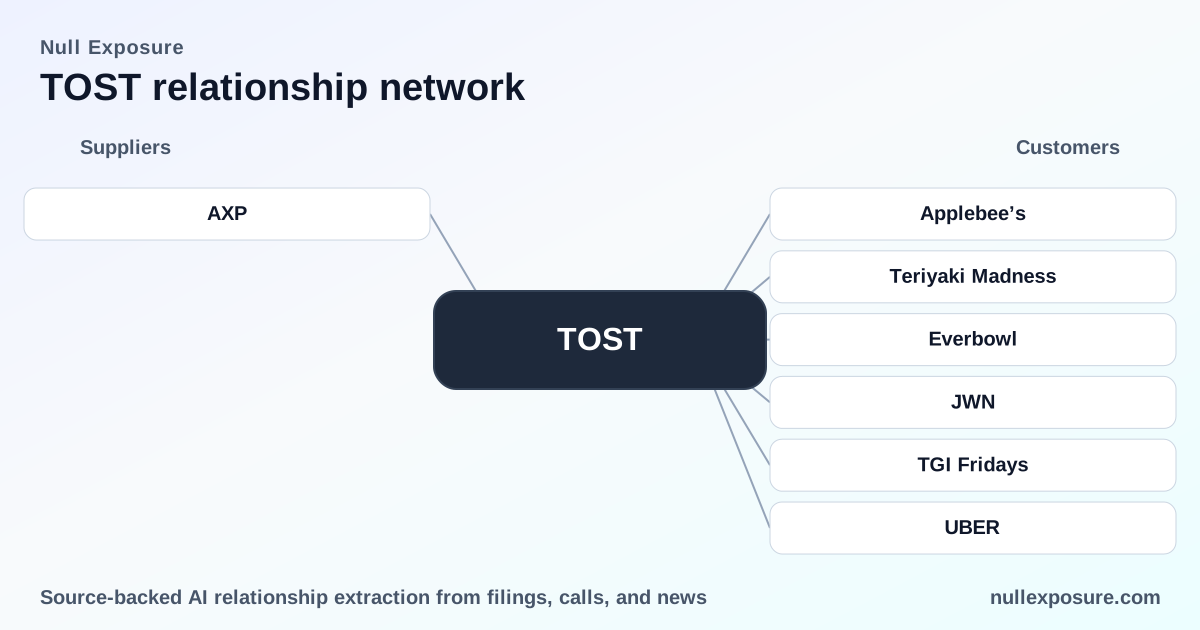
Toast Inc (TOST) — Supplier Relationships and Operational Constraints Investors Need to Know
Toast operates a cloud-based point-of-sale and payments platform for restaurants and monetizes through subscription and software revenue, hardware sales and financing, and payments processing take-rates. The company combines recurring SaaS economics with transaction-driven revenue, and it expands reach through strategic partnerships that drive transaction volume and customer acquisition. For investors evaluating supplier risk and counterparty exposure, focus on Toast’s hardware and cloud commitments, payment-processing dependencies, and the strategic partnerships that accelerate network effects. Learn more about supplier intelligence at https://nullexposure.com/.
How Toast’s supplier footprint funds growth and constrains flexibility
Toast’s operating model blends recurring software margins with capital-intensive hardware and payments flows. That mix creates a dual supplier posture: software/cloud vendors and payment processors are critical ongoing service partners, while hardware manufacturers represent concentrated, short-term cash commitments. Scale amplifies both leverage and vulnerability—Toast’s reported revenue of $6.153 billion and gross profit of $1.598 billion underline the platform’s size, but supplier cost lines directly affect take-rates and margins.
Key company-level signals:
- Short-term contracting posture: Toast disclosed non-cancellable hardware purchase obligations of $65 million due within the next 12 months, reflecting concentrated near-term cash flow commitments to manufacturers.
- Large multi-year vendor spend: Non-cancellable commitments with cloud service providers and other vendors totaled $185 million as of December 31, 2024, of which $69 million is due within 12 months and $116 million thereafter—indicating meaningful multi-year vendor exposure.
- Payment processing dependency: Toast explicitly relies on third-party payment processors to facilitate guest and merchant payments; interchange and acquiring fees are material line items.
- Manufacturer and service-provider roles: The company depends on third parties to manufacture hardware and to deliver payments and cloud services, making those supplier relationships operationally critical.
Together, these signals point to a moderately concentrated supplier base with critical service dependencies and material short-term cash commitments that procurement and treasury should prioritize.
Contracting posture and what it means for financing
Toast’s mix of short-term and multi-year commitments creates predictable operational needs but tactical exposure during market stress. Short-term hardware obligations create a lumpiness that can be financed via working capital or supplier credit; larger cloud commitments create steady fixed-cost floors. For corporate finance teams, the implication is clear: maintain flexible liquidity or committed credit lines to absorb payment timing volatility, and treat payment-processor agreements as operationally critical vendor relationships that require contingency planning.
- Working capital sensitivity is elevated because $65 million of hardware obligations are due within 12 months and interchange costs flow with transaction volumes.
- Negotiation leverage is asymmetric: Toast’s scale helps secure favorable pricing from cloud providers, but hardware suppliers can impose lead-time or price risk under short-term commitments.
If you evaluate supplier financing or lending against Toast exposure, structure for seasonality and ensure capital availability through sharp peaks in hardware deliveries.
The public supplier relationship on record: American Express
Toast announced a strategic partnership with American Express to enhance dining experiences and expand market reach. According to a press release reported by The Globe and Mail on March 10, 2026, the partnership is positioned to strengthen Toast’s payments and customer-facing services while broadening card acceptance and marketing opportunities. (Source: The Globe and Mail press release coverage, March 10, 2026.)
Operational constraints investors should internalize
Toast’s public disclosures provide clear operating constraints investors must underweight or hedge in valuation and operational scenarios:
- Contract type: short-term — “As of December 31, 2024, our non-cancellable purchase obligations to hardware suppliers totaled $65 million, all of which is due within the next 12 months.” This is a near-term cash liability that tightens liquidity requirements.
- Relationship roles: manufacturer and service provider — the company states, “We depend on third parties to manufacture our products and to supply key components necessary to manufacture our products,” and it acknowledges reliance on third-party payment processors. These are structural dependencies, not incidental vendor relationships.
- Spend bands: >$100 million aggregate vendor commitments and $10–100 million near-term hardware commitments — the firm reported $185 million of non-cancellable contractual commitments with cloud service providers and other vendors, with $69 million due within 12 months. These figures communicate scale and concentration of supplier spend.
Presenting these constraints as company-level signals clarifies that Toast’s supplier risk is systemic to the business model rather than limited to a single counterparty.
What this means for investors and operators
Operationally, suppliers determine both margin stability and growth velocity for Toast. Payment-processing fees compress take-rates, hardware commitments require capital planning, and cloud/service contracts set fixed-cost baselines. For investors and operators, the priority list is:
- Protect liquidity against near-term hardware obligations and seasonal transaction swings.
- Treat payment processors and cloud vendors as mission-critical partners; contract terms and redundancy matter.
- Use strategic partnerships (for example, with card networks or brands) to accelerate volume and reduce per-transaction cost through scale.
For targeted supplier due diligence and monitoring, a structured program that tracks payment processor metrics, hardware delivery schedules, and cloud-cost run rates will materially reduce operational surprise.
Practical takeaways — what to act on now
- Prioritize liquidity planning: $65 million of hardware obligations due in 12 months requires committed liquidity buffers or supplier financing arrangements.
- Elevate payment-processor oversight: Payment fees are a recurring margin pressure point; ensure contractual controls and alternative routing capabilities.
- Monitor spend concentration: $185 million of vendor commitments creates bargaining power but also single-point risk if a major vendor underperforms.
Want more actionable supplier intelligence on Toast and comparable platforms? Visit https://nullexposure.com/ for tailored supplier risk profiles and monitoring solutions.
Final assessment and next steps
Toast combines recurring software economics with transaction-led revenue, which scales well but creates concentrated supplier and payment-processing exposure that directly affects margins. The company’s strategic partnership with American Express is a growth lever that could increase transaction volume and broaden distribution, while hardware and cloud commitments drive near-term liquidity needs. Investors should balance growth upside from network partnerships against concentrated supplier obligations and payment-processing cost risk.
For proactive monitoring and to benchmark Toast against peers on supplier risk, learn more at https://nullexposure.com/.