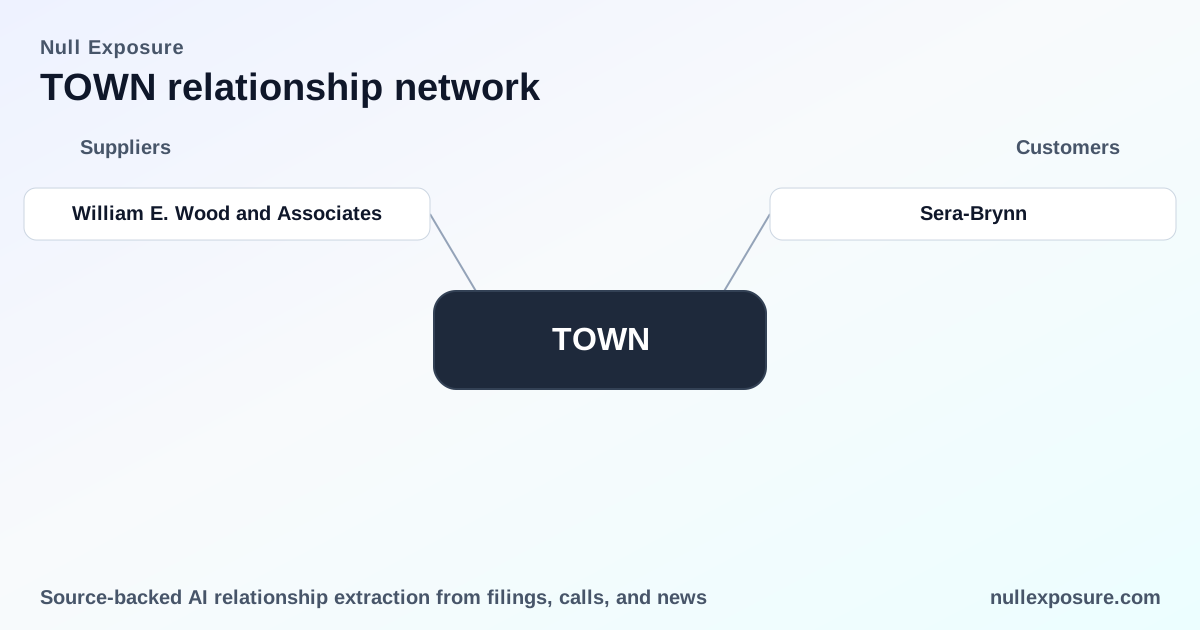
TowneBank (TOWN) — supplier relationships, operating posture, and what investors should price
TowneBank is a regional commercial and retail bank headquartered in Portsmouth, Virginia that monetizes through traditional banking channels: net interest margin on a loan and deposit book, fee income from retail and business services, and ancillary revenue from mortgage distribution via partners. With roughly $812 million in trailing revenue, a 20.9% profit margin, and a market capitalization near $3.06 billion, TowneBank combines steady regional deposit gathering with selective third‑party partnerships to broaden product distribution and mortgage origination capabilities. For a deeper look at supplier exposure and partner risk, start your due diligence at https://nullexposure.com/.
How TowneBank makes money and why supplier links matter
TowneBank’s core economics are conventional for a regional bank: interest income drives the bulk of revenue, while fees and mortgage-related activities add variability and optionality. Key financial signals: trailing revenue of $811.8M, EPS of $2.21, a trailing P/E of 15, a forward P/E of 12.6, and return on equity of 7.47%. These metrics reflect a profitable regional franchise with modest growth and reasonable valuation multiples for the regional banking peer group.
Supplier and partner relationships are material when they touch customer acquisition and product distribution. TowneBank outsources or co‑brands some mortgage services to specialist partners to scale origination without building a full mortgage platform in-house. That commercial trade‑off — scale via partners versus control — is a central operating consideration for investors and operators evaluating supplier risk.
The supplier landscape: the relationships to know
Below I cover every supplier relationship present in the available supplier results for TOWN.
William E. Wood and Associates — mortgage distribution partner
TowneBank partners with William E. Wood and Associates to offer mortgage services across its Hampton Roads and Northeastern North Carolina branch network, leveraging the specialist broker’s capabilities to distribute residential mortgages through bank branches. According to an NBC News report from FY2010, the strategic partnership enables mortgage availability in TowneBank offices across the region (https://www.nbcnews.com/id/wbna40532599). Takeaway: this is a distribution and origination relationship that augments TowneBank’s retail product set without full internalization of mortgage operations.
What the supplier footprint tells you about contracting posture, concentration, criticality, and maturity
The data payload contains no explicit supplier constraints disclosures for TowneBank. That absence is itself informative: no reported contract limitations or constraint excerpts suggests a transparent, low‑friction supplier posture at the company level rather than an opaque or highly restricted sourcing model.
- Contracting posture: TowneBank operates with a flexible contracting stance, preferring partnerships to vertical integration where practical. The use of mortgage partners implies the bank prioritizes distribution scale and specialized execution over building a full mortgage operations stack.
- Concentration: With the supplier inventory showing a single public partner in this set, supplier concentration risk is low in the disclosed universe, though investors should verify whether other, non‑disclosed partners (servicing platforms, fintech vendors, core processors) play material roles.
- Criticality: Mortgage partnerships represent important but non‑core distribution channels — they affect revenue diversification and customer acquisition but are not the same as core deposit or payments processing infrastructure. Losing a mortgage partner would be disruptive to origination flow but would not stop fundamental banking operations.
- Maturity: The documented partnership dates back to reporting in FY2010 and continues to be referenced, indicating a mature, long‑standing commercial relationship rather than a short‑term pilot.
Risk and opportunity checklist for investors and operators
Tie supplier insight back to valuation and operational risk. Focus on the following items when you underwrite TowneBank exposure.
- Credit and NIM sensitivity: Regional banks’ earnings depend on net interest margin and loan performance; supplier relationships that expand loan origination (like mortgage partners) are revenue enhancers but also increase interest rate and credit cycle sensitivity.
- Operational concentration: Confirm whether other third‑party vendors (core processing, payments, loan servicing) are concentrated; current public signals show an emphasis on partnership for mortgages but do not disclose downstream servicers.
- Regulatory and reputational exposure: Mortgage origination channels carry compliance and fair‑lending risk. Longstanding partnerships reduce onboarding risk but raise the bar on oversight systems.
- Cost of funding and capital allocation: TowneBank’s dividend yield (~3.21%) and forward P/E suggest management balances shareholder returns with capital conservation — supplier strategies that avoid heavy fixed‑cost buildouts align with that posture.
- Due‑diligence items for operators: request current contracts, SLA and indemnity language for mortgage partners, historical performance and complaint metrics, and evidence of regulatory controls and audit coverage.
If you want a consolidated supplier intelligence briefing or comparative supplier map across regional banks, review how these relationships are summarized at https://nullexposure.com/.
Valuation and portfolio implications
TowneBank trades at modest multiples (trailing P/E 15, forward 12.6; price/book ~1.26) with stable profitability. The use of mortgage partners is consistent with a capital‑efficient growth strategy: it grows fee income without commensurate fixed costs, but it does introduce counterparty, compliance, and distribution risk that should be reflected in any relative valuation premium. Institutional ownership over 52% indicates the stock is owned by sophisticated investors who are already pricing these trade‑offs.
For portfolio managers: overweight where you value steady regional deposit franchises and conservative capital allocation; underweight where you require bank-owned mortgage platforms or minimal third‑party operational exposure. Operators should treat partner oversight, audit access, and contract termination terms as priority negotiation levers.
Bottom line and action items
TowneBank is a profitable regional bank that leverages third‑party mortgage partnerships to extend distribution while keeping a compact operating footprint. The supplier signal set is limited but clear: mortgage distribution via William E. Wood and Associates is a long‑standing, material partnership for retail product reach. Investors and operators should prioritize contract governance, regulatory oversight, and concentration checks as part of standard diligence.
Explore supplier-focused intelligence and request a tailored relationship brief at https://nullexposure.com/ to convert these signals into actionable exposure limits and contractual requirements.
Next steps for due diligence: obtain current mortgage‑partner contracts, vendor performance history, regulatory exam findings related to third‑party vendors, and a full vendor inventory to confirm whether the public supplier list is complete. Revisit valuation after confirming the scope and control of mortgage distribution flows. For an immediate supplier-risk brief, visit https://nullexposure.com/ and start the workflow.