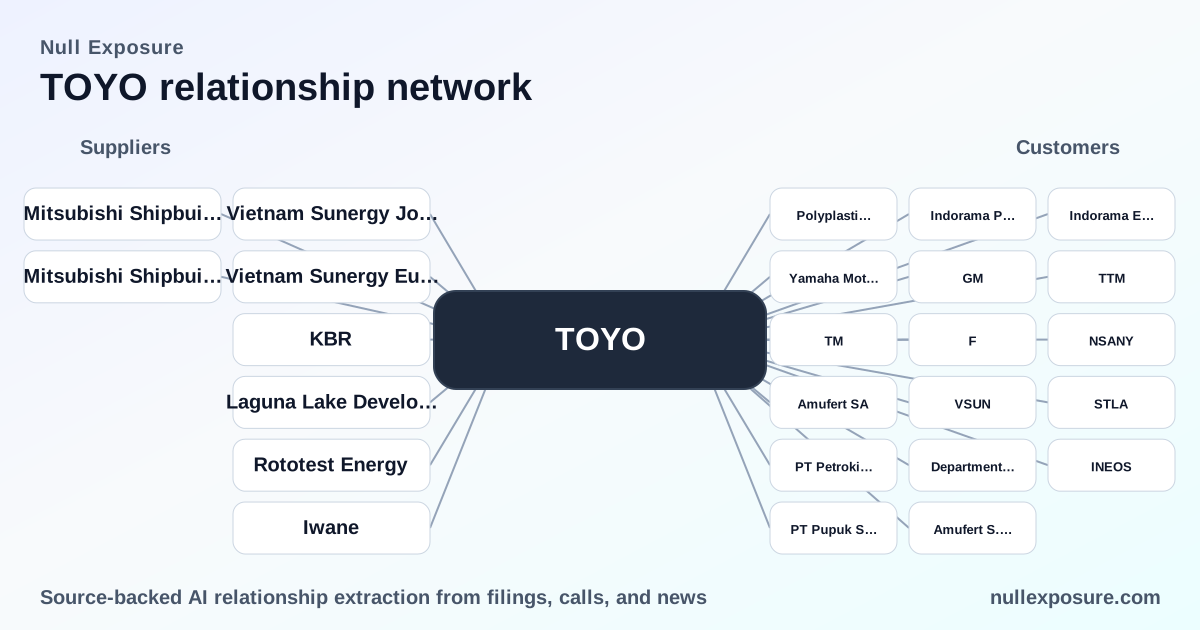
TOYO — Supplier relationships that shape a mid‑market solar and engineering play
TOYO is a NASDAQ‑listed engineering and solar solutions company that monetizes through a mix of product sales, IP acquisitions, and engineering contracts executed by its subsidiaries (notably Toyo Solar Company Limited). Revenue streams come from selling solar modules and related components, acquiring and commercializing brands and trademarks, and partnering on large engineering projects where intellectual property, platform licensing, and subcontracted builds generate fee and margin revenue.
If you want a concise map of counterparties and commercial exposure, start here: https://nullexposure.com/
How to read TOYO’s partner list as an investor
TOYO’s announced relationships show a company simultaneously consolidating solar branding while participating in heavy engineering projects for energy transition applications. The combination of marketing/IP acquisitions and engineering partnerships is a clear two‑pronged monetization model: scale brand recognition and product sales on one side; collaborate on capital‑intensive engineering projects on the other. That mix affects cash conversion, margin volatility, and contract counterparty risk.
- Brand/IP purchases point to near‑term marketing leverage and channel control.
- Engineering partnerships point to revenue that is milestone and contract‑driven, with concentrated project risk.
- High insider ownership and low institutional ownership are governance signals that influence strategic flexibility and capital access.
Learn more about structural counterparty risk and supplier intelligence at https://nullexposure.com/
What each relationship means for revenue and risk
Below I summarize every named counterparty in the available reporting and what each relationship implies for TOYO’s operating profile.
Vietnam Sunergy Joint Stock Company
TOYO acquired the VSUN trademarks from Vietnam Sunergy Joint Stock Company as part of a brand consolidation effort, paying $340,000 to secure registrations across 12 jurisdictions and bring the module brand in‑house. This is reported in a company press release cited on The Globe and Mail and CityBiz (announcement dated September 4, 2025) and reiterated in company summaries covering FY2025 (see: https://www.theglobeandmail.com/... and https://www.citybiz.co/article/740310/toyo-co-acquires-vsun-brand/).
Vietnam Sunergy Europe GmbH
The trademark purchase agreement for the VSUN brand also named Vietnam Sunergy Europe GmbH as a seller alongside the Vietnam Sunergy Joint Stock Company, completing transfer of the marks to Toyo Solar Company Limited. The Globe and Mail press release documents the transaction (September 4, 2025; https://www.theglobeandmail.com/...).
KBR Inc. (KBR)
TOYO has partnered with Houston‑based engineering firm KBR on ammonia production technique elements, a signal that TOYO is engaging established EPC/engineering players to deliver complex energy projects. The collaboration is cited in coverage of a Blue Ammonia FPSO AIP (January 2025) reported by Rigzone (https://www.rigzone.com/news/...).
Mitsubishi Shipbuilding Co., Ltd.
Mitsubishi Shipbuilding is listed as a collaborator on hull development for a Blue Ammonia FPSO, indicating TOYO’s supply chain extends into heavy maritime engineering and naval architecture subcontracts. This involvement is described in reports on the MODEC/TOYO AIP and FPSO development in early 2025 (see Rigzone and Euro‑Petrole coverage; https://www.rigzone.com/... and https://www.euro-petrole.com/...).
Laguna Lake Development Authority (LLDA)
TOYO Construction Co. Ltd. appears in a tripartite memorandum with the LLDA concerning the use of a disposal area for dredged materials as part of the Pasig‑Marikina River Channel Improvement Project (PMRCIP) Phase IV, signaling TOYO’s construction and civil‑works footprint in regional infrastructure programs (journal.com.ph, December 14, 2021; https://journal.com.ph/...).
Rototest Energy
TOYO lists Rototest Energy equipment among components for vehicle test platforms, reflecting TOYO’s capability in systems integration for automotive testing and simulation — a complementary revenue line outside core solar activities (Telematics Wire coverage of supplier kit; FY2022 reporting, https://telematicswire.net/...).
Iwane
TOYO co‑developed the True Sim professional driving simulator with Iwane, which positions the company to monetize simulator hardware/software bundles and licensing for vehicle design work. This partnership is described in product announcements and trade coverage around FY2022 (Telematics Wire; https://telematicswire.net/...).
Constraints and company‑level operational signals investors should weigh
There are no explicit constraint excerpts tied to specific partners in the available reporting, so the following are company‑level signals derived from TOYO’s public metrics and ownership profile:
- Concentrated ownership: Insiders hold roughly 76% of shares while institutional ownership is negligible (~0.45%), which confers strategic agility but increases governance and liquidity risk for outside investors.
- Revenue and margin profile: FY‑TTM revenue of $178m with a gross profit of ~$18.3m and operating margin near 7% indicates mid‑single‑digit operating leverage; earnings are positive with a trailing P/E around 11x and forward P/E under 4x, but quarterly earnings growth shows volatility.
- Capital intensity and contract posture: Participation in FPSO and large engineering projects implies milestone‑based cash flows and higher working capital demands compared with pure product manufacturers.
- Maturity and diversification: The company’s activities span solar product branding/IP and heavy engineering; that diversity reduces pure‑play cyclicality but introduces execution complexity across very different operating models.
Investors should treat these as structural company signals, not supplier‑specific constraints.
(If you need a supplier risk heatmap for TOYO’s engineering partners and brand acquisitions, explore the platform at https://nullexposure.com/)
Investment takeaways and next steps
TOYO’s strategy combines brand consolidation in solar (VSUN acquisition) with collaborative engineering on large energy transition projects (KBR, Mitsubishi collaborations). That model supports multiple monetization vectors but increases execution and project concentration risk. Key strengths: diversified revenue streams, positive margins, and niche engineering capabilities. Key risks: high insider ownership, low institutional oversight, and milestone‑driven cash flow variability tied to capital projects.
For primary due diligence, focus on counterparties’ credit profiles and contract payment terms on FPSO and ammonia projects, and track integration progress for the VSUN brand into TOYO’s sales channels.
Ready to map counterparties and quantify supplier concentration for TOYO? Start your supplier intelligence review at https://nullexposure.com/
Final note
TOYO is executing a hybrid model — brand/IP consolidation to drive product sales plus engineering partnerships to capture higher‑margin project work. Investors who underwrite TOYO should balance upside from vertical integration against the governance and project execution risks described above. For a data‑driven supplier risk assessment across TOYO’s counterparties, visit https://nullexposure.com/