TechPrecision (TPCS) — Supplier Relationships and Strategic Implications for Investors
TechPrecision operates as a manufacturing buyer, sourcing materials and services to produce precision metal components and assemblies and monetizes through the sale of those products to industrial and aerospace customers. The company’s supplier footprint and short-term financing activity together define both operational leverage and near-term liquidity dynamics, so investors should evaluate concentration risk, counterparty criticality, and financing posture when sizing exposure to TPCS. For a broader view of supplier risk across small-cap industrials, see https://nullexposure.com/.
What the disclosed counterparties tell you — quick read for deal teams
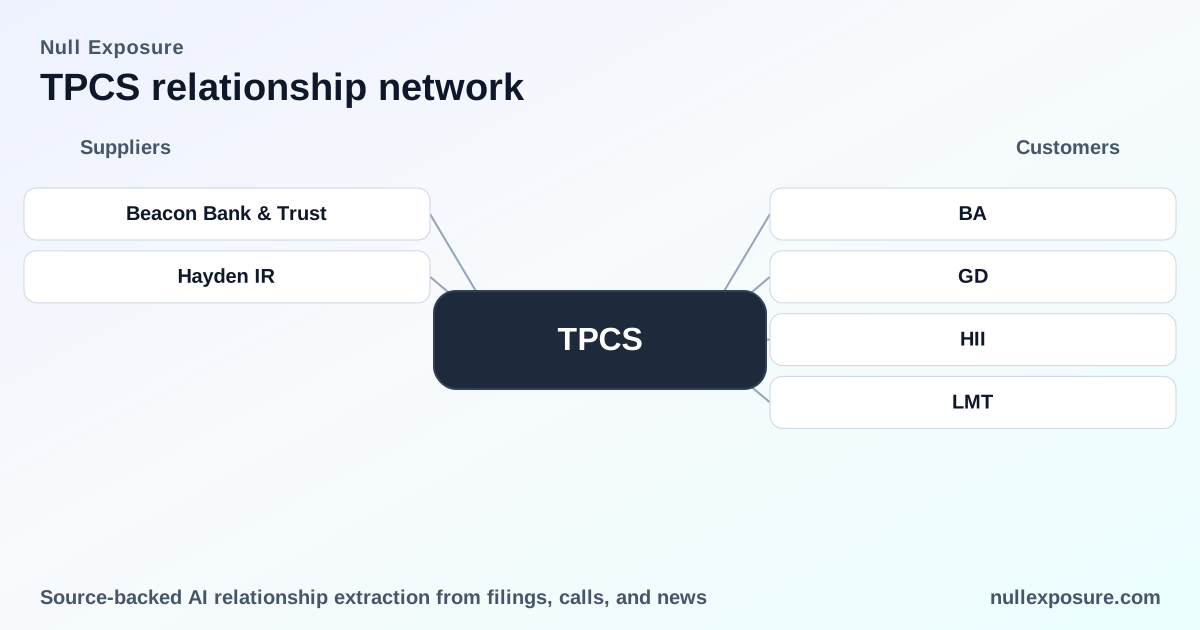
TechPrecision’s publicly visible counterparties in the supplied records break into two categories: one banking counterparty tied to a revolving credit amendment and one investor-relations vendor/contact that appears across filings and press releases. Below I summarize each relationship in plain English and cite the originating public item.
Beacon Bank & Trust — short-term amendment to the revolver
TechPrecision executed a change to its revolving credit agreement with Beacon Bank & Trust that moves the maturity date from January 16, 2026 to May 15, 2026, indicating a short extension rather than a long-term refinancing. According to a TradingView news post dated March 10, 2026, this amendment is the explicit change recorded in the company’s public disclosures. (Source: TradingView, March 10, 2026)
Hayden IR — investor-relations contacts recorded in filings and releases
Investor relations contacts for TechPrecision are listed as representatives of Hayden IR in multiple public items: a FinancialContent posting referencing the FY2024 annual meeting lists Richard D. Roomberg as the IR contact, and a later FY2026 press release lists Phillip Podgorski at Hayden IR as the IR contact on a quarterly results release. These contacts show Hayden IR is the outward-facing IR supplier for both FY2024 and FY2026 communications. (Sources: FinancialContent posting, Oct 14, 2024; AccessWire press release, March 2026)
How these relationships fit into TechPrecision’s operating model
The disclosed items form a narrow but revealing picture. A short-term revolver amendment and a stable IR vendor are not operational suppliers of materials, but they are meaningful to capital and market access. Consider these company-level signals:
- Concentration and supplier criticality are material. Company disclosures state that in fiscal 2025 four suppliers accounted for 10% or more of purchased material, and one supplier represented 27% of purchased material in fiscal 2025 (20% in fiscal 2024). That level of vendor concentration elevates single-supplier risk and gives a material supplier significant bargaining leverage over price and delivery. (Company disclosure excerpts, FY2025/FY2024)
- Contracting posture shows short-tenor financial management. The Beacon Bank amendment extends the revolver maturity only to May 15, 2026, consistent with a near-term liquidity focus rather than a definitive long-term refinancing. This suggests management is managing cash and credit on shorter cycles, making the company more sensitive to near-term covenant and liquidity shocks. (TradingView, March 2026)
- Supplier maturity and dependency skew toward a small set of large vendors. The repeated disclosure that one supplier represented a high percentage of purchased material across consecutive years signals structural dependence rather than transient concentration—this is a company-level operational constraint, not assigned to any single counterparty in the public excerpts.
Investment implications and risk map
For investors and operators evaluating TPCS supplier relationships, the interplay between supplier concentration and short-term financing posture defines the principal risks:
- Operational risk: With one supplier representing ~27% of purchases in FY2025, disruptions (logistics, quality, price increases) at that supplier would immediately affect cost of goods sold and potentially production continuity. This is a core single-supplier risk.
- Liquidity and covenant risk: The short extension of the revolver maturity implies management expects to address financing tasks within a brief window; if markets tighten or revenues slip, refinancing risk increases. The Beacon Bank amendment is a signal that near-term credit availability is actively managed.
- Market communications and governance: Use of Hayden IR as an external IR contact in multiple filings reflects an outsourced communications posture; this increases consistency of messaging but also centralizes investor outreach through a single vendor.
Key takeaways:
- High supplier concentration is material and persistent.
- Near-term financing amendments indicate elevated sensitivity to credit-market timing.
- External IR relationships add predictability to disclosures but do not mitigate supplier concentration risk.
If you are modeling downside scenarios, stress the cost and availability of the company’s largest suppliers and assume refinancing windows could become binding; for diligence and tracking, start with the two publicly visible counterparties above and expand to the major material suppliers identified in the company’s annual disclosures. For supplier risk monitoring tools, visit https://nullexposure.com/.
Actionable considerations for buy-side and ops teams
Operational and credit analysts should prioritize:
- Conducting counterparty due diligence on the largest material supplier that accounted for ~27% of purchases in FY2025 (identify the vendor from the company’s full filings).
- Stress-testing cashflows for a scenario where the revolver cannot be extended beyond May 2026 and assessing covenant headroom.
- Monitoring communications from Hayden IR as a leading indicator of management tone and potential corporate actions.
For procurement and supply-chain teams, negotiate dual-sourcing or contingency inventory for the disproportionately large supplier relationships; for credit teams, build an early-warning indicator for covenant slippage tied to working-capital swings.
Middle-of-article reminder: for an expanded supplier-risk framework and continuous monitoring, check https://nullexposure.com/.
Relationship list (concise, all disclosed counterparts)
- Beacon Bank & Trust — TechPrecision signed an amendment that moves the revolver maturity from January 16, 2026 to May 15, 2026, a short-term extension of its credit facility. (TradingView news, March 10, 2026)
- Hayden IR — Listed as the investor-relations contact in both an FY2024 annual-meeting notice (Richard D. Roomberg) and an FY2026 quarterly press release (Phillip Podgorski), indicating Hayden IR is the outsourced IR provider across multiple reporting periods. (FinancialContent, Oct 14, 2024; AccessWire, March 2026)
Bottom line and next steps for investors
TechPrecision’s public supplier footprint in these records is small but instructive: material supplier concentration combined with a short-tenor credit amendment creates a levered operational profile that investors must model explicitly. Prioritize discovery of the identity and contractual terms of the largest purchasing counterparty (the supplier responsible for 27% of purchases) and build scenarios around revolver renewal outcomes through May 2026.
For ongoing monitoring of supplier relationships and targeted counterparty intelligence, return to https://nullexposure.com/ for continuous signal coverage and tools to operationalize these observations.