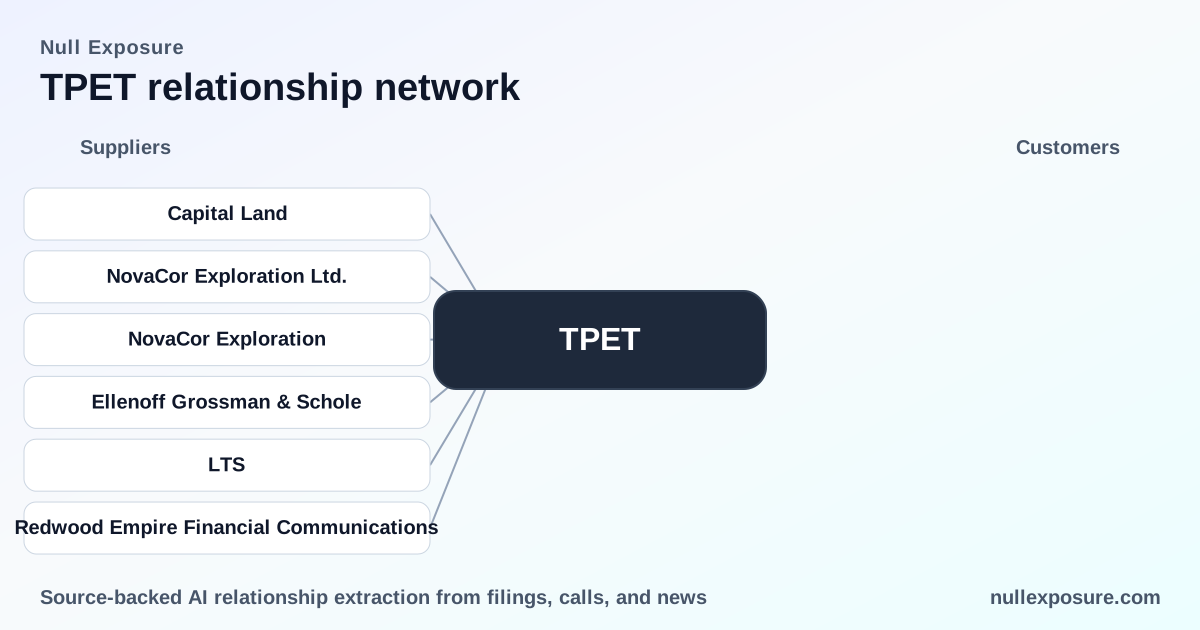
TPET supplier map: operators, agents and capital partners that move production to cash
Trio Petroleum (TPET) acquires producing heavy-oil assets in Saskatchewan through its Canadian vehicle, then monetizes those assets by producing cash flow and funding growth partially with equity-based purchase consideration and an at-the-market equity facility. The company’s commercial model is acquisition-led and outsourcing-heavy: TPET buys working interests and rights, often paying cash plus issuing restricted shares, then relies on third-party operators and local agents to run wells and satisfy local regulator requirements. For more detailed supplier intelligence and ongoing tracking, visit https://nullexposure.com/.
How TPET runs the business and where suppliers fit in
TPET’s model is built around small, targeted acquisitions of producing heavy-oil properties and rapidly converting them to cash flow. That model drives four structural supplier characteristics investors should weigh:
- Contracting posture: outsourced operations and regulatory delegation. TPET transfers operator responsibilities and regulatory licenses to local companies to meet Alberta Energy Regulator (AER) requirements, reducing in-house operating capital but increasing vendor dependency.
- Consideration mix increases counterparty complexity. TPET routinely combines cash and restricted-equity issuances as purchase consideration, which aligns sellers to future performance but dilutes shareholders and creates ongoing stakeholder relationships.
- Concentration and regional criticality. Recent transactions cluster in the Lloydminster / Saskatchewan heavy-oil corridor, concentrating operational risk geographically and making local operator performance and regulatory compliance critical.
- Early-maturity operating profile. The company’s leases and working interests are recent acquisitions; operational continuity depends on established local suppliers and agents rather than TPET’s internal infrastructure.
These dynamics make third-party operators, AER agents and capital markets counterparties central to execution and risk management. If you want regular updates on TPET’s evolving counterparty map and filings, check https://nullexposure.com/.
Relationship roster: who supplies what to TPET
Capital Land
Trio completed an acquisition of heavy-oil assets in Saskatchewan that originated with Capital Land, with the 10‑K noting the purchase closed in November 2025 through Trio Canada. The 10‑K also documents Capital Land receiving restricted shares upon closing and later acting as an AER agent with a 1% gross overriding royalty as compensation for those regulatory services. According to Trio’s FY2025 10‑K filing (tpet-2025-10-31), Capital Land is both a seller of assets and a service provider for regulatory administration.
NovaCor / Novacor Exploration Ltd. (multiple press reports)
TPET closed on multiple Saskatchewan heavy-oil assets acquired from Novacor; public releases describe the assets as producing, cash-flow positive properties and note that Novacor will remain the on-site operator for the acquired fields. A Globe and Mail press release and company announcements in April 2025 and March 2026 explain the Novacor transactions and that the deals closed in staged closings in 2025. (See Trio press releases on GlobeNewswire, The Globe and Mail, Rigzone and Yahoo Finance, March–April 2025–2026.)
Ellenoff Grossman & Schole
Trio filed a legal opinion from Ellenoff Grossman & Schole in connection with its at-the-market arrangements and SEC exhibits, indicating the firm provided counsel on the ATM legal opinion filed as Exhibit 5.1. TradingView reported the legal opinion reference in the ATM filing narrative (FY2026 ATM-related filing).
Ladenburg Thalmann & Co. Inc.
On January 9, 2026 Trio entered into an At-The-Market (ATM) sales agreement with Ladenburg Thalmann as sales agent, enabling the company to issue common shares from an existing shelf registration and expand equity financing capacity. A Globe and Mail press release covering Trio’s ATM program documents Ladenburg’s role as sales agent (press release, January 2026).
Redwood Empire Financial Communications
Redwood Empire is listed repeatedly as Trio’s investor relations contact in press releases announcing asset acquisitions and regulatory approvals, providing IR and disclosure support for the company’s market communications. Boereport and other press outlets list Redwood Empire’s Michael Bayes as the contact for investor relations in 2025–2026 press material.
Operational constraints and what they imply for counterparty risk
Several constraints identified in TPET’s public record shape how investors should think about supplier dependency.
- Geography concentration: Trio’s acquisitions are focused in the Lloydminster / Saskatchewan heavy-oil region, creating regional concentration risk and increasing the operational importance of local suppliers and regulators (company excerpt describing the December 30, 2025 Novacor asset closing in Lloydminster).
- Seller posture and equity consideration: TPET’s asset purchases commonly include both cash and share issuance as part of the purchase price, which aligns sellers to ongoing performance but increases shareholder dilution (April 2025 Novacor Asset Purchase Agreement description in Trio filings).
- Named operator and AER agent relationships: Novacor is documented to act as on-site operator for acquired assets, and Capital Land is used as an AER agent—Capital Land received a 1% gross overriding royalty in consideration for AER services—making these counterparties critical to day-to-day production and regulatory compliance (evidence in Trio’s FY2025 filings and related press releases).
- Capital markets service reliance: The ATM with Ladenburg and the legal opinion from Ellenoff Grossman & Schole underscore ongoing dependency on external financing agents and legal counsel to fund acquisitions and manage disclosure (ATM agreement disclosed in January 2026 filings and TradingView coverage).
When a constraint excerpt explicitly names a supplier—Novacor as operator, Capital Land as AER agent, Ladenburg as ATM agent—I attribute it to those relationships; other operational outsourcing notes (e.g., drilling contractors) function as company-level signals that TPET expects to continue relying on third-party service providers.
If you need a concise supplier risk scorecard or migration plan, visit https://nullexposure.com/ for tools and monitoring.
Investment implications — what to watch next
- Operator dependency: If Novacor underperforms or regulatory transfers stall, production and cash flow could be interrupted. Monitor AER license transfers and operator performance reports.
- Dilution risk: Equity issued as purchase consideration and ATM issuance capacity mean growth has explicit dilution trade-offs. Watch the pace of ATM sales and restricted-share vesting.
- Counterparty economics: Capital Land’s 1% override is small per asset but signifies long-term cost structures and ongoing royalty cash flows.
- Disclosure and market access: Reliance on external IR providers and sales agents increases the importance of transparent, timely filings and press releases.
Key actionable items for investors and operators: confirm operator KPIs and reporting cadence; verify AER license status; model dilution scenarios tied to ATM utilization; and track on-site operational performance by Novacor and any drilling contractors.
For ongoing intelligence and a supplier-focused view of TPET’s evolving counterparty map, return to https://nullexposure.com/.
In short: TPET’s model converts targeted Saskatchewan heavy-oil assets into cash via acquisitions that mix cash and equity, but the company’s execution and credit profile depend heavily on a small set of named local operators, agents and capital-market service providers. Investors should treat those supplier relationships as first-order drivers of near-term production stability and long-term capital efficiency.