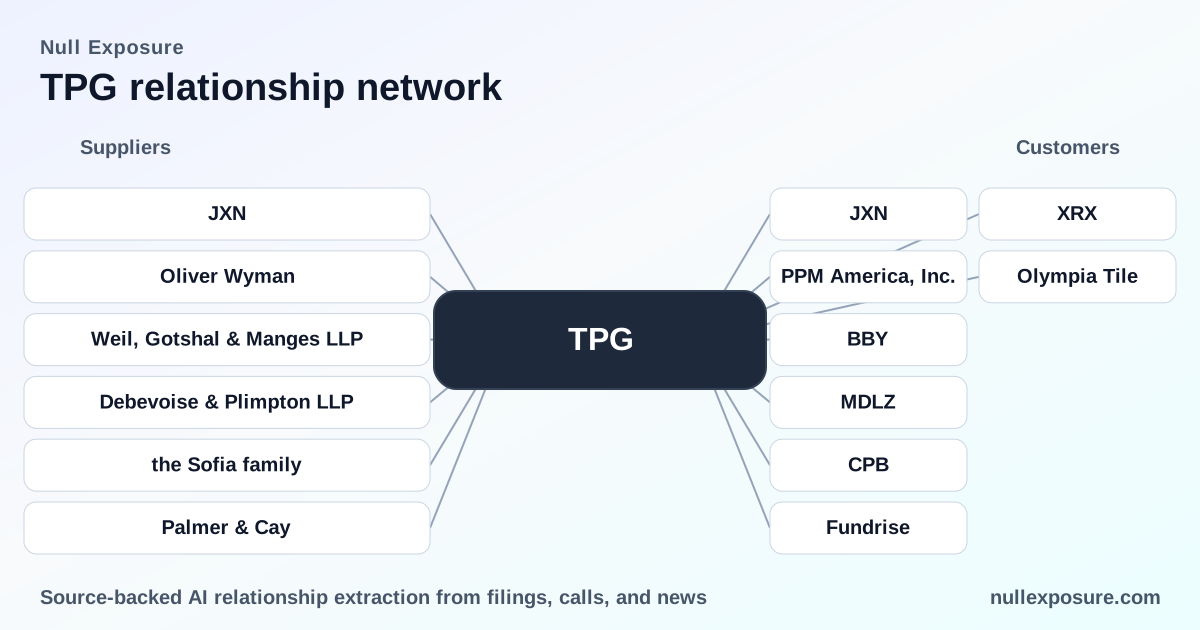
TPG’s supplier footprint: what investors need to know
TPG operates as a global alternative asset manager that monetizes through management fees, performance fees and carrying a balance of invested capital across private equity, credit, real estate and insurance platforms. The company supplements internal investment teams with external advisors, law firms, and distribution and underwriting partners to scale product launches and manage regulatory and actuarial complexity—generating fee income while retaining capital appreciation upside.
If you want a concise supplier playbook for capital-allocation decisions, start here: https://nullexposure.com/
Why the supplier map matters for valuation and operational risk
TPG’s supplier relationships show a deliberate mix of long-term strategic partnerships and high-quality professional advisors. Investors should treat these relationships as operational levers that influence product rollout speed, regulatory execution and margin capture.
- Contracting posture: The firm contracts with large, sophisticated counterparties for settlement, custody and financing. That posture reduces execution risk but raises dependency on counterparty credit and operational continuity (company disclosure on settlement/clearing and bank financing).
- Concentration and geography: Investment activity spans North America and APAC, exposing operational processes to cross-border custody, FX and regulatory variance—useful for assessing where operational headwinds or growth tailwinds will concentrate.
- Criticality and maturity: Several supplier engagements are either regulatory- or transaction-critical (legal, actuarial) and at least one strategic JV or management engagement carries a multi-year term structure, indicating materiality and durable integration into the business model.
- Service-provider reliance: Custodians, administrators and prime brokers perform functions central to fund operations; their availability and performance are integral to fee realization and fund NAV integrity.
Explore how supplier risk changes portfolio outcomes at https://nullexposure.com/ — practical market intelligence for investors.
Supplier relationships: concise investor digest
Below are every relationship noted in the assembled media and public filings for the period in question, with a plain-English summary and source reference.
Jackson Financial Inc. (JXN)
TPG entered a non-exclusive 10-year investment-management arrangement (with automatic 1‑year renewals through year 15) to provide Investment Grade Asset Based Finance and Direct Lending capabilities that complement PPM America, a Jackson subsidiary; the agreement signals a durable revenue stream from outsourced asset-management services. (Business Wire press release, Jan 6, 2026 — https://markets.financialcontent.com/pentictonherald/article/bizwire-2026-1-6-jackson-financial-inc-and-tpg-inc-announce-long-term-strategic-partnership)
Oliver Wyman
Oliver Wyman served as TPG’s actuarial advisor on the Jackson transaction, providing formal actuarial support that underpins insurance- and liability-linked structuring for the partnership. (Business Wire press coverage, Jan 2026 — https://markets.financialcontent.com/stocks/article/bizwire-2026-1-6-jackson-financial-inc-and-tpg-inc-announce-long-term-strategic-partnership)
Weil, Gotshal & Manges LLP
Weil advised TPG on corporate and regulatory matters related to the Jackson strategic partnership, reflecting the need for top-tier regulatory counsel in multi-jurisdictional financial arrangements. (Business Wire press coverage, Jan 2026 — https://markets.financialcontent.com/stocks/article/bizwire-2026-1-6-jackson-financial-inc-and-tpg-inc-announce-long-term-strategic-partnership)
Debevoise & Plimpton LLP
Debevoise served as TPG’s legal counsel on the same transaction, reinforcing the use of multiple elite law firms to cover transaction and governance workstreams. (Business Wire press coverage, Jan 2026 — https://markets.financialcontent.com/stocks/article/bizwire-2026-1-6-jackson-financial-inc-and-tpg-inc-announce-long-term-strategic-partnership)
the Sofia family / Broad Street Development / TPG Angelo Gordon
JLL represented the Sofia family in a sale where the buyer was a joint venture of Broad Street Development and TPG Angelo Gordon, illustrating TPG’s operational involvement in real estate joint-ventures and third-party capital aggregation for asset conversions. (JLL newsroom, 2025 transaction coverage — https://www.jll.com/en-us/newsroom/broad-street-development-pays-for-tribeca-conversion-opportunity)
Palmer & Cay
Palmer & Cay partnered with TPG on a new insurance business led by industry veteran Brian Bair, indicating TPG’s strategy to seed insurance operations through partnerships with established distribution and service-platform firms. (Sahm Capital news commentary, Feb 6, 2026 — https://www.sahmcapital.com/news/content/tpg-launches-third-wave-insurance-as-earnings-mix-evolves-2026-02-06)
What these suppliers mean for operations and valuation
The documented supplier set demonstrates a clear operating logic: TPG leverages external expertise to accelerate product launches while retaining fee-bearing economics. Legal and actuarial advisors support regulatory compliance and risk transfer structures that enable TPG to enter capital-intensive lines such as insurance and structured credit. The Jackson long-term management agreement is a concrete example of converting capability into contracted, fee-bearing revenue.
Key investor takeaways:
- Durable contracts bolster revenue visibility. The Jackson 10-year initial term is an example of multi-year locking that underpins valuation models for fee businesses.
- High-quality advisors reduce execution risk but increase fixed-cost obligations. Engagement of firms like Debevoise and Weil signals sophisticated, likely expensive legal/regulatory workstreams that are necessary for complex transactions.
- Geographic diversification drives both opportunity and complexity. Active presence across North America and APAC increases addressable markets while adding cross-border operational and compliance cost considerations.
- Service-provider dependence is material. The firm’s reliance on custodians, prime brokers and banks for settlement and financing creates a concentration vector that is operationally critical.
Constraints and corporate signals investors should model
Company-level disclosures describe a supplier universe concentrated among large global financial institutions and banks for settlement and financing, and third-party service providers for custody and fund administration — these are structural constraints on operations rather than one-off vendor choices. The filings also flag material consequences from information-security failures, positioning cybersecurity as a financial and reputational risk that can directly affect results of operations. Geography evidence shows concentrated exposures across North America and APAC, which should be modeled into stress scenarios for regulatory and market-volatility risk.
If you want a structured supplier risk matrix linked to these signals, use this as a starting point: https://nullexposure.com/
Final read: action points for investors
TPG’s supplier relationships reflect a strategic trade-off: using elite external partners accelerates entry into complex asset classes and supports fee revenue growth, while creating operational dependencies and predictable legal/regulatory spend. Investors should prioritize monitoring (1) the performance and renewal terms of long-dated management agreements, (2) counterparty concentration among custodians and financing banks, and (3) the effectiveness of information-security controls that are explicitly called out as material.
For targeted diligence and supplier-led scenario analysis, visit https://nullexposure.com/ — market-focused intelligence for allocators and operators.