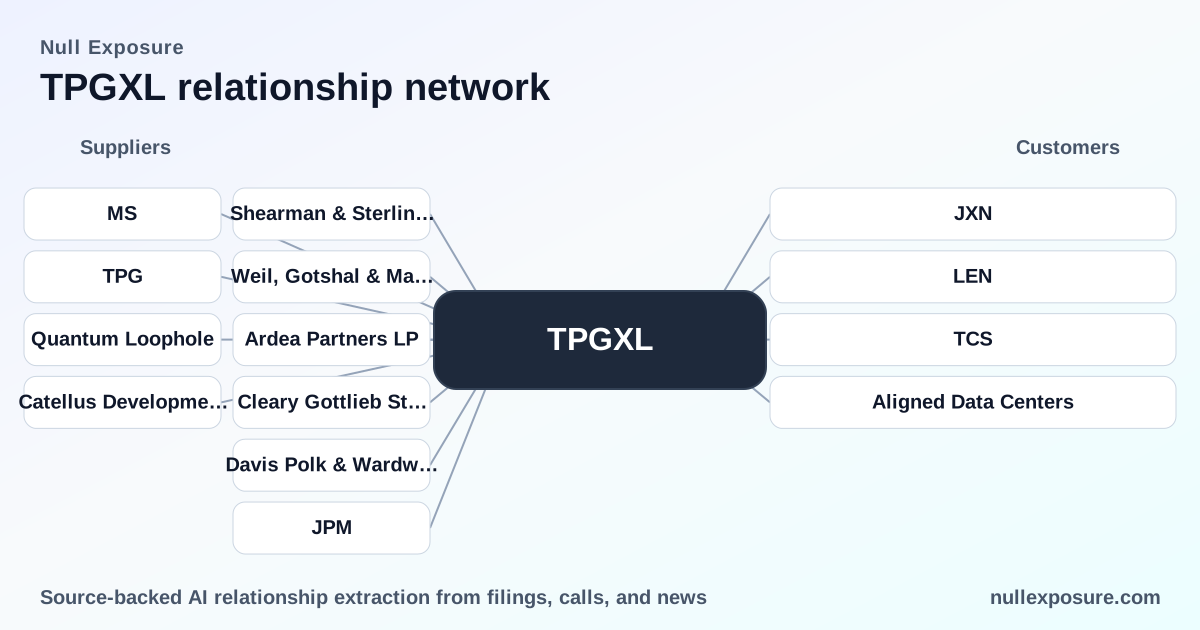
TPGXL: who supplies the firm that issues the 6.95% junior notes — and what investors should price
TPG Operating Group II issues long‑dated junior subordinated notes that deliver a fixed-income stream to investors while the firm’s underlying economics are driven by private equity, credit and real estate investments and fee generation across its funds. TPG monetizes through management and performance fees, carried interest on exits, and balance‑sheet financing that supports strategic acquisitions and platform builds; the junior notes are a financing layer that sits below senior debt and above equity in the capital stack, delivering yield in exchange for subordination and duration risk. For a concise supplier-risk view and deeper supplier relationships mapping, visit https://nullexposure.com/.
Why supplier relationships matter to TPGXL investors
TPG’s operational profile is not just an asset manager story — it’s a structured finance and platform operator story. Legal advisers, investment banks, fairness‑opinion firms and project managers influence transaction execution, regulatory exposure, and the viability of large strategic plays that underwrite the firm’s cash flows. For holders of TPGXL notes, those relationships influence refinancing capacity, transaction costs, and litigation or execution risk that can affect cashflow available to service subordinated securities.
Explore supplier-risk analytics and relationship provenance at https://nullexposure.com/ for a vendor-centric view.
Operating constraints that shape supplier risk
Company-level disclosures and public commentary create a set of operating signals investors must translate into credit and operational risk:
- Contract horizon is mixed but consequential. Filings disclose multi‑year revolving facilities scheduled to mature in 2028 and shorter 364‑day facilities (Mizuho) used for working capital, indicating the firm runs both long‑term and short‑term funding structures that need active management.
- Counterparties are large global institutions. Settlement, clearing and depository arrangements are handled by major financial institutions, which reduces provider fragility but increases systemic exposure to financial-market stress.
- Service relationships are material. TPG states that failures in financing markets, IT systems, or third‑party service provision could have a material adverse effect on its funds and operations — a direct signal that supplier disruptions carry financial impact.
- Supplier role is operational rather than vendor‑agnostic. The firm explicitly depends on custodians, administrators, prime brokers, advisors and external consultants to execute core activities; this is a structural dependency investors must monitor.
Collectively, these constraints point to a contracting posture where continuity of service and access to capital are critical — not peripheral — to noteholders’ risk calculus.
Relationship roll call: who TPG works with and why
Shearman & Sterling LLP
Shearman advised TPG on tax and executive compensation matters in connection with a strategic acquisition. According to Markets Media (March 10, 2026), Shearman was part of TPG’s legal advisory team for the Angelo Gordon transaction. Source: https://www.marketsmedia.com/tpg-to-acquire-angelo-gordon-for-2-7bn/
Weil, Gotshal & Manges LLP
Weil served as TPG’s lead transaction counsel on the Angelo Gordon acquisition, handling primary deal documentation and closing mechanics. TPG’s own news release confirms Weil’s role (March 10, 2026). Source: https://www.tpg.com/news-and-insights/tpg-completes-acquisition-of-angelo-gordon
Ardea Partners LP
Ardea Partners acted as lead financial advisor and provided a fairness opinion to TPG’s Board for the Angelo Gordon deal, a governance control that underpins valuation justification. Markets Media and TPG’s release both identify Ardea’s advising and fairness-opinion role (March 10, 2026). Sources: https://www.marketsmedia.com/tpg-to-acquire-angelo-gordon-for-2-7bn/; https://www.tpg.com/news-and-insights/tpg-completes-acquisition-of-angelo-gordon
Cleary Gottlieb Steen & Hamilton LLP
Cleary provided advice on investment fund matters connected to the Angelo Gordon transaction, supporting fund structure and regulatory considerations. Markets Media notes Cleary’s role on March 10, 2026. Source: https://www.marketsmedia.com/tpg-to-acquire-angelo-gordon-for-2-7bn/
Davis Polk & Wardwell LLP
Davis Polk advised on tax, executive compensation, and fund-related issues as part of the legal advisory cohort for the Angelo Gordon transaction, reinforcing transaction-level compliance and structuring. Cited in both Markets Media and TPG’s announcement (March 10, 2026). Sources: https://www.marketsmedia.com/tpg-to-acquire-angelo-gordon-for-2-7bn/; https://www.tpg.com/news-and-insights/tpg-completes-acquisition-of-angelo-gordon
J.P. Morgan Securities LLC (JPM)
J.P. Morgan acted as a financial advisor to TPG on the Angelo Gordon acquisition, providing strategic financing and deal advisory services that help shape funding and syndication. Identified in Markets Media and corroborated by TPG’s release (March 10, 2026). Source: https://www.marketsmedia.com/tpg-to-acquire-angelo-gordon-for-2-7bn/
Morgan Stanley & Co. LLC (MS)
Morgan Stanley served as a financial advisor alongside J.P. Morgan, advising on transaction structuring and potential financing pathways for the Angelo Gordon deal. Markets Media and TPG list Morgan Stanley in the advisor group (March 10, 2026). Source: https://www.marketsmedia.com/tpg-to-acquire-angelo-gordon-for-2-7bn/
Quantum Loophole
TPG is seeking a court order to remove Quantum Loophole from its role managing a planned $5 billion data‑center campus in Maryland, signalling a contested project-management relationship with execution and legal risk. DatacenterDynamics reported on TPG’s move to replace Quantum Loophole (March 10, 2026). Source: https://www.datacenterdynamics.com/en/news/tpg-seeks-to-remove-quantum-loophole-from-5bn-maryland-data-center-project/
Catellus Development Corporation
Catellus Development Corporation is slated to replace Quantum Loophole as the TPG affiliate that would manage the Maryland data‑center campus, shifting operational responsibility to a TPG affiliate and reducing reliance on an external manager. DatacenterDynamics identifies Catellus as the intended replacement (March 10, 2026). Source: https://www.datacenterdynamics.com/en/news/tpg-seeks-to-remove-quantum-loophole-from-5bn-maryland-data-center-project/
What the relationship map implies for TPGXL investors
- Legal and advisory depth is a positive for execution. Engagement of top-tier law firms and major banks indicates access to high‑quality transactional capability, reducing execution risk on complex acquisitions and licensing work.
- Concentration of counterparties among global banks reduces idiosyncratic vendor risk but increases systemic exposure. Reliance on large financial institutions for settlement and financing improves resilience in normal markets but elevates systemic correlation in stress.
- Operational execution risk is tangible on marquee projects. The dispute with Quantum Loophole and the move to install an affiliate operator (Catellus) show that TPG will internalize critical project execution when external management conflicts threaten timelines and cash flow.
- Refinancing and liquidity are active levers. Mixed short-term and long-term borrowing facilities require active liquidity management; the firm’s own disclosures flag that adverse financing conditions can have material effects on funds and, by extension, on obligations to note investors.
For an investor-focused supplier risk dashboard and continuous monitoring of these relationships, visit https://nullexposure.com/.
Practical monitoring checklist for underwriters and noteholders
- Track counsel and advisor continuity on large deals — changes or departures among lead counsel/advisors are material signals.
- Monitor project-management disputes that can delay cash flow (Quantum Loophole litigation is a near-term item).
- Watch rolling maturity dates and short‑term facilities; a stressed refinancing market elevates credit risk for subordinated securities.
- Confirm custodial and prime‑broker counterparties and counterparty limits to evaluate concentration.
Bottom line and next steps
TPGXL investors should treat supplier relationships as first-order credit and execution signals. High-end legal and banking relationships give TPG strong transactional horsepower, while the Quantum Loophole replacement illustrates how operational disputes can force rapid governance decisions with financial consequences. Maintain active surveillance on financing maturities and project execution outcomes to protect yield and capital.
For a deeper supplier‑risk assessment and curated relationship intelligence tailored to fixed‑income investors, go to https://nullexposure.com/ and request the supplier-map report.