TPTA Supplier Map: Who Runs Terra Property Trust’s Operations and What It Means for Investors
Terra Property Trust (TPTA) operates as an externally managed REIT that monetizes real estate ownership through income-generating commercial and residential assets and a dividend distribution strategy. The company outsources day-to-day investment management and operational functions to an advisor/manager and engages financial agents for investor-facing transactions, with financing structures that concentrate cost and execution risk. Investors should view TPTA as a management-levered REIT where service-provider relationships drive performance, expense cadence, and refinancing risk. Learn more about supplier exposure and monitoring at https://nullexposure.com/.
How TPTA makes money and why suppliers matter
TPTA’s economics depend on two linked pillars: (1) asset-level cash flow from leased properties and (2) the external manager’s execution of property-level strategy and capital transactions. The manager is compensated for investment management and operational services, meaning the company’s margin and distributable cash flow are materially determined by that contractual relationship and by the company’s financing costs. Financing is a primary expense line and a lever for returns; when interest expense dominates the income statement, the manager’s ability to optimize capital structure directly affects shareholder distributions.
Contracts, concentration and constraint signals investors should track
Company-level documents and press materials show long-term contracting posture, high spend concentration, and a service-driven operating model:
- The management agreement includes an Initial Term through December 31, 2027 with automatic one-year renewals, indicating multi-year dependence on an external manager and a structural renewal path.
- Financing disclosures reference a term loan with principal totaling $123.5 million and maturities tied to late-2027, signalling concentrated refinancing risk around that calendar window.
- Fee tables in public filings record tens of millions in fees and reimbursements paid to the manager ($17.4M–$22.7M in the cited tables), placing the relationship squarely in the material-to-large spend band for the firm.
- Management and investment services are the company’s operational core; therefore, service provider performance is a direct operational risk rather than a peripheral cost item.
These are company-level signals about operating model and supplier criticality; they are not assigned to an individual vendor unless explicitly named in the underlying evidence.
Who the suppliers are — the full list and what they do
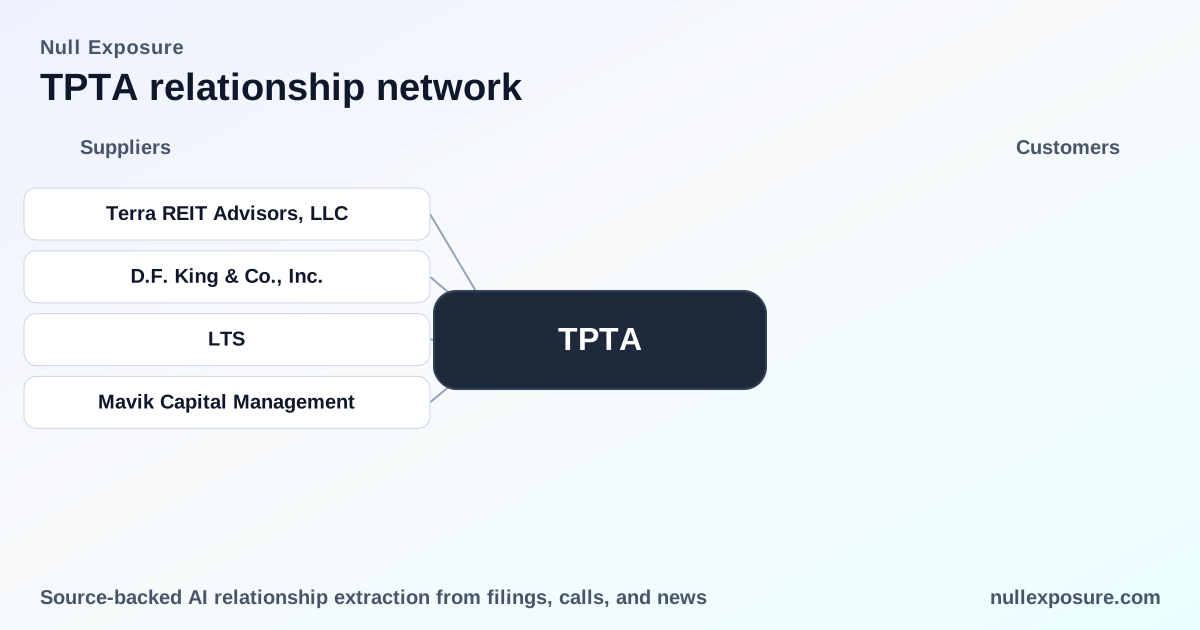
Below I cover every supplier relationship surfaced in the reporting set and provide a short, plain-English explanation with source context.
Terra REIT Advisors, LLC
Terra REIT Advisors is the company’s external manager and advisor; it provides day-to-day investment management and operational services under a management agreement that runs through December 31, 2027 and renews automatically thereafter. According to multiple investor releases (webcast and investor-update mentions across 2024–2026) the firm is an affiliate of Mavik Capital Management and is the primary operator of TPTA’s business. (GlobeNewswire, Feb 20, 2026; investor communications 2024–2025)
D.F. King & Co., Inc.
D.F. King is acting as the exchange agent and information agent for TPTA’s registered exchange offers and consent solicitation, supporting holder communications and solicitation logistics for capital structure actions. This places D.F. King in a transaction-critical role for any debt or equity reorganization tied to the offer. (GlobeNewswire, Feb 20, 2026)
Ladenburg Thalmann & Co. Inc.
Ladenburg Thalmann is serving as the dealer manager for TPTA’s exchange offers and consent solicitation, which means it coordinates distribution and investor outreach for the transaction and fees for that service will flow from the company during the solicitation period. (GlobeNewswire, Feb 20, 2026)
Mavik Capital Management
Mavik Capital Management is the affiliated asset-management parent connected to Terra REIT Advisors; reporting around 2023 cited Mavik as the manager in strategic discussions and in a proposed combination with Western Asset. Mavik provides the executive and investment team resourcing that underpins TPTA’s asset strategy. (HousingWire, FY2023)
What these relationships imply for investors
- Operational dependence on an external manager is high. The management agreement’s term structure and fee profile mean that a significant portion of asset-level returns is routed to a third-party service provider. Investors should treat manager performance as a first-order driver of distributions.
- Financing is the dominant expense and a concentration risk. Public excerpts identify a material term loan and interest expense as the largest line item — making refinancing timing, rates, and lender relationships critical to near-term liquidity and dividend sustainability.
- Transactional intermediaries are active and necessary. D.F. King and Ladenburg Thalmann handle exchange and solicitation mechanics; their engagement indicates management is pursuing capital-structure adjustments that investors should follow closely for dilution or liability management outcomes.
- Spend magnitude is not immaterial. Documented fee/reimbursement totals place the manager payments in the multi‑million-dollar range, creating an ongoing cost drag that scales with the company’s activity level.
Risk profile and governance implications
- Concentration risk: The company’s operational model concentrates execution risk in a single external manager and a narrow financing maturity window (late 2027). That creates a predictable calendar where investor attention should be highest.
- Contracted control: Long-term management agreements with automatic renewals reduce immediate termination optionality, raising the bar for investors seeking governance change without negotiated buyouts.
- Transaction dependence: Active engagement of dealer managers and exchange agents signals that corporate actions are in play; these transactions can reset capital structure and investor economics quickly.
If you track TPTA, set calendar reminders for the 2027 financing horizon and monitor management-fee disclosure lines in quarterly releases.
Learn more about supplier risk monitoring and view related coverage at https://nullexposure.com/.
Practical next steps for investors and operators
- Review the management agreement and fee schedules to quantify the manager’s drag on distributable cash flow and model scenarios for termination or renegotiation costs.
- Stress-test the balance sheet for a late‑2027 refinancing event at higher interest rates and estimate dividend sensitivity to rising financing costs.
- Monitor notices and filings tied to exchange offers and consent solicitations — engagement of D.F. King and Ladenburg Thalmann signals active capital-structure work that requires swift investor evaluation.
For model templates, monitoring tools and curated relationship intelligence for TPTA and comparable REITs, visit https://nullexposure.com/.
Bottom line
TPTA’s operating economics are externally managed and financing‑sensitive. Terra REIT Advisors (affiliated with Mavik) is the operational fulcrum, while D.F. King and Ladenburg Thalmann are engaged for discrete capital transactions. Investors should treat the manager relationship and the 2027 financing timeline as the two dominant axes of risk and opportunity when evaluating TPTA exposure. Explore supplier-level analytics and ongoing monitoring at https://nullexposure.com/.