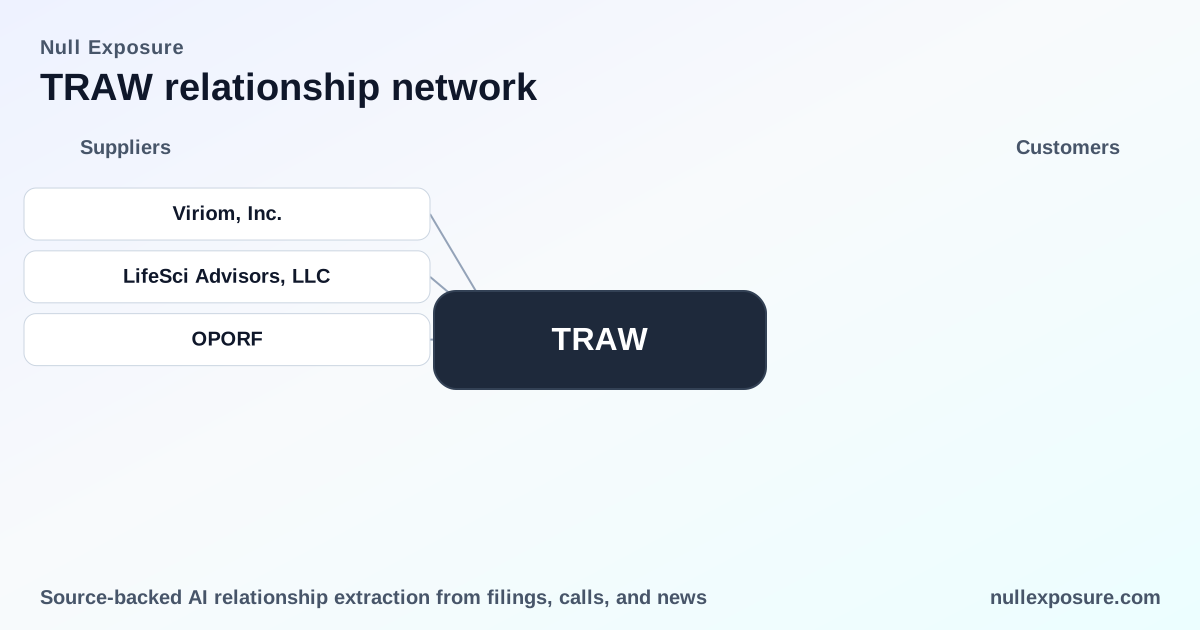
Traws Pharma (TRAW) — supplier relationships, operational posture, and investor implications
Traws Pharma is a clinical-stage biopharmaceutical company developing antiviral and oncology candidates; it advances programs through early- and mid-stage clinical work and monetizes primarily through clinical progress, asset transactions, and partnership or licensing arrangements rather than product sales today. With a modest market capitalization (approximately $19.4 million) and limited revenue (roughly $2.85 million TTM), the company’s value will be realized through successful clinical readouts, strategic asset sales, and commercialization partnerships that extract value from its intellectual property and clinical data.
For investors evaluating Traws as a supplier-dependent operator, the supplier map and the company’s own disclosures reveal a classic small-cap biotech operating model: asset-centric, heavily outsourced, and binary around clinical inflection points. If you want immediate, structured supplier intelligence on Traws, visit Null Exposure for an integrated view of counterparties and risk signals: https://nullexposure.com/
How suppliers shape the business model and risk profile
Traws runs a capital-efficient, outsourced development model. Company disclosures and public press activity make the following operating characteristics clear:
- Contracting posture — outsourced and transaction-driven. Traws explicitly relies on third-party CROs, manufacturers, and specialized service providers to execute trials, manage clinical data, and produce investigational material. The business buys execution capability rather than building large internal development teams.
- Concentration — a small set of critical partners. Clinical-stage companies of this scale are effectively single-program dependent; delays or issues with a handful of CROs or manufacturers translate directly into program and corporate-level risk.
- Criticality — third parties are mission-critical. Disclosures state that a cybersecurity incident at a vendor or other third-party service provider "could have a material and adverse impact on our business, results of operations and financial condition," underlining vendor criticality for continuity and regulatory compliance.
- Maturity — early-stage operational footprint. As a clinical-stage firm, Traws’ supplier relationships are transactional and short-to-medium term (trial execution, manufacturing for trials, challenge study arrangements), not long-term manufacturing scale relationships.
These characteristics mean supplier diligence is not auxiliary — it is central to evaluating Traws’ execution risk and valuation pathway.
Supplier relationships investors should know: Viriom, LifeSci Advisors, hVIVO
Viriom, Inc.
Traws executed an Asset Purchase Agreement with Viriom, Inc. in which Traws purchased key intellectual property and other assets associated with a pyrrolidine antiviral compound, reflecting an inorganic route to program expansion and IP consolidation. According to a GlobeNewswire press release (Nov 13, 2025), the transaction transferred those antiviral assets into Traws’ portfolio as a related-party transaction, signaling active balance-sheet management and strategic asset aggregation (GlobeNewswire, Nov 13, 2025).
LifeSci Advisors, LLC
LifeSci Advisors is listed as the investor relations contact on recent Traws filings and releases; the firm functions as the company’s IR/service-provider to manage communications with the market and investors. Traws identified John Fraunces of LifeSci Advisors as investor contact in a January 13, 2026 press release, indicating LifeSci Advisors is the retained communications advisor for investor outreach (GlobeNewswire, Jan 13, 2026).
hVIVO (operator: Open Orphan/OPORF)
Traws plans to run a seasonal influenza prophylaxis challenge study and other bridging healthy volunteer studies at hVIVO, a contract research organization specializing in human challenge trials, which positions hVIVO as a core clinical execution partner for certain antiviral development pathways. Multiple public reports — including company releases and coverage on Yahoo Finance and a local news outlet (MyChesco) in early 2026 — note that hVIVO is the selected CRO for planned challenge studies beginning in mid-2026, underscoring its operational role for the TXM program (GlobeNewswire, Jan 26, 2026; Yahoo Finance, March 2026; MyChesco, early 2026).
What the supplier map tells investors about value drivers and risks
- Value drivers. The Viriom IP purchase expands Traws’ asset base and creates optionality for licensing or downstream partnerships; engagement with specialist CROs like hVIVO enables rapid execution of human challenge studies, which can materially shorten the timeline to pivotal efficacy signals and thereby increase asset value.
- Execution risks. Reliance on external manufacturers and CROs concentrates program risk. Company disclosures explicitly acknowledge dependence on third-party manufacturers and CROs for clinical programs; a vendor interruption or quality issue directly delays clinical milestones and dilutes valuation.
- Operational risks beyond trials. The company also depends on third-party infrastructure for email, cloud services, and authentication — a vendor cybersecurity incident is categorized as a material business risk in the company’s disclosures, making vendor cyber posture an investment-relevant KPI.
- Commercialization implications. Given current scale, Traws is positioned to monetize through asset sale/licensing and partnerships rather than direct commercialization, so supplier relationships that enable clear, de-risked clinical data are directly correlated with favorable deal-making leverage.
If you want to benchmark Traws’ supplier exposure against peers or get counterparty scoring and remediation recommendations, Null Exposure maintains curated supplier profiles that accelerate counterparty due diligence: https://nullexposure.com/
Risk checklist for near-term monitoring
- Confirm timelines and contractual terms with hVIVO for the planned June 2026 challenge study, including liability, data ownership, and remedial clauses.
- Assess regulatory and manufacturing readiness for the pyrrolidine antiviral assets acquired from Viriom, including CMC responsibilities and transfer risk.
- Review the company’s vendor ecosystem for infrastructure and data hosting, and ask for third-party SOC/ISO attestations to address the stated cybersecurity materiality risk.
- Track press releases and investor communications routed through LifeSci Advisors to validate milestone claims and timing consistency.
Bottom line: key takeaways and investor actions
- Traws is a small, asset-driven biotech that monetizes through clinical progress, IP transactions, and partner deals rather than product sales. The Viriom purchase and hVIVO engagement are strategic supplier moves that increase program optionality and compress time-to-evidence for antiviral programs.
- Supplier dependence is high and material. The firm’s own disclosures treat third-party CROs, manufacturers, and infrastructure vendors as core execution risk points; vendor cyber incidents are explicitly identified as material.
- Active supplier diligence is table stakes for investors. Review contract terms, proof of vendor controls, and milestone linkage to payments; align any valuation thesis with the robustness of those supplier arrangements.
For a deeper, counterparty-level dossier on Traws and to validate supplier controls before underwriting exposure, see Null Exposure’s supplier intelligence and monitoring tools at https://nullexposure.com/ — they consolidate the public filings, press releases, and operational signals that matter for investor-grade due diligence.