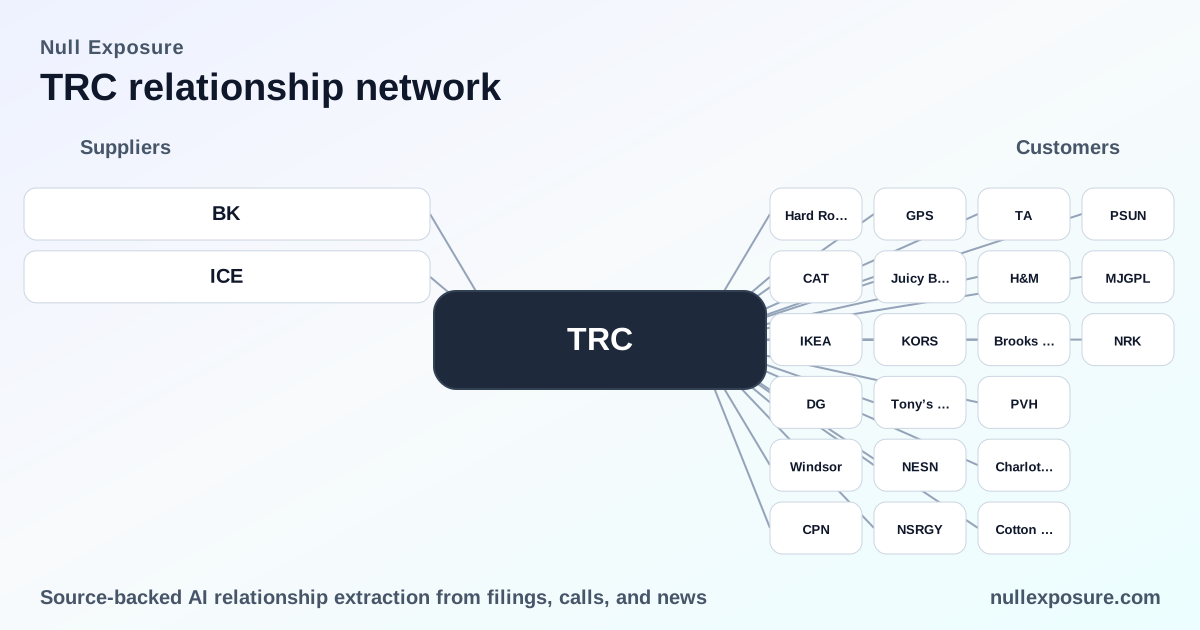
Tejon Ranch (TRC) — Supplier relationships that shape operating leverage and risk
Tejon Ranch Co. is a diversified agribusiness and land‑development company that monetizes through agricultural production, long‑cycle real estate development and selective asset sales, supported by water supply agreements and external financing. For investors assessing TRC as a supplier customer or counterparty, the company’s supplier relationships reveal a classic mix of long‑dated utility and credit commitments plus targeted, higher‑intensity professional services, which together determine operational continuity and funding optionality. Visit https://nullexposure.com/ for a consolidated view of supplier exposures and monitoring tools.
Why supplier relationships matter for TRC’s valuation and operating risk
Tejon’s business model is capital‑intensive and location‑specific. Water supply and access to capital are structural inputs that govern both near‑term agricultural cash flow and the timing of large‑scale development projects. Supplier relationships therefore are not peripheral — they are core operational levers.
Key operating-model signals from TRC’s disclosures:
- Contracting posture: a mix of long‑term anchor contracts (water supply) and shorter, tactical engagements (consulting services). Long maturities lock in inputs but create rollover risk at contract end dates.
- Concentration and criticality: water suppliers and the company’s credit facility are high‑criticality partners because interruptions or repricing would directly constrain farming output and development timelines.
- Spend scale and predictability: mid‑single‑million annual outlays for contracted water and targeted professional fees indicate predictable recurring cash requirements rather than open‑ended vendor expense.
- Maturity profile: multi‑year water rights through 2035 and a revolving credit facility with a 2029 maturity date create identifiable refinancing and operational checkpoints for investors.
These are company‑level signals drawn from TRC’s filings and corporate disclosures; the details below map the specific relationships visible in market reports and news coverage. If you want an ongoing supplier risk feed for TRC, check https://nullexposure.com/ for live updates.
Who TRC works with — what public reporting shows
Below are the supplier and counterparty relationships surfaced in recent market coverage and filings. Each relationship is summarized in plain language with a source reference.
Bank of New York‑Mellon — subscription agent for equity rights offering
Bank of New York‑Mellon acted as the subscription agent for a Tejon Ranch rights offering, processing allocations for the issuance of 2.61 million common shares; reporting notes that 1.92 million shares were issued via basic subscription privileges and 688,860 via over‑subscription. This is a financial services engagement tied to capital markets execution. (RTTNews coverage of the rights offering; referenced in company disclosures dating to the stated offering period.)
New York Stock Exchange — venue for investor engagement and public listing services
Tejon Ranch hosted an Investor Engagement Event at the New York Stock Exchange to present its strategic vision to the investor community, signaling active investor relations and public‑market engagement. The NYSE relationship is typical for listed companies and affects disclosure cadence and visibility rather than operational supply. (TradingView report covering TRC’s FY2025 investor engagement event.)
Constraints and what they imply for supplier risk and diligence
The company’s disclosures include a set of constraints and contract excerpts that illuminate supplier dynamics. These are company‑level signals rather than ties to a single supplier unless the excerpt explicitly names the partner.
- Long‑term water supply contracts run through 2035. TRC holds water contracts for State Water Project deliveries that allocate annual water for 5,487 acres (15,547 acre‑feet) subject to SWP allocations; the company recorded payments of $5,483,000 (2024) and $4,492,000 (2023) for these contracts and related costs, underscoring a multi‑year, material cash outflow tied to agricultural operations (company filing disclosures as of December 31, 2024).
- Material committed financing capacity with a defined maturity profile. The Revolving Credit Facility provides a revolving commitment of $160 million plus a $15 million letter‑of‑credit subfacility; interest‑only payments are required and the facility matures January 1, 2029 — a clear refinancing horizon for the company’s liquidity plan (company credit‑facility disclosure).
- Targeted short‑term professional services. A consulting agreement entered in 2024 for executive strategic counsel runs one year (April 1, 2025–March 31, 2026) at $85,000 per month, representing a discrete, high‑intensity spend item in the $1m–$10m band when aggregated and aligned with other recurring vendor costs.
- Geographic concentration in California’s San Joaquin Valley. Water contracts and agricultural operations are regionally concentrated, introducing shared environmental and regulatory risk across suppliers and operations.
Together these constraints imply a contracting posture that emphasizes operational continuity via long‑dated utility contracts and an explicit near‑term financing deadline. For suppliers and investors, the combination of predictable medium‑sized spend and concentrated geography elevates the importance of monitoring contract renewals, regulatory shifts, and capital markets access.
If you’re evaluating supplier exposure for TRC or comparable agribusiness developers, detailed monitoring of contract maturities and spend bands is essential — learn how we track these signals at https://nullexposure.com/.
How investors should read these relationships and act
- Prioritize diligence on water contract terms and allocation mechanics (quantity, priority, and cost pass‑through provisions) because water supply is a direct input to revenue generation for TRC’s agricultural segment.
- Treat the $160M RCF and $15M LOC sub‑facility as a financial dependency with a clear maturity event in 2029; stress‑testing scenarios should incorporate both refinancing cost and availability shocks.
- Monitor counterparty roles: engagements like the Bank of New York‑Mellon relationship are transactional and executional, whereas venue relationships (NYSE) influence communication and liquidity rather than operational continuity.
- Track short‑term professional engagements and mid‑single‑million recurring supplier payments to understand fixed operating cash requirements that reduce optionality during development cycles.
Bottom line and recommended next steps
Tejon Ranch’s supplier footprint reflects the economics of a land‑centric business: long‑dated resource contracts secure inputs, capital facilities enable project timing, and selective professional services fill governance and execution gaps. For investors and operators, the immediate focus should be on the 2035 water contract horizon, the 2029 credit maturity, and the company’s ability to convert development timing into cash flow before those milestones.
For actionable supplier intelligence and alerts tied to TRC contract maturities, counterparty changes, and spend concentration, start with https://nullexposure.com/ — it consolidates the signals investors need to judge operational continuity and counterparty risk. Visit https://nullexposure.com/ to subscribe and monitor TRC supplier exposures in real time.