LendingTree (TREE) — The vendor map that powers loan pricing and consumer research
LendingTree operates an online consumer marketplace that connects borrowers with lenders and other financial service providers, monetizing principally through lead generation, referral fees and partner distribution agreements tied to mortgage, auto and personal finance products. The platform’s value accrues from third‑party data and service relationships that feed its LoanExplorer rate engine and consumer research, turning partner-provided rate feeds, valuation inputs and survey vendors into revenue‑generating product features.
Explore supplier discovery and risk signals at https://nullexposure.com/ for a concise supplier intelligence view.
How LendingTree’s supplier profile drives economics
LendingTree is a two‑sided marketplace: consumers search and compare, and lenders/financial providers pay for qualified traffic and distribution. Revenue concentration depends on stable feed partners that supply real‑time rate quotes and underwriting pricing, while consumer research and content partners amplify SEO and engagement. That structure creates three commercial imperatives: (1) reliable, low‑latency pricing feeds; (2) compliant, state‑by‑state licensing and bonding to operate across North America; and (3) robust cybersecurity and vendor controls to protect consumer PII and preserve conversion rates.
Key business model drivers: lead monetization intensity, partner data quality, and regulatory compliance posture.
Operational constraints that matter to investors
The supplier constraints in LendingTree’s public materials reveal meaningful operating model characteristics:
- Long‑term occupancy and fixed cost posture. LendingTree discloses a lease for approximately 161,000 square feet in Charlotte that runs through 2036, signaling a long-term fixed cost base and reduced short‑term relocation risk for corporate operations (company filing language, FY2026). This is a company-level signal about capital allocation and real estate commitment.
- North American regulatory footprint is structurally critical. LendingTree’s public disclosures describe state mortgage licensing requirements and surety bond obligations across U.S. jurisdictions, which is a reminder that national governance and state licensing are operationally critical and create recurring compliance spend (company disclosure on licensing and bonding, FY2026).
- Third‑party service provider orientation with formal cybersecurity controls. The company highlights vendor risk assessment, information protection technologies and third‑party cybersecurity reviews as active controls—a signal that service providers are mission‑critical and subject to formal oversight, not ad‑hoc sourcing (cybersecurity section, FY2026).
Together these constraints indicate a mature vendor governance posture with concentrated operational dependencies in North America.
Visit https://nullexposure.com/ to see a supplier risk snapshot and mapping for TREE.
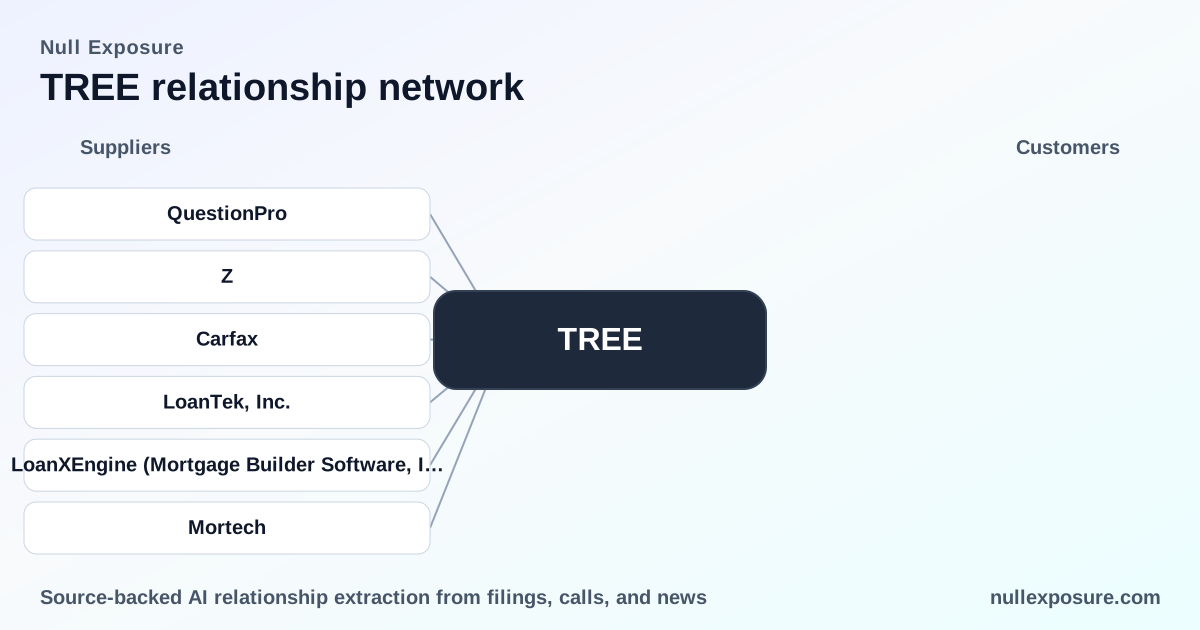
Who supplies LendingTree: the complete list and what each relationship means
Below are every supplier relationships captured in LendingTree’s public materials (FY2026), with concise takeaways and source references.
QuestionPro
LendingTree commissioned QuestionPro to field an online consumer survey of 2,000 U.S. adults in January 2026, using those results to populate consumer sentiment content and housing‑market commentary that supports site traffic and reader engagement. According to LendingTree’s housing‑market survey methodology (FY2026): https://www.lendingtree.com/home/mortgage/housing-market-crash-survey/
Zillow / Mortech
LendingTree discloses that mortgage rate quotes on LoanExplorer include data from Mortech, presented as a registered trademark of Zillow, indicating that Zillow’s pricing engine is a live feed contributor to LoanExplorer pricing and display. The disclosure appears in LendingTree’s FY2026 rate‑quote methodology: https://www.lendingtree.com/auto/popular-luxury-vehicles-study/
Carfax
LendingTree relied on Carfax’s guide to classify which automotive brands qualify as luxury for an auto study, showing an editorial/data sourcing relationship that informs consumer content rather than direct pricing feeds. The citation is in LendingTree’s auto study (FY2026): https://www.lendingtree.com/auto/popular-luxury-vehicles-study/
LoanTek, Inc.
LoanTek is listed among third‑party providers that supply mortgage rate quotes and loan pricing data to LendingTree’s LoanExplorer product, indicating a feed provider role that affects displayed lender pricing and fees. See LendingTree’s LoanExplorer disclosure (FY2026): https://www.lendingtree.com/auto/popular-luxury-vehicles-study/
LoanXEngine (Mortgage Builder Software, Inc.)
Mortgage Builder Software’s LoanXEngine is cited as another source powering mortgage pricing inputs for LoanExplorer, reflecting a supply relationship for price and product data consumed by LendingTree’s comparison engine. LendingTree’s FY2026 rate‑quote statement references LoanXEngine: https://www.lendingtree.com/auto/popular-luxury-vehicles-study/
Mortech
Mortech is named explicitly among third‑party providers supplying mortgage rate quotes, pricing and fee data for LoanExplorer; its inclusion underscores the platform’s reliance on multiple rate engines to deliver competitive quotes to consumers. The reference is in LendingTree’s LoanExplorer disclosures (FY2026): https://www.lendingtree.com/auto/popular-luxury-vehicles-study/
What these relationships imply for risk and value capture
- Concentration and criticality: Multiple named feed providers (Mortech/Zillow, LoanTek, LoanXEngine) suggest deliberate redundancy for pricing accuracy—this reduces single‑point failure risk but raises vendor management complexity.
- Commercial posture: The mix of editorial partners (Carfax, QuestionPro) and technical feed partners indicates a split sourcing strategy: content partners for acquisition and feed partners for conversion economics.
- Maturity of controls: Public language about cybersecurity and third‑party assessments signals a mature contracting posture where service providers are treated as operationally critical, with formal oversight and compliance checks.
These characteristics support a platform that is operationally dependent on suppliers for both traffic and transaction conversion, and therefore warrants active vendor risk management from investors tracking revenue durability.
Explore operational vendor heatmaps and supplier scoring at https://nullexposure.com/ to gauge exposure across categories.
Investor takeaways and recommended monitoring
- Primary investor thesis remains: LendingTree monetizes through lead flows and partner distribution; supplier feeds directly influence conversion and pricing margins.
- Monitor feed partner stability, contract renewal terms and any consolidation among mortgage‑pricing vendors—these are direct inputs to margin resilience.
- Track regulatory filings and bonding/lending license disclosures for materially expanded state obligations that increase compliance costs or constrain scaling.
For an immediate vendor risk briefing and to map supplier criticality for TREE, visit https://nullexposure.com/ for a compact supplier intelligence pack.
Final thought: LendingTree’s supplier set is both a strength and a risk—multiple pricing feeds and research partners support scale, but governance and contractual depth determine whether that advantage sustains revenue per user over a full credit cycle.