Trex Company: supplier footprint, contracting posture, and what investors should take from recent partner moves
Trex manufactures and distributes wood‑plastic composite decking and accessories, monetizing through product sales to dealers, distributors, and national channel partners while controlling input costs via a mix of long‑term reclaimed wood fiber commitments and short‑term polyethylene purchases. The company combines a branded, premium product strategy with regional distribution expansion and active capital allocation (including an accelerated share repurchase), so investors should evaluate both supply continuity and procurement elasticity when assessing margin durability and growth leverage.
If you want a compact supplier intelligence view for deal or diligence work, start with a quick portfolio read at https://nullexposure.com/.
Why supplier relationships matter to Trex right now
Trex’s gross margins and throughput depend on a narrow set of raw inputs and a concentrated supplier base. Reclaimed wood fiber is procured under long‑term commitments, while polyethylene—another principal input—is bought under short‑term contracts, exposing Trex to commodity price cycles for plastics. The company reported over $1.17 billion in trailing revenue, so even relatively small shifts in input costs or distribution coverage translate to meaningful P&L movement.
Significant recent actions—regional distribution expansions and a $100 million ASR—underscore parallel priorities: secure feedstock and distribution while returning capital to shareholders. If you are evaluating TREX as a counterparty or investment, focus on contractual tenure, supplier concentration, and regional coverage continuity.
What Trex disclosed about supplier and partner moves (what the company told investors)
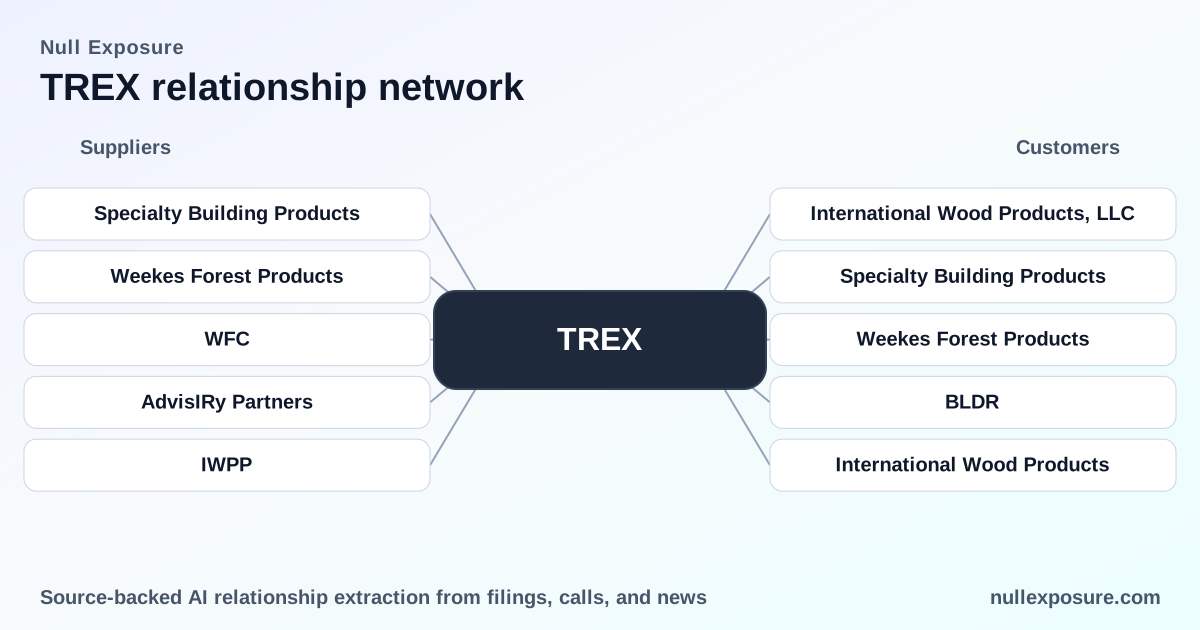
Below I cover every relationship cited in the public disclosures compiled for TREX supplier analysis. Each entry is a concise, readable take with a source callout.
-
Specialty Building Products
Trex expanded its relationship with Specialty Building Products in Michigan, building on a long‑standing Trex–SBP collaboration to deepen distribution and channel penetration in that state. This was disclosed on Trex’s 2025 Q4 earnings call. (Trex 2025 Q4 earnings call, March 2026.) -
Weekes Forest Products
Trex expanded sales and distribution ties with Weekes Forest Products to strengthen its footprint across the upper Midwest—including Minnesota, Wisconsin, Iowa, and North Dakota—indicating deliberate regional channel densification. (Trex 2025 Q4 earnings call, March 2026.) -
International Wood Products (IWP / IWPP)
Trex announced expansion of its relationship with International Wood Products, extending its successful collaboration in the Pacific Northwest and California to capture West Coast residential decking demand. (Trex 2025 Q4 earnings call, March 2026.) -
Wells Fargo Bank (ASR agreement)
Trex entered into a $100 million accelerated share repurchase (ASR) agreement with Wells Fargo Bank, a capital‑allocation action that reduces share count immediately via upfront payment and signals management confidence in near‑term free cash flow. (MarketMinute report, March 3, 2026.) -
Wells Fargo (ASR delivery details)
Trex paid $100 million upfront to Wells Fargo and expected an initial delivery of roughly 1.9 million shares under the ASR, with the final share count to be determined at completion—this provides a specific framing for the magnitude of the buyback. (Intellectia.ai coverage of Trex repurchase, March 2026.) -
AdvisIRy Partners
Trex will continue a longstanding relationship with AdvisIRy Partners for investor relations consulting as executive changes occur, keeping external communications and shareholder engagement consistent during leadership transition. (Intellectia.ai report on Trex capital actions and IR, March 2026.)
Each relationship listed above is pulled from the company’s latest earnings commentary and contemporaneous market reporting; investors should treat channel expansions as operational levers and the ASR as a balance‑sheet decision with immediate EPS impact.
How supplier constraints shape Trex’s operating model and procurement posture
Three company‑level constraint signals drive Trex’s upstream economics and contract strategy:
-
Contracting posture: mixed tenure — Trex uses long‑term supply commitments for reclaimed wood fiber while polyethylene is procured under one‑year or purchase‑order arrangements. This hybrid approach locks in a critical, harder‑to‑source biological input while keeping polymer purchases flexible to react to market prices.
-
Supplier concentration is notable — For 2024 Trex reported that roughly 21.4% of Trex Residential’s materials purchases came from its four largest suppliers, a meaningful concentration that amplifies vendor risk and bargaining power dynamics.
-
Maturity and criticality — Excerpts describe long‑standing collaborations (for example with SBP and AdvisIRy), indicating that several supplier and channel relationships are mature and operationally critical rather than transactional.
These signals imply a procurement strategy that balances supply security for the most meaningful physical input with price flexibility for volatile commodity plastics. For operators, that means procurement teams will prioritize supplier reliability and logistics optimization for fiber, while maintaining active hedging or purchasing discipline for polyethylene.
Practical investor and operator implications
- Margin sensitivity: Because polyethylene is bought on short‑term contracts, margins are sensitive to polymer price swings; investors should stress‑test operating margins under higher plastic cost assumptions.
- Concentration risk: With over one‑fifth of purchases concentrated among four suppliers, a disruption to any major partner would create meaningful operational stress. Insurance, inventory buffers, and alternative sourcing pathways are key mitigants.
- Distribution growth: Regional expansion with SBP, Weekes, and IWP demonstrates distribution optimization; these moves improve market access and can lift sales velocity if field inventory and dealer adoption follow.
- Capital allocation signal: The $100 million ASR executed with Wells Fargo is an unequivocal shareholder‑return action that reduces float and signals confidence in cash generation; operators should track maintenance capex versus buybacks to understand long‑term reinvestment. (MarketMinute and Intellectia.ai, March 2026.)
If you want a deeper transaction view or a tailored supplier‑risk brief, see the supplier intelligence hub at https://nullexposure.com/.
Final read: short checklist for diligence
- Confirm current contract tenors for reclaimed fiber and polyethylene with the supplier contracts team.
- Quantify the contribution and replaceability of the top four material suppliers that comprised ~21.4% of spend in 2024.
- Reconcile the economics of regional distribution expansions with incremental logistics and working capital needs.
- Monitor buyback completion metrics from the Wells Fargo ASR to model EPS and leverage impacts.
For deal teams and portfolio managers who need a clean, commercial view of Trex’s partner network and procurement posture, NullExposure consolidates these signals into actionable diligence outputs—start here: https://nullexposure.com/.
Bottom line: Trex combines stable, long‑tenor sourcing for critical fiber with flexible, short‑term plastic procurement, operates with noticeable supplier concentration, and is actively managing capital via an ASR—each factor shapes its margin resilience and risk profile. For investors and operators, focus on supplier continuity, commodity exposure, and whether distribution expansions convert into sustainable top‑line gains.
Explore more supplier intelligence at https://nullexposure.com/.