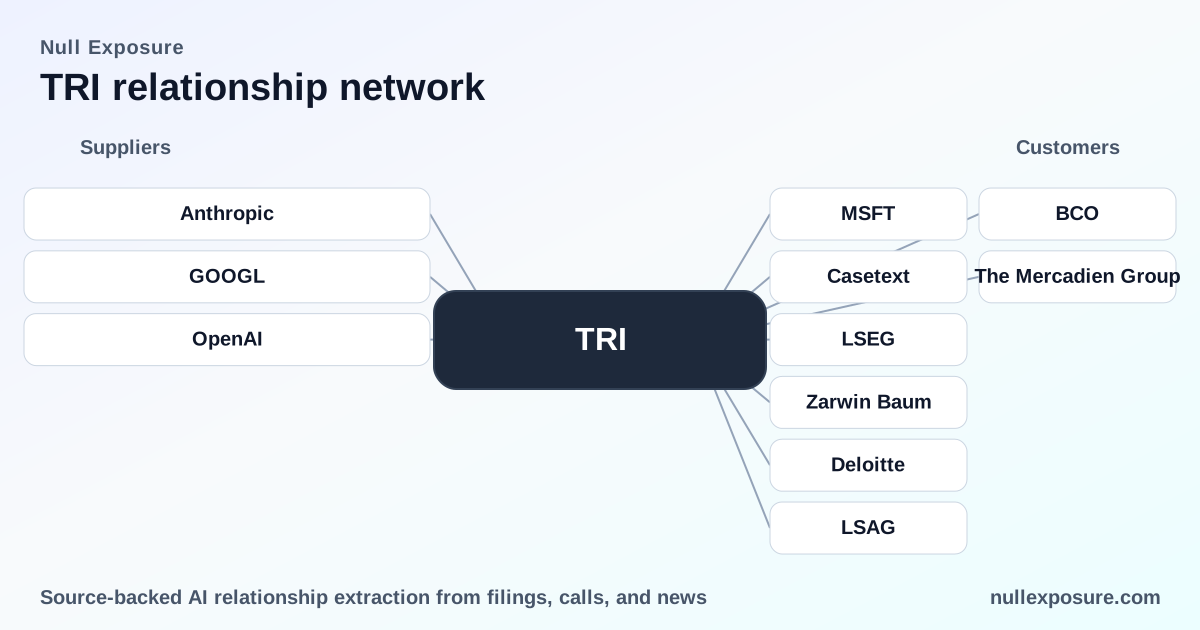
Thomson Reuters (TRI) — Supplier relationships with frontier AI partners and what investors should know
Thesis: Thomson Reuters monetizes a global portfolio of subscription and licensing products for legal, tax, regulatory and news customers by combining proprietary content and workflows with third‑party frontier AI models and its own controls; the company sells access and enterprise integrations that convert high-margin recurring revenue into predictable cash flow while outsourcing compute and model innovation to a small set of AI specialists. Investors should view TRI as a content-and-software monetization business that leverages external AI partners to accelerate product differentiation and reduce in-house model development costs. Learn more about relationship mapping and enterprise implications at https://nullexposure.com/.
Why these supplier relationships matter to TRI’s commercial model
Thomson Reuters operates a subscription-first business with strong operating margins (operating margin TTM 26.6%) and recurring revenue behavior (Revenue TTM ~$7.48B). The firm’s decision to integrate externally developed large language models into products is a deliberate capital-light scaling strategy: rather than owning model infrastructure end-to-end, TRI pays for model access and layers its proprietary content, compliance controls, and workflows on top to preserve product control and regulatory suitability.
- Contracting posture: TRI contracts with leading model providers for capabilities it does not want to replicate internally, keeping development focused on domain controls and content licensing rather than base-model engineering.
- Concentration and redundancy: TRI’s supplier set includes multiple frontier providers, creating redundancy that reduces single-vendor dependency while enabling negotiated terms across providers.
- Criticality and maturity: These model partnerships are strategically critical to how TRI scales new offerings (e.g., CoCounsel) and are being operationalized at scale in FY2026; the relationships are mature enough to be embedded in go-to-market products rather than experimental pilots.
If you evaluate supplier risk as part of due diligence, TRI’s approach signals operational leverage — high-value proprietary content plus outsourced compute — rather than asset-heavy ownership of model stacks. Explore a fuller supplier risk profile at https://nullexposure.com/ to map dependencies against commercial revenue lines.
The supplier relationships in the public record (each relationship covered)
Below are the partner relationships disclosed in the sourced release and what each partner contributes.
Anthropic — Thomson Reuters integrates Anthropic’s Claude among its frontier model set, using Claude alongside other models and internal systems to maintain performance control and oversight. According to a PR Newswire release in March 2026, TRI lists Anthropic as one of the leading models that underpin its CoCounsel and other regulated-industry solutions (https://www.prnewswire.com/news-releases/one-million-professionals-turn-to-cocounsel-as-thomson-reuters-scales-ai-for-regulated-industries-302694903.html).
Google (GOOGL) — TRI leverages Google’s Gemini as part of a multi‑model strategy to provide capabilities to customers, combining Gemini with proprietary datasets and control layers to ensure regulatory fit. A March 2026 PR Newswire announcement states Thomson Reuters works with Google’s Gemini alongside other frontier models to scale AI for regulated industries (https://www.prnewswire.com/news-releases/one-million-professionals-turn-to-cocounsel-as-thomson-reuters-scales-ai-for-regulated-industries-302694903.html).
OpenAI — Thomson Reuters uses OpenAI’s GPT as an external model input, integrated with TRI’s own proprietary technologies and structured datasets to maintain system-level oversight and product reliability. The same PR Newswire release from March 2026 lists OpenAI’s GPT as one of the frontier models employed in TRI’s product stack (https://www.prnewswire.com/news-releases/one-million-professionals-turn-to-cocounsel-as-thomson-reuters-scales-ai-for-regulated-industries-302694903.html).
What these relationships mean for risk, negotiation leverage and product differentiation
These partnerships create several clear investment implications:
- Operational leverage: By layering TRI’s proprietary content on top of externally developed models, the company retains control over the customer experience and compliance, while avoiding the heavy capital expenditure and time required to develop equivalent base models.
- Supplier diversification: Working with multiple leading providers (Anthropic, Google, OpenAI) reduces single-vendor concentration risk and gives TRI negotiating leverage on pricing and service levels. This is especially valuable given the strategic importance of model access to TRI’s high-value workflows.
- Regulatory and contractual posture: TRI emphasizes system-level oversight and structured datasets, reflecting tight contracting posture to control hallucination, provenance, and compliance — essential for legal, tax and regulated-industry customers.
- Time-to-market advantage: Integrating best-in-class third-party models accelerates product rollout and customer adoption, converting technical capability into revenue growth without proportionate internal R&D expense.
Constraints and company-level signals
The public supplier results in our dataset list the model partners above and include no explicit contractual constraints or limitations on those relationships. The constraints set is empty, which itself is a signal: TRI has not publicly filed constraint disclosures tied to these supplier relationships in the referenced release, leaving negotiation terms, exclusivity and pricing to private contract detail. Investors should treat the absence of constraint disclosures as a neutral data point — it does not indicate the presence of restrictive covenants or exclusivity, but it also does not clarify margin dynamics or termination rights.
Financial context and investor takeaways
Thomson Reuters is a large-cap information services company (market cap ~$42.8B) with healthy profitability metrics (profit margin ~20.1%, EBITDA ~$2.09B). The strategic decision to partner with frontier AI vendors amplifies TRI’s product moat while preserving capital allocation discipline. However, investors must monitor three variables closely:
- Supplier access and pricing: model access costs could compress incremental margins if competitive dynamics change.
- Regulatory exposure: TRI’s customers demand traceability and controls; failure to maintain oversight could damage retention in high‑value verticals.
- Execution on integration: the commercial payoff depends on TRI converting model capability into differentiated workflow automation and upsell.
For a deeper supplier risk map and to benchmark TRI’s partner set against other information services providers, visit https://nullexposure.com/.
Final view and actions for investors
Thomson Reuters has transitioned its product strategy to combine high-quality proprietary content with best-in-class external models, giving it a fast path to product innovation without the investment burden of base-model development. This is a scalable, capital-efficient approach that protects customer trust through TRI-controlled datasets and compliance layers.
If you are evaluating TRI for a portfolio or operational partnership, prioritize diligence on contract terms with model providers, margin sensitivity to model access costs, and evidence that TRI’s control layers prevent downstream compliance incidents. For a tailored supplier analysis and to see how these relationships map against revenue lines, visit https://nullexposure.com/ for a custom report and relationship visualization.