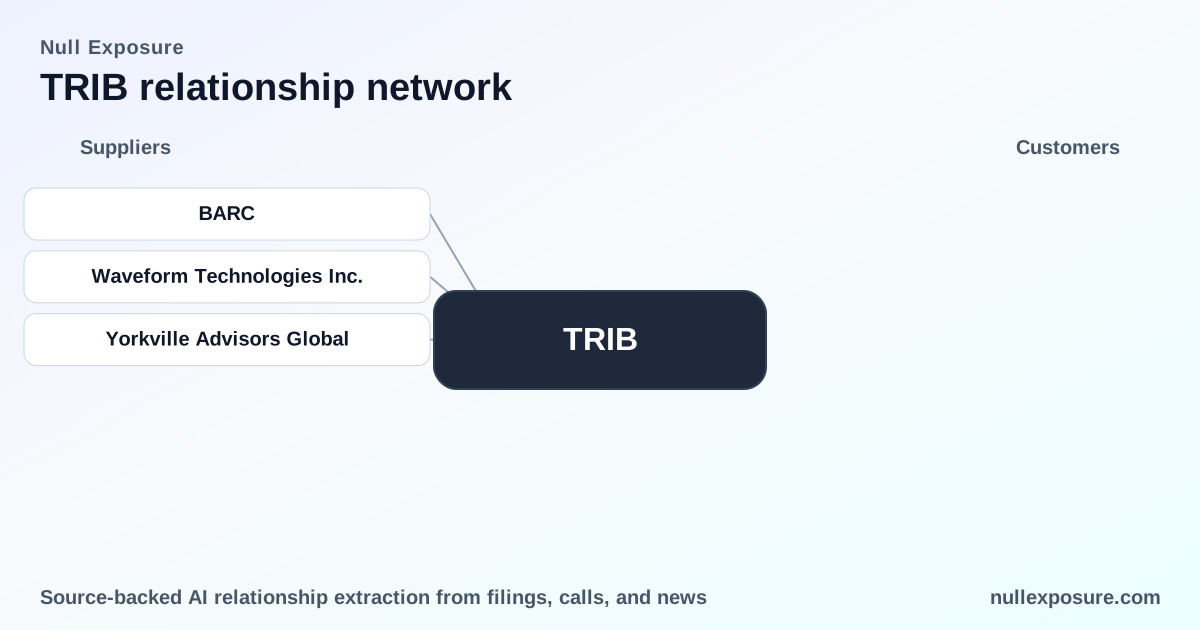
Trinity Biotech (TRIB) — supplier relationships, strategic finance, and what investors should price in
Trinity Biotech builds, acquires and sells diagnostic systems—reagents and instruments for clinical laboratories and point-of-care settings—and has pushed into wearable biosensors through recent asset acquisitions. The company monetizes primarily through product sales and recurring consumables, while leaning on strategic finance and partnerships to underwrite a pivot into continuous glucose monitoring; Trinity delivered $61.6M in trailing revenue with negative EBITDA in the most recent filings, making external financing and partner relationships central to near‑term execution. Investors should treat supplier and finance relationships as operational levers that determine whether a technology pivot becomes profitable or simply adds cash burn.
For a quick reference on coverage and supplier intelligence, visit https://nullexposure.com/ for ongoing updates and primary-source tracking.
Why these relationships matter right now
Trinity is executing a dual play: stabilize legacy diagnostics revenue while integrating newly acquired biosensor assets to enter the wearable continuous glucose monitoring (CGM) market. That combination is capital‑intensive and integration‑sensitive—exclusive advisors, asset sellers and financing partners determine timing, capital availability, and strategic optionality.
- High leverage between capital and execution: negative operating margins and an active financing program compress the runway for trial-and-error product development.
- Execution risk is concentrated: a small set of counterparties—financial advisors and equity/debt providers—shape strategic outcomes more than diversified suppliers.
Visit https://nullexposure.com/ to read our supplier-risk playbook for small-cap medtech turnarounds.
The relationships you need on your radar
Barclays — strategic financial advisor for the realignment
Trinity appointed Barclays as its exclusive financial advisor to support a strategic realignment focused on its CGM push and broader portfolio actions. According to a March 2026 report in DrugDeliveryBusiness, Barclays was named to guide transaction planning and capital strategy. (DrugDeliveryBusiness, Mar 2026)
Waveform Technologies Inc. — biosensor asset seller and technology source
Trinity completed an acquisition of the biosensor assets of Waveform Technologies to seed its wearable biosensor and CGM program, giving Trinity ownership of IP and development-stage technology intended to fast-track product development. This transaction was described in coverage of Trinity’s CGM initiative and in company disclosures around FY2025–FY2026. (QuiverQuant summary of company announcements, FY2025–FY2026)
Yorkville Advisors Global — financing partner via a $25 million Securities Purchase Agreement
Trinity signed a $25 million Securities Purchase Agreement with an affiliate of Yorkville Advisors Global, securing near-term capital to support operations and integration of the biosensor program. The financing agreement was made public in March 2026 and is positioned as immediate liquidity to shore up the company’s balance sheet. (Bitget news summarizing the SEPA, Mar 2026)
How the catalogue of relationships changes the risk profile
Each relationship above plays a discrete and measurable role in Trinity’s trajectory.
- Barclays (advisor): adds transactional credibility and execution capability for restructuring or capital raises; exclusivity concentrates deal flow through one advisor, accelerating decisions but narrowing options. (DrugDeliveryBusiness, Mar 2026)
- Waveform (asset seller): provides the technical foundation for a high‑opportunity but high‑execution CGM product; integration of acquired biosensor IP is functionally critical to the company’s stated strategic pivot. (QuiverQuant, FY2025)
- Yorkville (financing): supplies immediate liquidity but introduces covenants, dilution potential, or repayment pressure that will influence product development timelines and commercial resource allocation. (Bitget, Mar 2026)
Key takeaway: the company’s path to commercialization is now more dependent on financial partners and acquired IP than on organic R&D or a diversified supplier base.
Company‑level operating signals and constraints (what the data tells us)
No explicit contractual constraints were captured in the supplier-scope results; that absence is itself informative. At the company level, the observable signals are:
- Contracting posture: Trinity is actively using advisor exclusivity and direct asset acquisition to accelerate strategic change—this reflects a proactive, deal‑driven posture rather than incremental supplier selection.
- Concentration: counterparty concentration is high—one exclusive advisor (Barclays), one material asset seller (Waveform), and one large financing partner (Yorkville) dominate strategic levers.
- Criticality: the Waveform asset and the Yorkville financing are critical to the CGM pivot and near-term solvency respectively; failure in either dimension would materially impair the strategy.
- Maturity: the relationships skew toward transactional and early-stage integration rather than long-standing supply agreements; the company is in a transitional maturity phase where strategic partners temporarily substitute for scale and internal capability.
These are company-level signals derived from published relationship activity and financial releases; they imply a high‑touch, financing‑dependent operating model rather than a mature, supplier-diversified manufacturing program.
Investment implications — what to watch and price
- Capital risk is front and center. With negative EBITDA and recent equity/debt raises, further dilution or restrictive covenants are likely if commercial milestones slip. Confirm covenant language and dilution mechanics in Yorkville documents before adjusting valuation.
- Integration execution is the primary operational risk. The Waveform acquisition accelerates time to prototype but increases execution complexity—expect a multi‑quarter risk window where R&D spending outpaces revenue gains.
- Deal execution matters for upside. Barclays’ role as exclusive advisor is a net positive for speed and confidentiality in strategic transactions, but exclusivity compresses choice; investors should monitor announcements for sale, JV or capital raise outcomes that materially change governance or cap structure.
For ongoing monitoring and supplier‑relationship scans tied to capital events, check our research hub at https://nullexposure.com/.
Bottom line for investors
Trinity Biotech is reshaping its business through targeted acquisitions and concentrated financing relationships. The company’s near-term valuation is driven less by organic diagnostics sales and more by the success of the Waveform integration and the sufficiency of Yorkville-supplied capital. Barclays’ advisory mandate improves the odds of timely capital or strategic reconfiguration, but exclusivity also centralizes control over transaction timing and scope.
If you are evaluating a position in TRIB, underwrite scenarios for both successful CGM commercialization and for outcomes where capital constraints force asset dispositions or dilution. For detailed supplier and counterparty timelines, proprietary tracking, and primary-document links, visit https://nullexposure.com/ to subscribe to our supplier-risk monitoring and deal flow alerts.