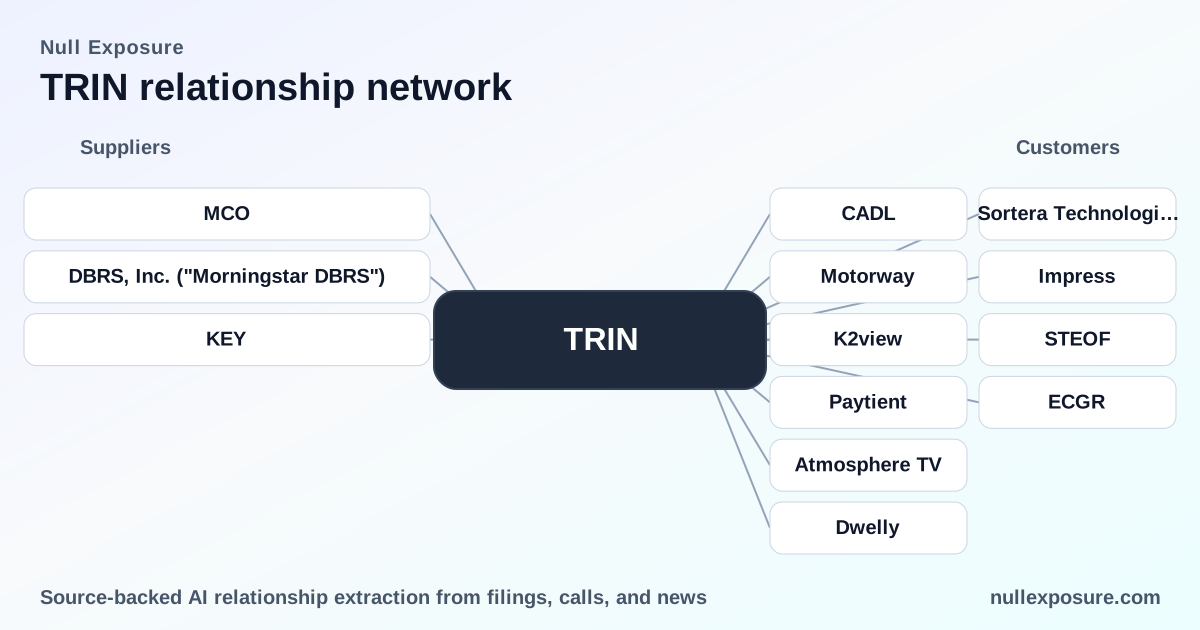
Trinity Capital (TRIN): How its counterparty map funds a high-yield venture-debt franchise
Trinity Capital operates as a venture-debt specialist that finances growth-stage companies with equipment loans, term facilities and related credit solutions. The firm monetizes through interest and fee income on its debt investments, realized gains on exits, and a utility-style dividend paid to shareholders; its economics depend on disciplined underwriting, access to wholesale credit lines, and the durability of investment-grade ratings that lower funding costs. For investors and operators evaluating TRIN as a supplier or counterparty, the decisive signals are credit ratings, the structure of committed facilities, geographic concentration of loan assets, and whether those facilities are long-term and actively deployed.
Explore more company-level signals and relationship analysis at https://nullexposure.com/.
Why these supplier relationships matter to investors
Trinity is a lending-oriented asset manager where counterparty access equals balance-sheet leverage. Long-dated funding and investment-grade external opinions directly compress funding costs and expand lending capacity; conversely, deterioration in credit metrics would push funding spreads higher and constrain origination. The firm’s recent actions show a mix of conservative rating validation and capacity expansion:
- Long-term funding posture: Trinity executed note purchase agreements that create multi-year senior note tranches through 2027–2029, signaling durable funding rather than short-term wholesale rollover risk. This is a company-level indicator of contractual maturity and funding stability.
- Geographic footprint: Investments are concentrated in North America—particularly Western and Northeastern U.S.—with listed exposure to Canada and selective European debt holdings. That concentration concentrates operational and credit risk geographically while simplifying portfolio monitoring.
- Active relationship stage: Public schedules of investments indicate the firm’s portfolio is active and being managed on an ongoing basis, not a closed wind-down book.
These operating model signals define Trinity’s contracting posture (long-term secured and unsecured debt issuance), concentration risk (NA-heavy), and maturity profile (multi-year notes and active investment schedule)—all relevant when assessing the firm as a supplier, lender, or capital counterparty.
Relationship register: Moody’s, Morningstar DBRS and KeyBank — what each means
Moody’s Investors Service
Moody’s has assigned Trinity a new investment-grade long-term issuer rating of Baa3 with a stable outlook, giving Trinity formal access to lower-cost institutional funding and signaling improved credit standing to banks and institutional counterparties. According to a PR Newswire release dated March 10, 2026, this fresh rating is a material credit endorsement for Trinity’s funding strategy (PR Newswire, Mar 2026: https://www.prnewswire.com/news-releases/trinity-capital-inc-receives-new-investment-grade-rating-from-moodys-302446287.html).
DBRS, Inc. (Morningstar DBRS)
Morningstar DBRS confirmed Trinity’s investment-grade credit rating at “BBB (low)” and revised the trend to Positive, reinforcing the rating momentum from other agencies and enhancing confidence among secured lenders and institutional buyers of Trinity’s notes. The confirmation and positive trend were reported in a DBRS/Morningstar note referenced in January 2026 (sahmcapital summary, Jan 29, 2026: https://www.sahmcapital.com/news/content/morningstar-dbrs-confirms-trinity-capitals-investment-grade-rating-and-revises-the-trend-to-positive-2026-01-29).
KeyBank
KeyBank is the arranger/agent behind a US$200 million secured term loan facility that expands Trinity’s lending capacity at a time when venture-debt origination demand and unfunded commitments are elevated; how quickly Trinity utilizes and deploys that capacity is a direct lever on origination pace and asset growth. Financial commentary and coverage in early 2026 highlight the KeyBank facility as central to near-term capacity and dividend coverage implications (Simply Wall St coverage, FY2025–FY2026: https://simplywall.st/stocks/us/diversified-financials/nasdaq-trin/trinity-capital/news/does-trinity-capitals-venture-debt-focus-secure-trins-high-y/ and https://simplywall.st/.../amp).
What investors should read into these relationships
The combination of investment-grade validation (Moody’s Baa3 and DBRS BBB low/Positive) and a large secured facility from a commercial bank creates a clear operating lever: lower marginal funding costs and scalable lending capacity. That configuration enables Trinity to:
- Price competitively for growth-stage borrowers, preserving yield while protecting credit quality through secured structures and covenants.
- Sustain dividend distributions through diversified funding sources rather than volatile capital markets alone.
- Ramp originations when credit windows open because of committed long-term funding.
At the same time, the configuration creates concentrated operational risk: heavy North American loan concentration and reliance on a few large facilities increase sensitivity to regional credit cycles and counterparty covenant surveillance. The firm’s October 2024 tranche note issuance (Series A 2027–2029) is evidence of a deliberate, multi-year funding strategy that improves predictability but raises exposure to interest-rate path and refinancing dynamics over a multi-year horizon.
Explore a concise supplier-risk checklist and deeper counterparty mappings at https://nullexposure.com/.
Practical implications for diligence and contracting
For operators and investors negotiating supplier relationships with Trinity, three priorities follow:
- Contractual clarity on facility usage and covenants. Demand visibility on how committed facilities (KeyBank term loan and note tranches) can be drawn and what triggers covenant resets or default. Long-term note structures are a positive, but their covenants affect operational freedom.
- Focus monitoring on borrower credit performance. Trinity’s earnings and dividend profile are sensitive to growth-stage borrower outcomes; diligence should include stress tests on portfolio credit performance and loss rates.
- Geographic and asset concentration controls. Given the North American concentration, counterparties should assess the geographic risk bucketing and whether sector exposures (insurtech, SaaS, equipment finance) are diversified enough to withstand regional downturns.
Key takeaway: Trinity’s supplier relationships give the company credible, institutional funding and a clear pathway to expand originations, but counterparty exposure concentrates operational risk and creates dependency on continued credit performance.
Final read for investors: where the balance of risk and opportunity sits
Trinity’s upgraded credit standing and a large bank facility translate into immediate capacity upside and lower funding cost, which supports its yield-driven venture-debt model and monthly dividend policy. However, the firm’s concentrated North American footprint, reliance on a few major funding relationships, and exposure to growth-stage borrower credit cycles are the primary risk vectors to stress in any supplier evaluation.
If you need a concise supplier-risk report or model-ready relationship map for Trinity and comparable counterparties, visit https://nullexposure.com/ and request the Trinity supplier package.
Boldly evaluate counterparty covenants, funding tenor, and geographic concentration; those three controls determine whether Trinity is a stable supplier partner or a cyclical credit risk in stressed markets.