Trustmark Corporation (TRMK): Supplier relationships, funding posture, and what investors should know
Trustmark operates as a regional bank holding company that monetizes through interest margin on lending, deposit funding, transaction and fee income (merchant and investment services), and wholesale funding strategies. The company’s balance of steady net interest income and fee-generating services produces solid profitability metrics — a market capitalization near $2.48 billion, a trailing P/E of 11.04 and a return on equity around 11% — positioning Trustmark as an incumbent regional bank with diversified revenue streams and active third‑party vendor reliance. For deeper supplier intelligence and ongoing relationship tracking, visit https://nullexposure.com/.
The thesis in one line
Trustmark is a fee-and-spread bank that leverages digital distribution and third-party partners to extend product reach while maintaining a layered funding mix of deposits, short-term advances and longer-term subordinated debt; investors should treat vendor relationships as operational multipliers that materially affect distribution and client engagement.
The Greenlight relationship — digital capability added to retail channels
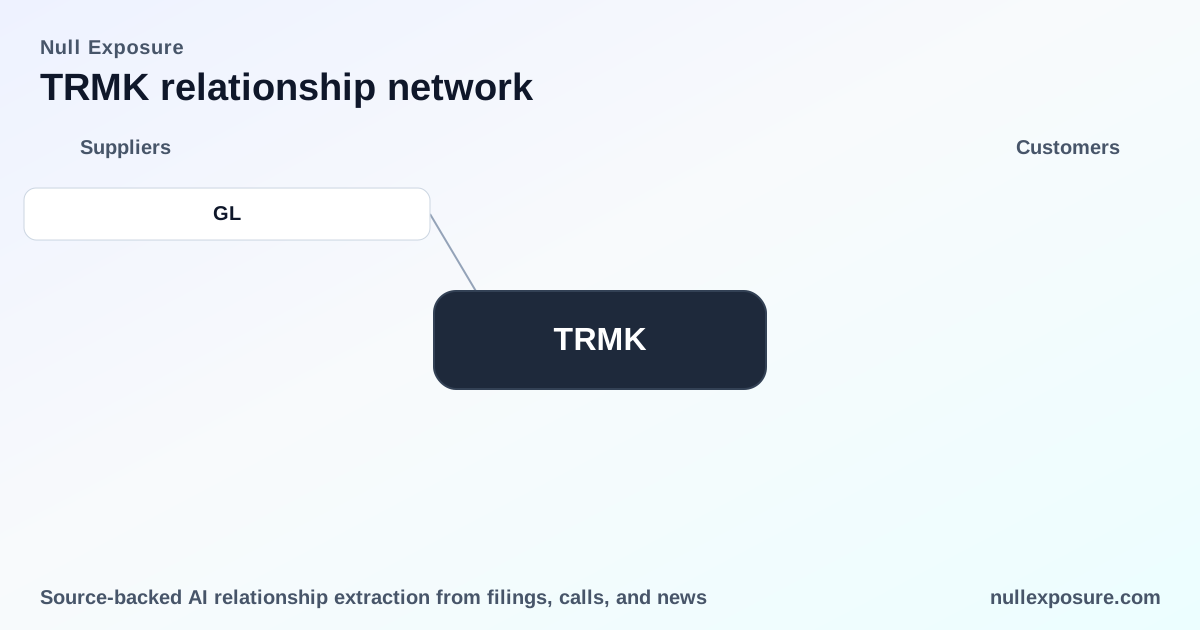
Trustmark has announced a partnership giving its customers access to Greenlight Financial Technology’s family finance app through the bank’s digital channels. This integration adds a consumer-facing fintech product to Trustmark’s digital offerings and expands value propositions for families and younger account holders. According to a Simply Wall St report published March 10, 2026, the app will be available via Trustmark Bank’s digital channels, enhancing retail engagement (Simply Wall St, March 10, 2026).
Key takeaway: This is a distribution-oriented tie-up that increases Trustmark’s retail product shelf without the need for in‑house development.
How Trustmark funds growth and manages liquidity
Trustmark’s funding model combines core deposits with both short-term and long-term wholesale borrowings, which creates flexibility but also requires active liability management. Company filings note the use of federal funds, repurchase agreements, Federal Reserve Discount Window access and Federal Home Loan Bank (FHLB) advances as core elements of its short-term liquidity toolkit. The bank also carries subordinated notes that mature on December 1, 2030 and are redeemable under specified conditions, reflecting a mix of maturing long-term obligations in the capital structure (company filings).
Implications for investors
- Contracting posture: The mix of short-term FHLB advances and longer-dated subordinated debt demonstrates an intentional liquidity laddering strategy that balances cost and maturity risk.
- Maturity profile: The subordinated notes create a discrete long-term maturity event in 2030 that investors should model for capital and interest-cost sensitivity.
- Operational flexibility: Access to multiple short-term borrowing channels reduces single-source concentration for funding.
Third-party services: pervasive and functionally critical
Trustmark uses third-party providers across investment services, merchant services, securities valuation and customer-facing product delivery. Filings disclose a continuous investment services contract that provides broker-dealer and advisory capabilities delivered over time, merchant services providers that contract directly with business customers for card processing and transaction services, and an independent pricing service used to value securities available for sale. These relationships are described in regulatory and financial filings as ongoing service arrangements.
Risk profile: Reliance on external vendors for distribution (broker-dealer/advisory), transaction processing and pricing inputs creates operational concentration points where vendor performance or contractual disruption can affect revenue recognition, client experience, and regulatory compliance.
For investors focused on supplier risk, a structured vendor review is essential: validate SLAs, termination clauses, data-handling controls and contingency plans tied to each major provider.
Visit https://nullexposure.com/ for supplier monitoring tools and supplier relationship dashboards that track these vendor dependencies.
Concentration, criticality and corporate signals
Several company-level signals affect investor assessment of supplier exposure and contract dynamics:
- Vendor reliance is explicit and broad. Trustmark’s disclosures describe multiple third-party service relationships supporting core revenue lines (brokerage/advisory services and merchant processing). This is a structural operating model decision rather than an ad hoc approach.
- Funding concentration is mixed. Trustmark reported $200 million of outstanding short-term FHLB advances at year-end 2024 versus $400 million the prior year, showing active management of short-term wholesale usage and signaling a willingness to adjust funding concentration dynamically.
- Contract duration and maturity are meaningful. The presence of subordinated notes with a stated December 1, 2030 maturity introduces a multi-year capital commitment that underpins long-term funding cost and capital planning.
Investor action: Treat the vendor ecosystem as an amplifier of both opportunity and operational risk — the bank is deliberately outsourcing capability to scale its product offering while keeping a diversified funding stack.
Concise supplier relationship list
- Greenlight Financial Technology — Trustmark Bank will provide customers access to Greenlight’s family finance app through the bank’s digital channels, expanding retail digital products and financial education tools for families (Simply Wall St, March 10, 2026). This is a distribution and product-extension relationship rather than a capital or processing tie.
What to watch next and the investment angle
Investors should track three items closely: execution of third-party integrations (customer uptake and retention), the trajectory of wholesale borrowing (FHLB and other short-term advances), and refinancing or redemption optionality on subordinated debt ahead of its 2030 maturity. Trustmark’s financial ratios — moderate price-to-book (~1.13), profitable margins and a dividend yield around 2.35% — support a value-oriented bank thesis contingent on stable credit performance and vendor continuity.
For ongoing monitoring of Trustmark’s supplier network, contract maturities and third‑party dependencies, explore curated supplier intelligence at https://nullexposure.com/.
Bottom line
Trustmark’s strategy marries traditional banking fundamentals with selective third-party partnerships to broaden product reach and preserve capital efficiency. The bank’s vendor footprint materially contributes to customer distribution and fee income while its mixed short‑ and long‑term funding structure provides flexibility; both factors require active monitoring by investors focused on operational risk and capital timing.
For investors and operators evaluating supplier risk with Trustmark, targeted vendor diligence and funding sensitivity analysis are central to assessing downside exposure and upside optionality. Visit https://nullexposure.com/ to get operationally focused supplier insights and relationship tracking.