Trinity Industries (TRN): What investors should know about supplier ties to Palantir and Databricks
Trinity Industries operates as a North American railcar manufacturer and service provider, monetizing through the sale and leasing of railcars, aftermarket services, and integrated logistics offerings. The company’s economics are driven by manufacturing scale, raw-material cost exposure, and margin recovery from operational efficiency programs—including recent strategic investments in embedded AI and analytics to streamline manufacturing, logistics, and finance workflows. For investors evaluating counterparty risk and operational leverage, the supplier relationships with Palantir and Databricks are direct inputs into Trinity’s effort to convert technology investment into sustained margin improvement.
Explore strategic supplier intelligence at https://nullexposure.com/ for deeper supplier maps and risk scoring.
Why supplier relationships materially influence Trinity’s P&L
Trinity’s disclosure profile makes a simple structural point: inputs define margins. The company reports that raw steel, specialty components, and coatings represent a large share of railcar cost; one excerpt states such inputs account for more than 70% of the cost of most railcars. That concentration means procurement posture, supplier concentration, and manufacturing continuity are not peripheral—they are core drivers of gross margin.
- Trinity acts principally as a buyer and manufacturer, operating manufacturing facilities that depend on numerous specialty components (brakes, wheels, bolsters, bearings) that have limited alternative suppliers. Company disclosures note that while the number of alternative suppliers has declined, at least two suppliers continue to produce most components, implying a constrained but not single-source supply base.
- Contracting is transactional and enforceable: Trinity’s own filings describe purchase orders and legally binding obligations for raw materials, components, and third-party services—signal that procurement commitments are formal and ongoing.
- Relationships are active and operational: purchase orders and ongoing manufacturing activity place supplier relationships on the critical path to production rather than in a planning-only role.
These are company-level signals: they indicate Trinity’s operating model is procurement-driven, concentrated on manufacturing, and reliant on continuity of supply and effective supplier management.
What management disclosed on the Q4 2025 call: the partners list
Management explicitly referenced technology partners when discussing operational improvement programs on the Q4 2025 earnings call.
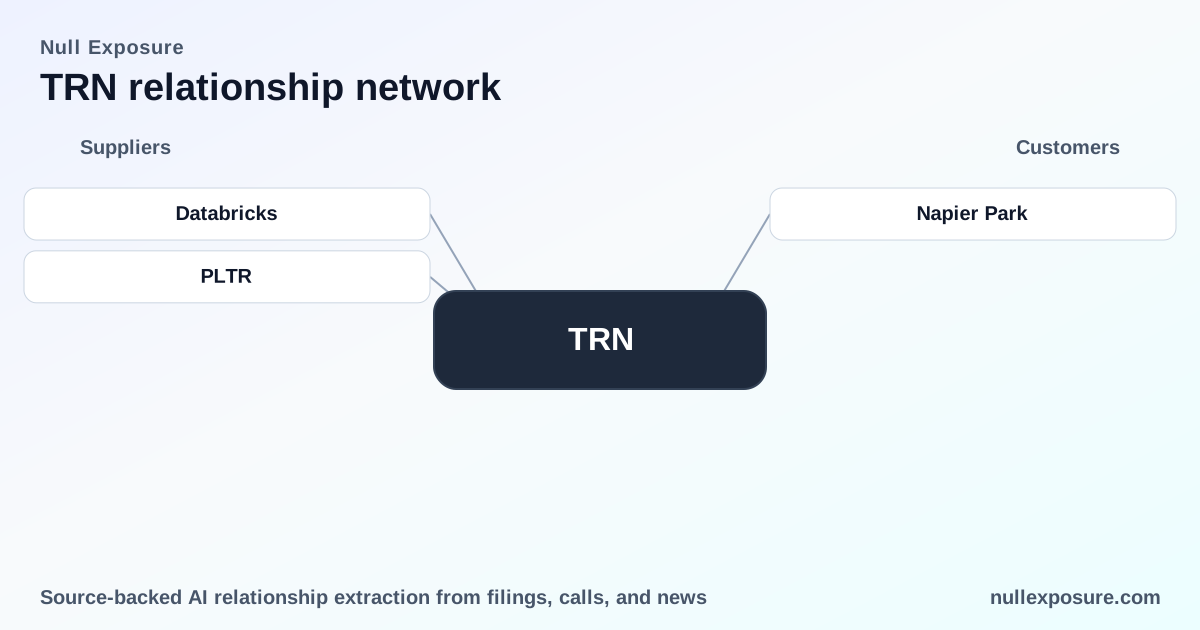
- Databricks — Trinity said it is “working with partners like Palantir and Databricks” to embed AI into manufacturing, logistics, and financial workflows. This positions Databricks as a data/analytics collaborator in Trinity’s digitization push (Q4 2025 earnings call transcript published March 10, 2026 on InsiderMonkey).
- Palantir (PLTR) — The same earnings call indicated Palantir is a named partner in embedding AI across the company’s workflows; Palantir is identified as a strategic software integrator for analytics and operational decisioning (Q4 2025 earnings call transcript published March 10, 2026 on InsiderMonkey).
Both references are concise but significant: management groups Palantir and Databricks together as external technology partners used to deploy AI inside manufacturing, logistics, and finance functions.
Plain-English summaries of each relationship
- Databricks: Trinity is leveraging Databricks’ analytics platform to operationalize AI models inside manufacturing and logistics processes, enabling faster data processing and insights across production lines. According to the Q4 2025 earnings call transcript (published March 10, 2026 on InsiderMonkey), Databricks is one of the partners embedded in Trinity’s AI strategy.
- Palantir (PLTR): Trinity has enlisted Palantir to integrate analytics and decisioning capabilities across manufacturing, logistics, and financial workflows, effectively converting raw operational data into actionable business decisions. Management referenced Palantir on the Q4 2025 earnings call as a named partner in its AI deployment (Q4 2025 earnings call transcript published March 10, 2026 on InsiderMonkey).
How the technology relationships change the risk/reward profile
Embedding AI and analytics partners into factory and supply-chain operations is a force-multiplier for an asset-heavy manufacturer; it is not a cure-all.
- Upside: Better demand forecasting, predictive maintenance, and logistics optimization reduce downtime, compress inventory, and lower per-unit cost — directly supporting margin expansion. For a company where raw materials are >70% of railcar cost, even small efficiency gains in yield, throughput, or scrap reduction scale to meaningful margin recovery.
- Operational risk: Integrating external analytics raises execution risk—implementation slippage, integration complexity, and vendor dependency. Given that Trinity’s supply chain already features limited alternative suppliers for specialty components, any operational disruption that reduces throughput has amplified financial effect.
- Contract and concentration risk: Trinity’s disclosures emphasize enforceable purchase orders and ongoing contractual obligations; when procurement is already concentrated and materials are critical, technology partners that change cadence or data flows introduce new vendor-management requirements and contractual complexity.
Investors should treat these partnerships as operational levers with measurable targets, not marketing statements. Trackable KPIs include cycle time, scrap rate, inventory turns, downtime hours, and procurement lead times.
If you need a deeper supplier risk profile and contractual exposure map, visit https://nullexposure.com/ for enhanced risk analytics and supplier lineage.
Portfolio and procurement actions for investors and operators
For investors:
- Monitor quarterly commentary for measurable efficiency metrics tied to the Palantir/Databricks programs (e.g., reduction in cycle time, inventory days, or maintenance events).
- Reweight forward margin assumptions based on realized gains reported in operations, not on vendor announcement alone.
For operators:
- Insist on clear SLAs and staged rollouts with technology partners; prioritize quick wins that reduce variable cost per unit.
- Embed vendor risk clauses and exit options in contracts to protect against lock-in, especially when supply-chain concentration already elevates counterparty risk.
Constraint signals: operating-model characteristics from Trinity’s disclosures
Trinity’s public disclosures provide several concise operating-model signals that shape supplier risk:
- Materiality: critical — inputs constitute a dominant share of unit cost (>70% for most railcars).
- Relationship roles: buyer and manufacturer — Trinity both sources inputs and assembles final products at its manufacturing facilities.
- Relationship stage: active — contractual purchase orders and ongoing supplier commitments are in force.
- Segment focus: manufacturing — the firm’s primary operations are production-oriented and reliant on specialty components.
These constraints are company-level signals and explain why supplier management—and the software and analytics partners that support it—carry financial significance for Trinity.
Explore supplier maps and counterparty scoring to quantify these signals in your investment process at https://nullexposure.com/.
Bottom line
Trinity’s partnerships with Palantir and Databricks are operationally strategic and financially consequential: they aim to convert data into measurable production and procurement efficiencies that directly influence gross margin. Given Trinity’s high material-intensity and constrained supplier base, investors should demand concrete metrics tied to these initiatives and treat vendor integrations as performance levers that either unlock margin or introduce execution risk. Monitor subsequent quarterly disclosures for quantifiable outcomes rather than rhetoric.