Terreno Realty (TRNO): Supplier Relationships and Operational Implications for Investors
Terreno Realty operates as a focused industrial REIT that acquires, owns, and leases industrial properties in six U.S. coastal and near-coastal markets, monetizing through rental income and capital appreciation while outsourcing day-to-day operations. The company’s operating model relies on external property managers for local execution and uses secured credit facilities for capital flexibility; these patterns shape counterparty exposure and procurement concentration. For a consolidated view of third‑party relationships and supplier risk, visit NullExposure’s homepage.
Business model in one paragraph: how Terreno delivers value
Terreno’s economics center on selective land and building ownership in high-demand industrial corridors, generating steady rent rolls and modest development income while preserving an asset-light administrative layer. The company leverages local third‑party property managers for operations and sources acquisitions through those relationships, while financing working capital and acquisitions through secured credit arrangements. Terreno’s balance of predictable operating cash flow and leverage sensitivity makes counterparty strength — especially lenders and property managers — a material input into investor returns.
Explore supplier analytics on NullExposure for deeper diligence on counterparties and amendment activity.
What the headline relationship tells investors
KeyBank — senior credit agent and lender (FY2026)
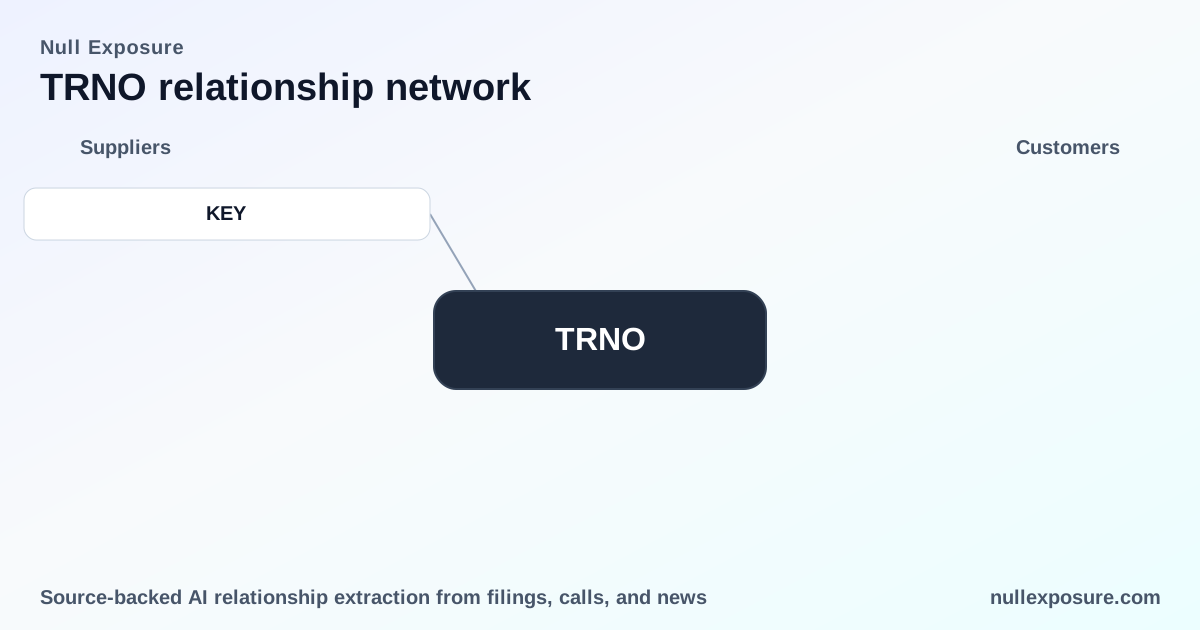
Terreno executed a fourth amendment to its senior credit agreement with KeyBank serving as administrative agent alongside other lenders, a move that adjusts the company’s credit terms and near-term liquidity posture. TradingView covered the amendment on March 10, 2026, noting KeyBank’s role as administrative agent in the financing arrangement. (TradingView, March 10, 2026.)
This amendment is the single explicit supplier-level relationship captured in the supplier sweep; it signals active management of secured debt facilities and direct dependence on institutional lenders for capital flexibility. The amendment’s existence underscores that lender relationships are operationally critical to Terreno’s ability to close acquisitions and refinance maturing debt obligations.
The broader supplier picture — company-level signals you must price
The collected relationship excerpts and company disclosures produce three actionable company-level signals that inform counterparty risk and operational posture:
-
Outsourced property management is core to operations. According to Terreno’s filings, the company “prefers to utilize local third‑party property managers for day‑to‑day property management and as a source of acquisition opportunities,” and believes outsourcing is cost effective and provides operational flexibility. This establishes a contracting posture that is intentionally decentralized and reliant on local vendors. (Company filing disclosures, FY2026.)
-
Capital deployment and near-term purchase commitments are meaningful. As of February 3, 2026, Terreno disclosed three outstanding purchase contracts for industrial properties with a combined purchase price of approximately $113.2 million, which signals recurring, mid‑to‑large transaction activity with third‑party sellers. This places procurement and closing processes in the $100M+ spend band and increases counterparty importance. (Company disclosure, February 3, 2026.)
-
Service‑provider concentration and criticality. The combination of outsourced operations and meaningful acquisition spend implies high operational criticality for a small set of vendors — local managers and financing counterparties — even if overall supplier counts remain large. Outsourcing reduces fixed overhead but raises vendor selection and monitoring as key governance activities. (Company filings; spend disclosures, FY2026.)
Why contracting posture and maturity matter for investors
Terreno’s contracting posture — deliberately outsourcing property management — reduces the firm’s fixed operational footprint and supports scalability in rising markets. However, this posture creates concentration risk at the vendor level for each market: when a local manager underperforms, recovery options take time and transaction-level exposures can be material. The financing relationship with KeyBank and syndicated lenders is mature in the sense that amendments are a regular governance mechanic, but amendments also reflect leverage sensitivity and active covenant management.
- Concentration: Local managers are individually critical at each market cluster; vendor failure is not system‑wide but is locally consequential.
- Criticality: Lenders are critical to acquisition pacing; amendments to credit agreements directly affect transaction cadence.
- Maturity: The company uses standard institutional credit markets and recurring third‑party manager contracts, indicating a conventional maturity profile rather than experimental or early-stage contracting.
Relationship-by-relationship recaps
- KeyBank — Terreno executed a fourth amendment to its senior credit agreement with KeyBank acting as administrative agent and other lenders, adjusting the company’s secured financing arrangements and near-term liquidity structure. (TradingView, March 10, 2026.)
Risk considerations that flow from supplier structure
- Counterparty concentration risk. Outsourcing local operations concentrates execution risk in third parties; each market’s operational continuity depends on the quality of the contracted manager.
- Financing dependency. The amendment with KeyBank signals that covenant and liquidity management are an active part of governance; investors should price in refinancing and covenant execution risk, especially in rising rate or credit‑constrained environments.
- Transaction execution exposure. The disclosed $113.2 million of outstanding purchase commitments as of February 3, 2026 exposes Terreno to closing risk and seller performance for sizeable deals, elevating procurement oversight as a financial control issue.
What investors should do next
- Validate lender capacity and covenant terms. Review the fourth amendment text and lender group composition to assess capital runway and covenant flexibility; financing is a controlling input into growth and dividend stability.
- Audit local manager performance. Request metrics on occupancy, leasing velocity, and tenant retention by market; outsourced management quality drives NOI and capex outcomes.
- Monitor purchase pipeline concentration. Confirm whether the $113.2 million in outstanding purchases are distributed by market and counterparty to understand regional execution risk.
For a focused counterparty risk scan and documented amendment tracking, review NullExposure’s supplier analytics at https://nullexposure.com/.
Conclusion — position sizing and monitoring
Terreno’s strategy of combining targeted property ownership with outsourced local management and secured lending creates a repeatable operating model with clear concentration and financing dependencies. The KeyBank amendment is a concrete reminder that lenders play a governance role in near‑term deal flow, while the company’s reliance on local third‑party managers makes vendor diligence a continuous investor task. For investors looking to size exposure, prioritize covenants, lender composition, and manager performance metrics as primary monitoring triggers.
If you need an actionable counterparty brief or amendment monitoring for TRNO, start with NullExposure’s homepage for tailored supplier intelligence and ongoing alerts.