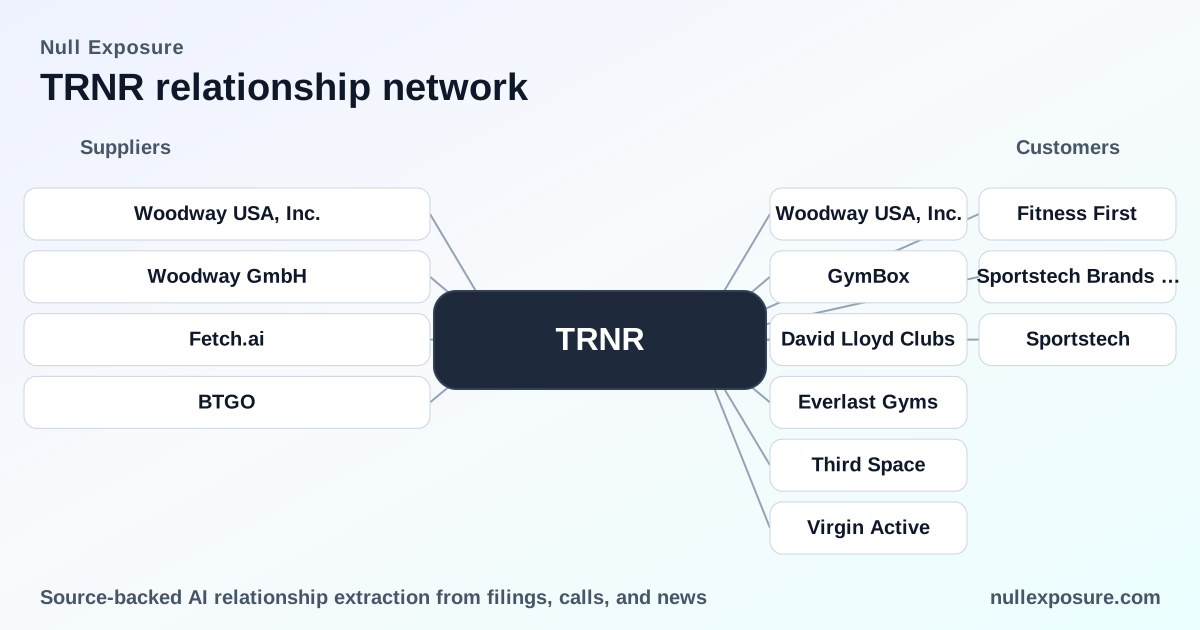
Interactive Strength (TRNR): Supplier Map and What It Means for Investors
Interactive Strength sells connected fitness hardware and accompanying digital services, and it monetizes through device sales, recurring content/service access and strategic distribution deals for hardware lines. The company outsources manufacturing and logistics while retaining product and platform control, so gross margin expansion and service revenue growth depend heavily on supplier execution and distribution partnerships. For deeper supplier intelligence on TRNR visit https://nullexposure.com/ for sourcing and monitoring.
How the business model depends on third parties — a concise operating thesis
Interactive Strength combines hardware-dependent revenue with service/recurring revenue economics: devices generate upfront cash, platforms and content generate ongoing margins. That hybrid model makes supplier relationships a dual lever — they affect both cost-of-goods for hardware and the company’s ability to deliver a reliable customer experience (installation, streaming, payment flows). Supplier concentration and contracting posture directly influence short-term margins, fulfillment risk and the cadence of product launches.
Visit https://nullexposure.com/ for a practical supplier risk checklist and monitoring tools.
Supplier relationships on the record — what investors need to know
Woodway USA, Inc.
Interactive Strength has an Exclusive Distribution Agreement dated February 20, 2024 with Woodway USA, Inc., establishing a formal channel relationship for distribution of certain hardware products. This is documented in TRNR’s FY2024 Form 10‑K filing and signals a formalized U.S. distribution path. (Source: TRNR 10‑K, FY2024 filing, referenced in trnr-2024-12-31.)
Woodway GmbH
European supply for AIR‑PRO units is routed through Woodway GmbH, which the company and press identify as a longstanding distributor for both TRNR products and Wattbike; a March 2026 press report noted a €200k order fulfillment through that channel. This confirms a regional distributor relationship for continental Europe and Germany in particular. (Source: TheNewsStar press release, March 2026.)
Fetch.ai
Interactive Strength announced a securities purchase agreement to back the purchase of FET tokens, positioning part of its treasury to acquire crypto assets tied to Fetch.ai — a non-traditional supplier/partner relationship that effectively makes the company a strategic buyer of platform-native tokens for AI infrastructure exposure. The transaction was reported in March 2026. (Source: TradingView / CryptoBriefing coverage, March 2026.)
BitGo
For custody and trading of its planned crypto holdings, Interactive Strength will utilize BitGo’s custody platform, integrating a third‑party digital-asset custodian into treasury operations for the FET allocation. This was disclosed alongside the Fetch.ai purchase announcement in March 2026. (Source: TradingView / CryptoBriefing coverage, March 2026.)
What the documented constraints say about TRNR’s supplier posture
The company disclosures provide clear operational signals about supplier risk and maturity:
- Contracting posture — short-term and transactional. TRNR states it does not have long-term contracts with most third‑party manufacturers and buys on a purchase‑order basis, which creates flexibility but also execution risk around capacity and pricing. This is a company-level characteristic rather than a relationship-specific claim.
- Geographic concentration — APAC manufacturing footprint. Multiple excerpts identify primary manufacturing in Taiwan and mainland China; this creates exposure to regional natural disasters, supply disruptions, and geopolitical friction that investors must price into scenario analyses.
- Role and criticality — third‑party manufacturers and service providers. The company outsources all product manufacturing and also relies extensively on third‑party logistics, cloud hosting, payment and identity services, and content delivery. Those suppliers are critical to both revenue realization (hardware delivery and white‑glove installs) and subscription experience (streaming, payments).
- Maturity and bargaining dynamics. The lack of long-term manufacturer contracts suggests lower switching costs for TRNR in principle but increases vulnerability to supplier-side capacity constraints and spot price volatility; conversely, explicit distribution agreements (e.g., Woodway USA) show selective longer-form commercial commitments where distribution scale justifies it.
Operational and investment implications — what to underwrite into the model
The supplier map and constraints lead to a compact set of investment implications for operators and allocators:
- Gross-margin sensitivity to supplier pricing and logistics. Given outsourced manufacturing and short-term purchase orders, hardware margin is directly exposed to input cost swings and freight/fulfillment stress.
- Execution risk around product availability in key markets. European availability flows through Woodway GmbH and U.S. distribution has a named agreement with Woodway USA; disruption at a distributor would directly affect near-term device sales in those regions.
- New treasury/asset custody vectors increase operational complexity. The Fetch.ai token purchase plus BitGo custody introduces non-core financial and custody risks into the corporate operating model that require dedicated controls and governance.
- Diversification and contingency planning are priority areas for management. APAC concentration and transactional manufacturing suggest investors should expect management to pursue supplier diversification or contractual upgrades as scale allows.
Key actions for investors and operators:
- Monitor order fill rates and distributor shipping lead times for signs of margin pressure or lost sales.
- Require transparency on custody controls and treasury risk frameworks tied to crypto holdings.
- Stress-test revenue durability under regional supply disruption scenarios (Taiwan/China).
For ongoing supplier exposure monitoring and alerting tools, see https://nullexposure.com/.
Final takeaways and recommended next steps
Interactive Strength’s commercial model is hardware-led but supplier-dependent, and two parallel stories matter for valuation: (1) the company’s ability to convert device sales into recurring service revenue, and (2) its capacity to manage supplier and distribution execution risks while adding unconventional treasury exposure (FET + BitGo custody). Investors should underwrite execution risk on manufacturing and logistics, and quantify incremental operational cost and governance requirements tied to digital-asset holdings.
For a full supplier intelligence briefing and continuous monitoring tailored to TRNR, visit https://nullexposure.com/ and request a supplier risk report.