T. Rowe Price Group (TROW): what its supplier map says about operational leverage and vendor risk
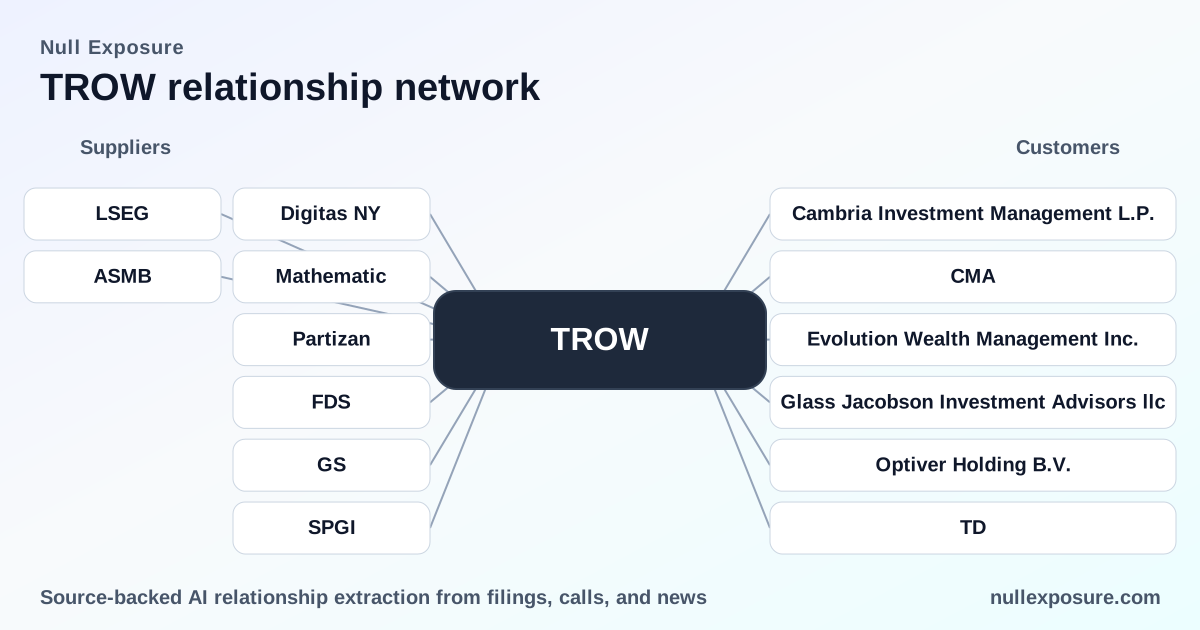
T. Rowe Price (TROW) monetizes investment expertise and client relationships: it collects management and advisory fees on assets under management, sells packaged funds and retirement solutions, and subsidizes distribution through third‑party intermediaries. The firm's supplier footprint is a blend of creative and data vendors for marketing, index and market-data partners for research, and distribution/clearing relationships that underpin product accessibility — each relationship has different operational criticality and contract posture. For investors assessing counterparty risk or procurement exposure, the supplier roster highlights where business continuity and brand execution depend on third parties. Read more on vendor implications at https://nullexposure.com/.
Quick operating thesis for investors
T. Rowe Price is a fee-driven asset manager with high client concentration toward institutional and intermediary channels and significant reliance on third parties for distribution infrastructure, market data, and marketing activation. The company’s unit economics are robust (profit margin and ROE strong on reported figures) but the operational model requires stable supplier performance: marketing partnerships move demand and brand perception, while data and index providers support investment processes and product benchmarking. These relationships are not discretionary in the short run — they are functional to revenue generation and client retention.
What the supplier list actually reveals about contracting and risk
- Contracting posture: T. Rowe Price engages both creative agencies and large market-data vendors; creative relationships (project-based campaigns) imply short- to medium-term contracts, while data/index agreements are typically multi-year, renewable licenses.
- Concentration: The presence of major index and data providers signals concentration in a small set of critical vendors for benchmarking and analytics.
- Operational criticality: Clearing and distribution arrangements are existential to product delivery; data and index feeds are mission-critical to portfolio management.
- Maturity: Many supplier relationships manifest as established, professional vendors (e.g., FactSet, FTSE/Russell, Goldman Sachs collaboration), not ad-hoc partners, indicating a mature procurement posture.
These are company-level signals drawn from public citations and reporting; they are not tied to a single supplier unless an excerpt explicitly names that supplier.
Supplier roster and what each relationship means for operators and investors
Below are the relationships identified in public mentions. Each entry includes a plain-English take and a source citation.
- Digitas NY — T. Rowe Price engaged Digitas NY to develop a brand campaign, indicating a marketing-led vendor relationship used to shape investor-facing communications; the engagement is project-based and focused on creative output (LBBonline, March 10, 2026: https://lbbonline.com/news/t-rowe-price-spotlights-the-power-of-curiosity).
- Assembly — Assembly was contracted to develop the activation plan for the same campaign, signaling specialized activation/activation-strategy support that translates creative work into distribution and media plans (LBBonline, March 10, 2026: https://lbbonline.com/news/t-rowe-price-spotlights-the-power-of-curiosity).
- Mathematic — The firm handled special effects for commercials, a role consistent with production and post-production vendors engaged on a per-project basis to ensure high-quality visual output (LBBonline, March 10, 2026: https://lbbonline.com/news/t-rowe-price-spotlights-the-power-of-curiosity).
- Partizan — Antoine Bardou-Jacquet of Partizan directed the commercial shoots, which demonstrates T. Rowe Price’s use of award-winning creative talent to elevate brand campaigns and signal premium positioning (LBBonline, March 10, 2026: https://lbbonline.com/news/t-rowe-price-spotlights-the-power-of-curiosity).
- FactSet Research Systems Inc. (FDS) — T. Rowe Price cites FactSet as a data source in its dividend-growth analysis, confirming reliance on established market-data vendors for research and performance calculations (T. Rowe Price insight page, March 2026: https://www.troweprice.com/en/uk/financial-intermediary/insights/why-dividend-growth-investing-has-staying-power).
- Compustat (SPGI) — The firm references Compustat as a data source in analytical work, indicating use of standardized financial databases for historical analytics and backtesting (T. Rowe Price insight page, March 2026: https://www.troweprice.com/en/uk/financial-intermediary/insights/why-dividend-growth-investing-has-staying-power).
- FTSE/Russell (LSEG) — T. Rowe Price lists FTSE/Russell among index sources, which underscores dependence on index providers for benchmarking and target-date product construction (T. Rowe Price insight page, March 2026: https://www.troweprice.com/en/uk/financial-intermediary/insights/why-dividend-growth-investing-has-staying-power).
- Goldman Sachs (GS) — T. Rowe Price developed a target-date series in collaboration with Goldman Sachs, signaling strategic co‑development with large financial institutions for product design and distribution scaling (T. Rowe Price target-date review, March 2026: https://www.troweprice.com/personal-investing/resources/insights/target-date-year-in-review.html).
Commercial implications for procurement and risk management
- Marketing/creative vendors (Digitas NY, Assembly, Mathematic, Partizan) are low-to-medium operational risk but high impact on brand and net-new flows; these engagements are typically contractually flexible but require tight SLAs on deliverables and intellectual property rights.
- Data and index providers (FactSet, Compustat, FTSE/Russell) are high operational criticality: outages, fee increases, or license disputes would affect research, valuations, and product benchmarking. Renegotiation risk can pressure margins given the indispensability of these services.
- Strategic partnerships with large financial institutions (Goldman Sachs) are high strategic value and can materially affect distribution, product design, and credibility in target segments.
If you need a structured vendor risk scorecard tailored to these relationships, start here: https://nullexposure.com/.
Constraints and company-level vendor signals
Two relevant company-level constraints surfaced from disclosures: first, T. Rowe Price recognizes distribution costs paid to third‑party financial intermediaries, which implies ongoing commission and servicing expense lines and an active distribution ecosystem. Second, T. Rowe Price references Pershing as a third‑party clearing broker that maintains brokerage customer accounts and clears transactions, indicating reliance on established clearing partners for order execution and custody flows. These are signals of a procurement posture that mixes long-term infrastructure contracts (clearing, data) with shorter-term agency arrangements (marketing, production).
Where investors should focus: risk vs. optionality
- Risk: Concentration among a handful of market-data and clearing providers increases vendor leverage; data license cost inflation or service interruption would have immediate operational impact. FactSet/Compustat/FTSE-Russell are notable in this dimension.
- Optionality: Marketing and production vendors offer flexibility to pivot brand strategy and are less likely to create systemic operational failure. Strategic alliances (e.g., with Goldman Sachs) create scalable distribution pathways and product innovation optionality.
Bottom line and next steps
T. Rowe Price runs a balanced supplier model: creative agencies fuel flows; data and index vendors underpin investing and product construction; clearing and distribution partners enable access. For investors and procurement teams, the action is twofold: monitor vendor concentration and license terms for critical data/clearing services, and treat marketing partners as tactical levers for demand generation.
For deeper vendor-mapping or a tailored supplier risk assessment, visit https://nullexposure.com/ for consultancy and intelligence. If you want a vendor heat map that links contractual exposure to revenue sensitivity, start the conversation at https://nullexposure.com/.