TrustCo Bank Corp NY (TRST): Supplier relationships and operational constraints investors should price in
TrustCo Bank Corp NY operates as a regional federally chartered savings bank, monetizing through traditional net interest income, fee-based personal and business banking services, and a modest share repurchase program to support per-share metrics. The company runs a multi-state branch footprint and outsources a broad set of communications, information and technology functions to third parties, creating supplier-driven operational dependencies that influence cost structure and operational resilience. For a concise vendor-risk view and supplier intelligence, visit https://nullexposure.com/ for the full supplier map.
The investor thesis in one paragraph
TrustCo (TRST) is a low-beta regional bank with a tangible book and steady profitability: ROE ~8.35% and profit margin ~31% on $181m revenue (TTM). The franchise generates core earnings via deposit spread and fees while selectively returning capital via dividends and share repurchases. The operating model is branch-centric and third-party services-intensive, so supplier posture—contract terms, geographic exposure and service criticality—translates directly into operational and capital risk that investors must price.
How suppliers shape a regional bank’s economics
Regional banks are straightforward businesses until operations fail: branch leases, core processors, comms and cybersecurity vendors, and clearing/payment relationships determine both cost dynamics and outage risk. TrustCo’s model amplifies that fact because it operates 136 offices across five states, with the majority leased on market terms—creating a long-term contractual exposure to real estate landlords and service contracts. According to company filings through FY2025, 113 of 136 properties are leased and lease expirations range from 1 month to nearly 20 years, indicating material long-term lease obligations that underpin branch distribution economics.
Every recorded relationship the record shows
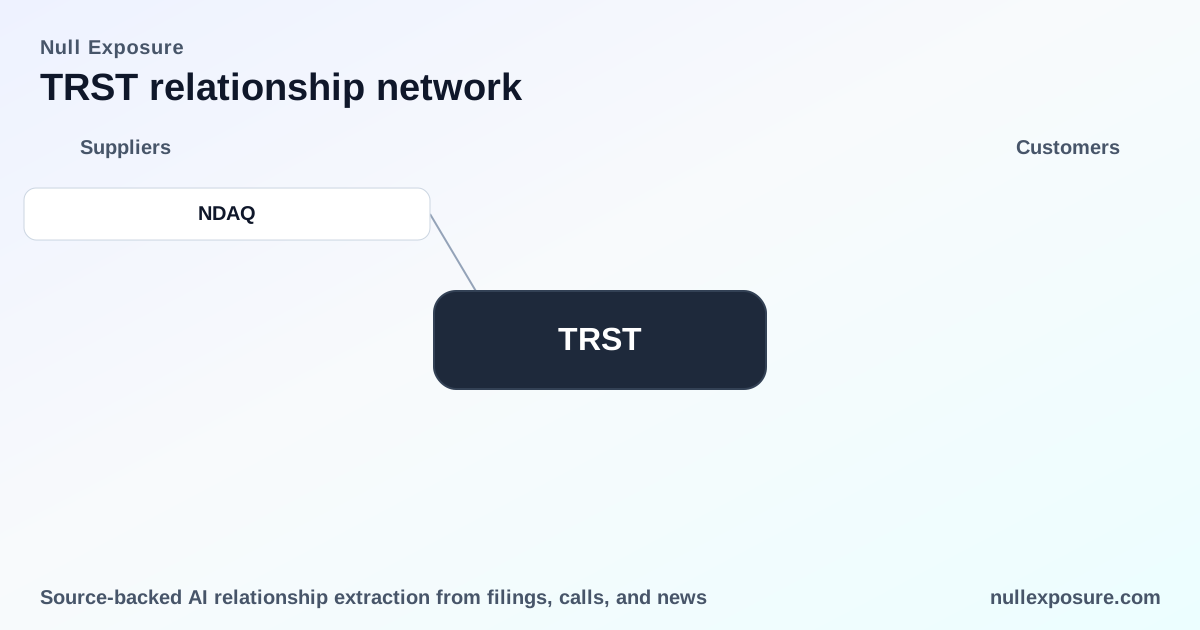
TrustCo’s supplier data returned a single explicit relationship in public reporting:
- Nasdaq Global Select Market (NDAQ) — TrustCo’s common shares are listed and traded on the Nasdaq Global Select Market under the ticker TRST; the listing was referenced in a company press release announcing a share repurchase program in December 2025. This is a market-access relationship that enables liquidity, reporting obligations and compliance costs tied to a national exchange listing. (GlobeNewswire press release, December 19, 2025.)
This listing relationship is transactional and public-facing rather than a back-office vendor, but it carries governance and disclosure obligations that shape capital actions (for example, repurchase programs) and cost of compliance.
Constraints in the supplier posture — what the facts signal
The vendor and contract constraints uncovered in filings present a concise picture of TrustCo’s operating posture:
- Long-term contracts and leased footprint. The bank operates 136 offices; 113 are leased and lease expirations span up to 19.8 years. That signals a long-duration real estate commitment that limits near-term flexibility on branch rationalization and imposes future renewal and rental-rate exposure. (Company filing excerpts, FY2024–FY2025 disclosures.)
- Geographic concentration across northeastern and southeastern states. Operations are concentrated in New York, New Jersey, Vermont, Massachusetts and Florida, which creates regional credit and operational correlation to local economic cycles and regulatory regimes rather than national diversification.
- Service-provider reliance for operations and controls. TrustCo explicitly states heavy reliance on third-party providers for communications, information and financial control systems. That investment and dependency profile elevates vendor concentration and cyber/technology risk relative to a bank that insources core platforms.
- Segment focus on services. The bank’s operating disclosures emphasize outsourced services, indicating the supplier relationships are operationally critical rather than peripheral.
These constraints should be read as company-level signals about how TrustCo runs its business, not as attributes of any single supplier unless explicitly named.
What this means for investors and operators
The supplier footprint and constraints translate into clear investment and operational implications:
- Cost rigidity and leasing exposure. Long-term leases make branch cost structure sticky and create path dependency in branch rationalization decisions. Investors should underwrite scenarios where higher commercial rents or office consolidation needs compress margins.
- Operational concentration risk. Heavy outsourcing of communications and controls concentrates operational risk in a small set of third-party providers; a high-severity vendor outage or breach would have immediate customer-impact and regulatory consequences.
- Regulatory and market-facing obligations. The Nasdaq listing constrains capital actions to disclosure and market-timing considerations; the December 2025 repurchase program shows the bank uses repurchases to manage share count and return on equity.
- Regional economic sensitivity. With the branch footprint concentrated in several states, local economic shocks (real estate, employment, tourism in Florida) will transmit to loan performance and deposit behavior more directly than for a nationally diversified bank.
Key things to monitor: vendor concentration metrics, upcoming lease expirations and renewal obligations, third-party audit and SOC reports, cybersecurity incident history, and any changes to the exchange listing or reporting status.
Pragmatic risk checklist for due diligence
- Confirm the identity and contractual tenor of core processors and communications vendors and request termination/transfer clauses.
- Map lease expirations and estimated renewal costs for the 113 leased properties; identify any single-year clusters that could compress capital.
- Review board-level oversight of vendor risk management and penetration testing outcomes.
- Track any Nasdaq filings tied to capital actions (repurchases, dividends) that reflect how management balances growth and shareholder returns.
For a vendor-level view and supplier scoring that translates disclosures into investment signals, see https://nullexposure.com/.
Bottom line and recommended next steps for investors
TrustCo is a profitable regional bank with a durable branch network and a clear dependency on long-term leases and outsourced service providers. These characteristics create both defensive strengths (stable physical distribution, steady fee lines) and concentrated operational risks (vendor outages, lease renewal exposure). Investors should treat vendor and lease disclosures as first-order risks when modeling downside scenarios and credit-sensitive stress tests.
To act: obtain vendor contracts or SOC attestations from management, stress-test lease renewal costs in downside cases, and monitor exchange filings for capital deployment changes. For further supplier-level intelligence and alerts that mesh with investment models, visit https://nullexposure.com/ for detailed supplier mappings and updates.
Bold, supplier-aware underwriting and targeted operational diligence will separate passive buyers from active, risk-aware investors in TRST.