Triton International (TRTN-P-A): Who underwrote the preferred and what that means for counterparties
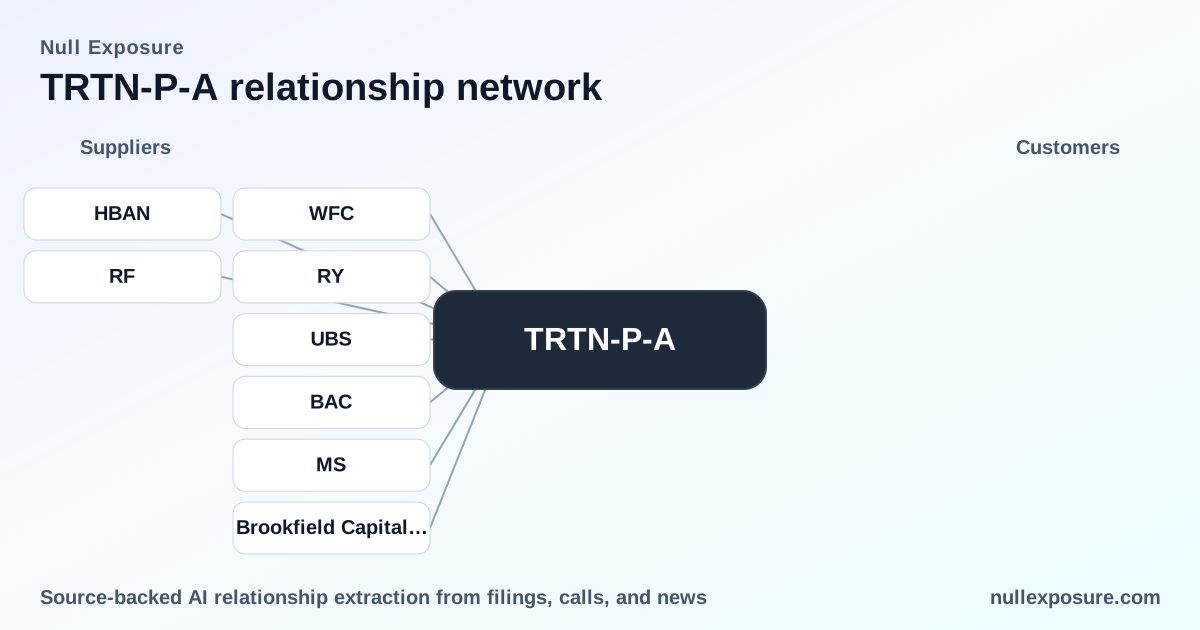
Triton International monetizes a global fleet of intermodal containers through lease revenue and residual-value management, and it funds fleet capital needs by accessing public and private capital markets—most recently through a preferred-stock offering. The placement of TRTN-P-A was handled by a broad syndicate of global and regional banks, signaling institutional distribution capability and established capital-market access that support fleet financing and dividend stability for preferred holders.
If you want a concise, supplier-focused breakdown of the placement and its market implications, visit the Nillexposure homepage: https://nullexposure.com/.
Why the underwriting line-up matters to investors and operators
The names on an underwriting syndicate are not window dressing; they tell a story about distribution, pricing power, and access to liquidity. Triton’s choice to use a mix of global banks and regional co-managers conveys several company-level operational signals:
- Contracting posture: Triton runs active capital-market programs and contracts with top-tier underwriters to execute equity and preferred issuances, indicating a proactive financing stance.
- Concentration and distribution: A multi-bank syndicate spreads placement risk and expands investor reach, which reduces single-counterparty distribution concentration.
- Criticality of relationships: Investment banks are functionally critical for primary raises—underwriting and market-making support immediate funding needs for fleet investment.
- Maturity of market access: The presence of major global dealers signals mature access to institutional investors and robust deal execution capability.
These are company-level signals about how Triton manages funding and liquidity; they are not assigned to any single relationship unless that relationship explicitly conveys a constraint.
Who ran the deal — concise takeaways for each counterparty
The following firms were listed in Triton’s public notice of pricing for the offering; each description is a plain-English take on the role they played.
-
Wells Fargo Securities, LLC — Served as a joint book-running manager on the TRTN-P-A offering, acting as a lead underwriter responsible for pricing and distribution to institutional clients, according to a press release published on Yahoo Finance on March 10, 2026.
(Source: Yahoo Finance, March 10, 2026.) -
BofA Securities, Inc. — Named among the joint book-running managers, BofA handled institutional placement and syndicate coordination as part of the lead underwriting group.
(Source: Yahoo Finance, March 10, 2026.) -
Morgan Stanley & Co. LLC — Participated as a joint book-running manager, bringing institutional sales coverage and execution capability to the preferred offering.
(Source: Yahoo Finance, March 10, 2026.) -
RBC Capital Markets, LLC — Listed as a joint book-running manager, RBC provided distribution reach into U.S. and international institutional channels during the placement.
(Source: Yahoo Finance, March 10, 2026.) -
UBS Investment Bank — Served as a joint book-running manager, contributing global investor access and syndicate support for the issuance.
(Source: Yahoo Finance, March 10, 2026.) -
Brookfield Capital Solutions — Identified as a co-manager, Brookfield’s role focused on supporting distribution and placement alongside the primary book-runners.
(Source: Yahoo Finance, March 10, 2026.) -
Huntington Securities, Inc. — Acted as a co-manager, supplying regional placement capacity and additional distribution channels for the offering.
(Source: Yahoo Finance, March 10, 2026.) -
Regions Securities LLC — Functioned as a co-manager, helping extend the syndicate’s reach into regional institutional and private client channels.
(Source: Yahoo Finance, March 10, 2026.)
What this syndicate composition implies for counterparties and suppliers
The mix of global heavyweights (Wells Fargo, BofA, Morgan Stanley, RBC, UBS) with specialized regional and alternative managers (Brookfield Capital Solutions, Huntington, Regions) is deliberate and instructive for suppliers and operators:
- Execution depth: Top-tier banks in the lead indicate access to deep institutional liquidity, which supports timely funding for fleet purchases or refinancing needs.
- Distribution breadth: Regional co-managers extend retail and regional institutional reach—useful when issuing securities that need broad placement beyond marquee institutional accounts.
- Cost and governance implications: Using a larger syndicate increases underwriting fees but improves execution certainty; for suppliers, that translates into a company with active access to capital but with associated financing costs that influence cash flow priorities.
- Operational criticality: These underwriting relationships are strategically important because primary issuance supports the company’s core leasing footprint and working capital—any disruption to primary-market access would be operationally meaningful.
Explore how these dynamics affect supplier exposure and counterparty credit by visiting Nillexposure for deeper supplier intelligence: https://nullexposure.com/.
Risk factors and what to watch next
For investors and counterparties evaluating exposure to Triton via TRTN-P-A or commercial relationships, prioritize these items:
- Market access risk: Despite a strong syndicate, market conditions (rates, demand for credit instruments) will directly affect Triton’s ability to refinance or grow the fleet.
- Funding cost pressure: Underwriting fees and market pricing translate into higher cost of capital that competes with dividend and reinvestment priorities; monitor subsequent issuance spreads and coupon levels.
- Concentration of funding types: If preferred and equity issuance substitute for secured borrowing, supplier credit exposures shift depending on balance-sheet leverage and liquidity management.
Bottom line: where this leaves the investor or supplier
Triton’s TRTN-P-A placement demonstrates institutional financing muscle and a pragmatic distribution strategy. For suppliers and operators, the presence of top-tier underwriters reduces short-term funding uncertainty but introduces capital-cost dynamics that will shape procurement and payment behavior.
Want a tailored supplier risk brief or counterparty scorecard on Triton and its syndicate partners? Start with Nillexposure for targeted supplier intelligence and relationship mapping: https://nullexposure.com/.
(Primary source for relationship listings: Triton International press release on Yahoo Finance, March 10, 2026.)