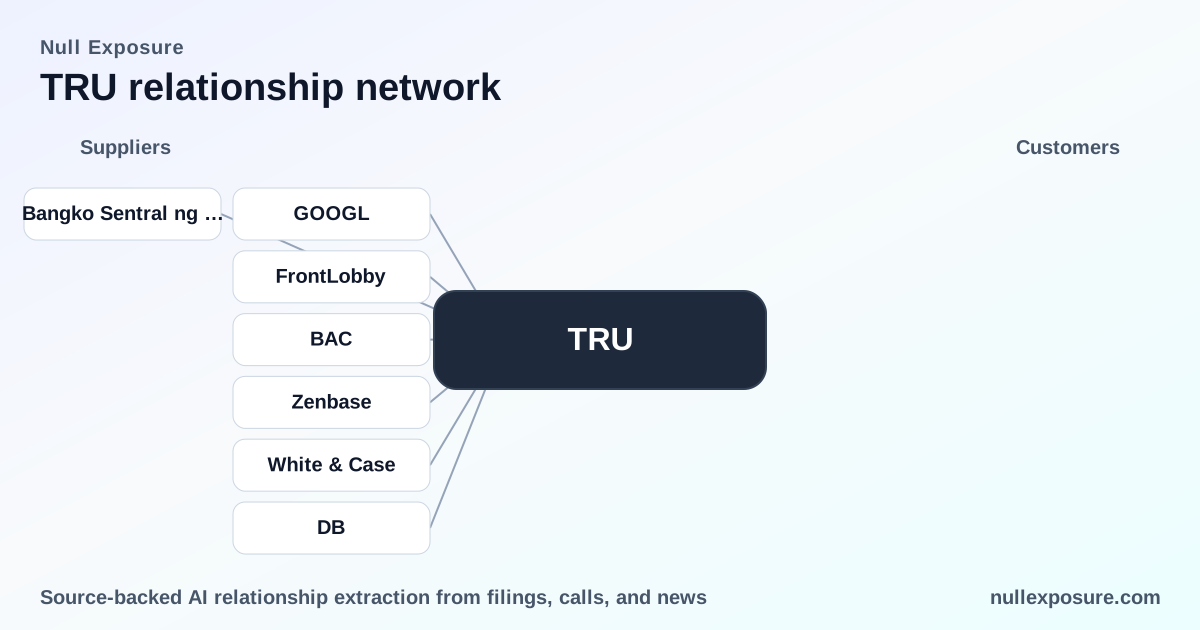
TransUnion (TRU): Supplier Relationships That Power Credit Intelligence
TransUnion sells risk and information solutions to financial institutions, lenders, and enterprises by aggregating consumer data, licensing analytics, and delivering subscription software and professional services. The company monetizes through a mix of recurring SaaS fees for analytics platforms, transaction fees for consumer credit products, and licensing arrangements for third‑party models and data. Investors should evaluate supplier ties both for product capability (AI, cloud, specialty data) and for operational concentration risk. For a broader supplier risk lens, visit https://nullexposure.com/.
Why suppliers matter for a credit‑intelligence leader
TransUnion’s product stack is two parts data and one part compute/analytics: proprietary and partner-supplied data feed its credit files, while cloud and AI partners accelerate model development and productization. Supplier choices therefore influence speed-to-market, cost structure, and compliance posture—critical inputs to margin and growth forecasts. The relationships below outline how TransUnion sources technology, specialized data, advisory services, and capital markets support.
All disclosed supplier relationships and what they mean for investors
-
Google / Google Cloud / Google LLC — TransUnion has launched an AI Analytics Orchestrator Agent built on Google’s Vertex AI and powered by Gemini models to enhance explainable credit analytics across the TruIQ suite, signaling a strategic cloud and generative-AI partnership to accelerate product features. This linkage is documented in TransUnion press materials and multiple news outlets in March 2026, including the company newsroom and coverage by SiliconANGLE and SimplyWall.St.
Source: TransUnion newsroom (Investor Day, March 2026) and SiliconANGLE (March 2026). -
FrontLobby — TransUnion formed a partnership with FrontLobby to add rental payment histories into its credit reports as a distinct category, expanding alternative credit signals for renters and broadening coverage of non‑traditional credit behaviors. Coverage of the new rental-data partnerships was reported by SimplyWall.St in March 2026.
Source: SimplyWall.St (March 2026). -
Zenbase — TransUnion announced a similar collaboration with Zenbase to incorporate rental payment histories into consumer credit records, reinforcing the firm’s strategy to diversify inputs into credit scoring and increase inclusion for renters. Reporting on this partnership appeared in SimplyWall.St in March 2026.
Source: SimplyWall.St (March 2026). -
BofA Securities (Bank of America) — BofA Securities acted as financial advisor to TransUnion in connection with TransUnion’s acquisition of majority ownership of the consumer credit business of Buro de Crédito, illustrating the role of large investment banks in TransUnion’s inorganic growth and capital allocation execution. The transaction and advisors were disclosed on TransUnion’s newsroom in March 2026.
Source: TransUnion newsroom (transaction announcement, March 2026). -
White & Case — White & Case served as legal advisor to TransUnion for the Buro de Crédito transaction, indicating reliance on global law firms for cross-border M&A execution and regulatory navigation in Latin America. Legal advisor disclosure is included in TransUnion’s transaction announcement.
Source: TransUnion newsroom (transaction announcement, March 2026). -
Deutsche Bank New York Branch — TransUnion amended a credit agreement that lists Deutsche Bank New York Branch among the lending counterparties, reflecting ongoing syndicated financing relationships used to manage liquidity and support strategic transactions. TradingView reported the credit agreement amendment in March 2026.
Source: TradingView summary of credit agreement amendment (March 2026). -
Bangko Sentral ng Pilipinos (BSP) — TransUnion partnered with the BSP to deliver digital financial‑education materials across the Philippines, demonstrating a regulatory and public‑sector engagement strategy to increase financial literacy and support product adoption in emerging markets. The partnership details were published on TransUnion Philippines’ newsroom in 2026.
Source: TransUnion Philippines newsroom (2026).
What the supplier mix reveals about TransUnion’s operating model
The disclosed relationships show a company that is both platform‑driven and partner‑dependent in discrete areas.
-
Contracting posture: TransUnion uses a mix of licensing and service contracts. Company disclosures confirm licensing of third‑party scoring algorithms and contracting with external service providers to maintain systems, indicating a pragmatic approach that blends insourcing of core data assets with outsourced technology and advisory services.
-
Concentration and criticality: Google/Google Cloud is a strategic technology partner for AI and cloud infrastructure; that relationship is highly critical for product acceleration and model delivery. Banking and advisory partners (BofA, Deutsche Bank, White & Case) support capital markets and transactional activity rather than day‑to‑day product operations.
-
Maturity of relationships: Legal and financial advisors are mature, transactional relationships tied to M&A and financing. Newer partnerships with FrontLobby and Zenbase target data enrichment and market expansion, reflecting a strategic push to broaden consumer coverage and support product-led growth.
-
Operational implications: Relying on third‑party models and cloud AI platforms reduces time‑to‑market but introduces dependency on vendor roadmaps, pricing, and compliance controls. Investors should price both the upside from rapid feature deployment and the risk of platform dependency into valuation models.
Risk versus opportunity — the investor checklist
- Opportunity: Google Cloud partnership accelerates product differentiation in AI-driven credit intelligence and supports cross‑sell of TruIQ solutions; rental‑data partnerships expand addressable market among renters.
- Risk: Vendor concentration on major cloud/AI providers creates operational dependency and negotiating leverage for suppliers; syndicated credit facilities and M&A activity introduce financing and integration execution risk.
- Governance note: Active engagement with central banks and regulatory bodies in growth markets reduces consumer‑protection friction and supports onboarding for new data sources.
For a practical supplier-risk scoring framework and ongoing monitoring, explore governance tools at https://nullexposure.com/.
Strategic takeaways for operators and institutional investors
- Product strategy is increasingly co‑engineered with partners. AI and cloud suppliers accelerate capability delivery but require clear contractual SLAs and IP carveouts to protect margins and data control.
- Data diversification is a growth lever. Integrating rental payment streams extends credit access and supports volume growth; investors should watch adoption velocity and contribution to receivable/transaction revenues.
- Financial and legal advisors signal deal readiness. Recent advisor appointments and credit amendments coincide with inorganic expansion—monitor integration metrics and cost of capital impact on free cash flow.
If you evaluate supplier risk as part of underwriting or portfolio oversight, review TransUnion’s relationship map and latest filings at https://nullexposure.com/ for ongoing updates.
Bottom line
TransUnion’s supplier set underscores a dual strategy: accelerate analytics and product capability through deep cloud/AI partnerships while expanding data inputs via specialist vendors and public‑sector engagement to grow credit coverage. Investors should balance the revenue and feature upside against vendor concentration risk and financing cadence. For continuous updates and supplier‑level intelligence, visit https://nullexposure.com/.