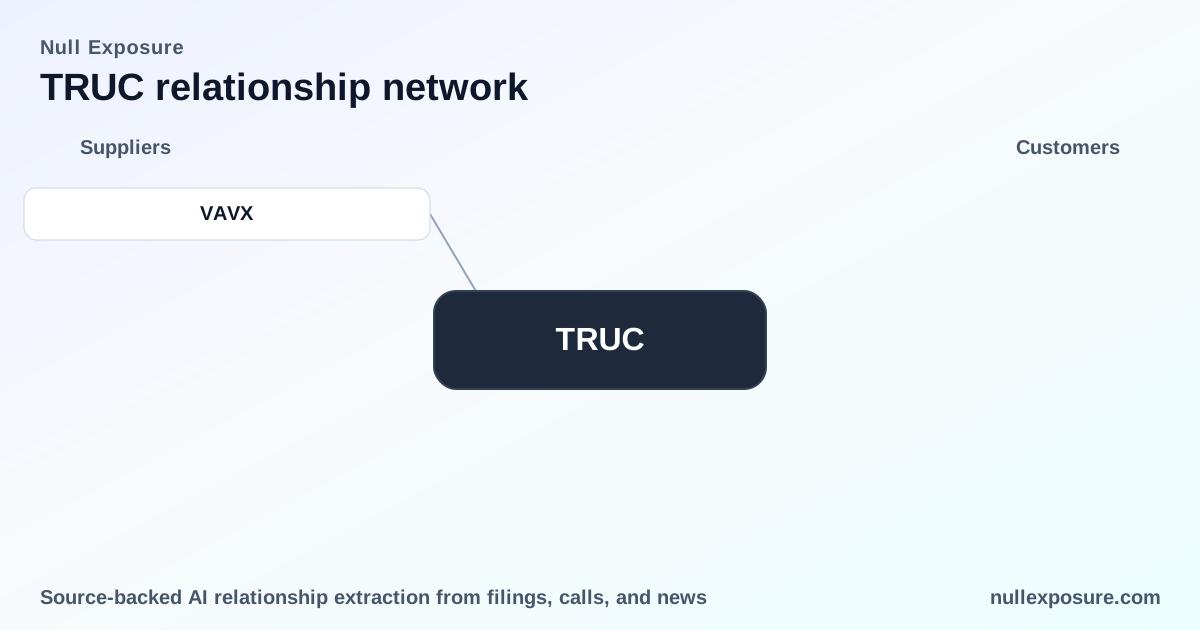
TRUC (Professional Transportation Group Ltd Inc): supplier signal brief and relationship map
Professional Transportation Group Ltd Inc (Ticker: TRUC) operates as a specialized logistics and transportation services provider, monetizing through contracted freight and route-based service agreements, technology-enabled routing and fleet management, and ancillary logistics services sold to corporate customers. Revenue is derived from operational delivery of transportation services and related logistics contracts, with margins driven by route efficiency, asset utilization and service mix. This note maps public supplier/market signals tied to TRUC, interprets what those signals reveal about operational exposure and contracting posture, and identifies immediate research actions for investors evaluating supplier relationships. Learn more and explore the source inventory at https://nullexposure.com/.
How TRUC runs and where the money flows
TRUC is positioned as a services operator: it sells time- and distance-based transportation, logistics planning and execution, and value-added services to commercial clients. Operational cash flow is contract-driven rather than asset-appreciation-driven, meaning client contracts, fleet uptime and operational discipline directly determine topline stability. Contracts will generally be short-to-medium term in transportation markets, so client concentration and route exclusivity are the primary levers on revenue volatility, while technology and workforce competency drive cost efficiency.
- Contracting posture: transactional and renewal-based, with recurring service contracts but limited long-term lock-ins typical of trucking/logistics.
- Concentration: The business model is sensitive to a small number of large contract wins or losses; investors should prioritize counterparty exposure and revenue concentration analysis.
- Criticality: Services are operationally critical to clients’ supply chains; loss of capacity or major service interruption would have immediate revenue impact.
- Maturity: As a service operator in an evolving logistics environment, TRUC’s maturity signal is mixed—established operational mechanics but growth and scale constraints driven by asset intensity and market competition.
If you want a consolidated signal view or to cross-reference supplier relationships, start here: https://nullexposure.com/.
What public signals show about supplier/market links
The public relationship inventory for TRUC is sparse and dominated by market-news mentions that reference the ticker in an ETF context. Below I list every relationship result surfaced in the public feed and provide a plain-English summary with source context.
VanEck — Communications Services TruSector ETF (Meyka analysis)
Meyka’s stock analysis page for TRUC references VanEck’s Communication Services TruSector ETF in a context that tags the ETF with the TRUC ticker (Meyka, March 10, 2026; https://meyka.com/stock/TRUC/analysis/). This mention indicates market-data or news-tagging overlap between the Professional Transportation Group ticker and an ETF name in retail/market coverage.
VanEck — price-movement note (why-stock-up-today)
A separate Meyka item titled “why-stock-up-today” reported VanEck Communication Services TruSector ETF (TRUC) trading up +1.13% at $25.85, reflecting intraday market commentary (Meyka, March 10, 2026; https://meyka.com/stock/TRUC/why-stock-up-today/). This is a market-sentiment signal tied to short-term price movement commentary referencing the TRUC ticker in an ETF context.
Reading the relationship list: practical implications
Both public relationship entries point to the same external entity (VanEck) but in the context of its ETF branding. This creates a clear signal-noise challenge for investors tracking supplier links for a small services company: market data and news aggregators are tagging the TRUC ticker with ETF-related coverage, which can obscure true supplier or commercial relationships. Treat these entries as market-tagging signals rather than evidence of an actual commercial supplier contract between Professional Transportation Group and VanEck.
Key operational takeaways:
- Signal contamination is the primary risk — brokerage, news aggregators and crawlers frequently conflate tickers with unrelated entities; that is the likely explanation for the VanEck references in the TRUC feed.
- No direct supplier contracts or vendor relationships were disclosed in the public feed. Investors should not interpret ETF mentions as supplier relationships without further corroboration.
- Data sparsity increases counterparty risk assessment costs. When supplier disclosure is limited, allocate research resources to direct primary-source checks: company filings, client lists, carrier agreements and 10-Q/8-K disclosures (as applicable).
You can request a more granular supplier-disambiguation report here: https://nullexposure.com/.
Operational constraints and company-level signals
The relationship-specific feed includes no explicit contractual constraints. As a result, company-level operating signals become the principal inputs for risk assessment:
- Disclosure scarcity: The absence of supplier constraints or contract excerpts in public signals points to either limited public disclosure or low integration with third-party aggregators. This raises the bar for primary due diligence.
- Concentration vulnerability: Given the transportation business model’s reliance on contract renewals and route economics, absence of supplier detail increases the probability that large-client exposure could be underreported.
- Maturity and criticality: The firm’s operating maturity is typical for specialized logistics operators—established service mechanics but high operational leverage; service continuity is critical to client obligations and therefore contract terms and carrier insurance/contingency arrangements should be prioritized in review.
What investors should do next
- Demand primary documentation: obtain customer lists, major contract samples, and recent filings or investor presentations that confirm revenue sources and counterparty identity.
- Validate market signals: verify whether news mentions are ETF/ticker conflations and get cleaned entity resolution from data providers.
- Stress-test concentration: model revenue sensitivity to losing one or two top clients and evaluate contract termination clauses and cure periods.
Actionable investor tools and deeper supplier mapping are available at https://nullexposure.com/.
Bottom line
Public relationship signals for TRUC consist solely of market-commentary references to VanEck’s ETF branding in March 2026, which does not constitute evidence of commercial supplier relationships for Professional Transportation Group. For investors, the priority is to resolve ticker-level noise, secure primary sourcing on client and vendor contracts, and stress-test exposure to concentration and operational interruptions. Until primary-source supplier disclosures are obtained, counterparty risk cannot be reliably quantified from the public feed alone.
For an accelerated supplier-disambiguation package and primary-source validation, visit https://nullexposure.com/.