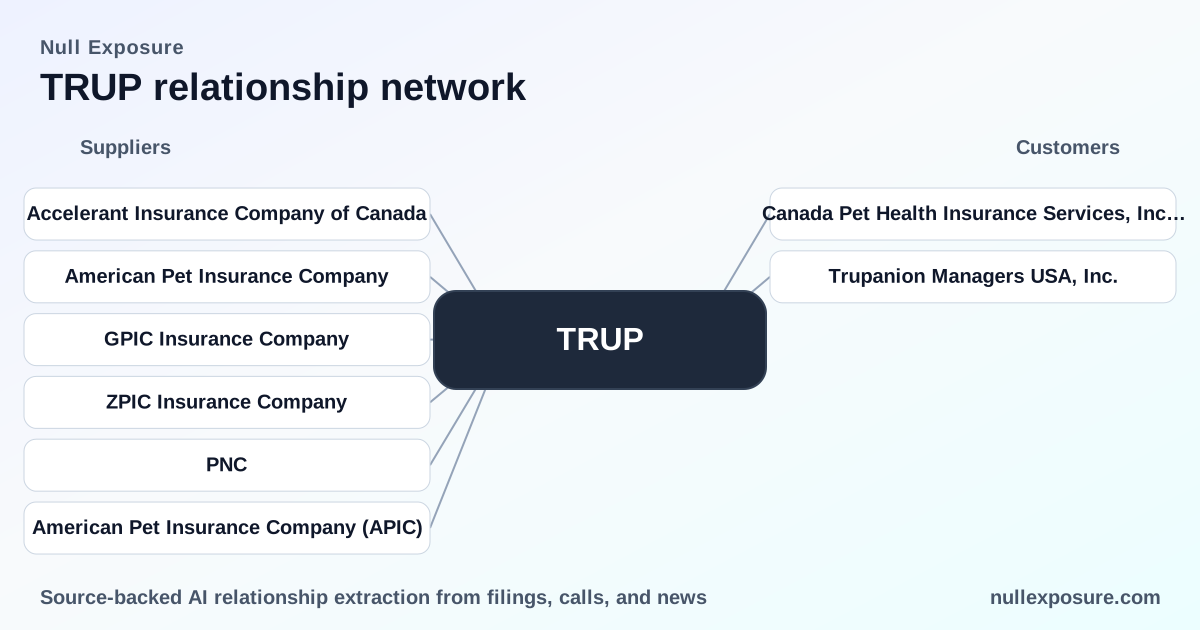
Trupanion (TRUP): How its supplier and financing relationships shape underwriting and cash flow
Trupanion operates a subscription-based veterinary medical insurance franchise, issuing policies for dogs and cats and collecting monthly premiums while outsourcing claims payment and some operational functions. The company underwrites risk through a set of affiliated insurance entities and supports liquidity with bank financing; it monetizes through premium retention, service fees, and investment income on reserves. Investors should evaluate Trupanion through two lenses: the operational links between Trupanion and its carrier affiliates that determine underwriting economics, and the external financing and third‑party service arrangements that affect liquidity and claims execution. Learn more context and relationship mapping at https://nullexposure.com/.
The operating model in plain language: why suppliers matter to returns
Trupanion’s business is simple on paper—collect premiums, pay veterinary claims, and maintain customer lifetime value—but the economics are driven by how the firm delegates underwriting and operations. Policies are issued by a small set of insurance affiliates, creating concentrated counterparty routing for regulatory capital and claims flow. At the same time, Trupanion contracts with third‑party service providers for parts of claims processing and back‑office staffing, which shifts fixed costs and introduces operational dependencies.
- Contracting posture: Trupanion uses wholly‑owned insurance entities to issue policies in core markets and engages third‑party vendors for manpower and claims administration functions, indicating a mixed captive/outsourced posture that balances regulatory control with variable operating cost.
- Concentration and criticality: A handful of carrier affiliates handle policy issuance and regulatory compliance; those relationships are critical to delivery and underwriting control.
- Maturity and scale: Trupanion’s model is mature enough to support syndicated bank financing while still sensitive to claims trends and partner performance—capital access and claims execution are both material to near‑term results.
For investors seeking an actionable supplier map and to prioritize diligence, start with the carrier affiliates and the new credit facility disclosures. For direct access to this supplier mapping, visit https://nullexposure.com/.
Who Trupanion works with — relationship map from recent FY2026 disclosures
Below are each of the counterparties surfaced in Trupanion’s FY2026 reporting and related news, with one‑line plain‑English summaries and source notes.
Accelerant Insurance Company of Canada
Trupanion issues Canadian policies through Accelerant Insurance Company of Canada as one of its authorized Canadian carriers; the company disclosed this routing in its FY2025/FY2026 earnings materials. According to Trupanion’s public results commentary and press release coverage, Accelerant is explicitly named as a Canadian policy issuer. (GlobeNewswire press release, Feb 12, 2026; Finviz news coverage, Mar 2026)
American Pet Insurance Company (APIC)
American Pet Insurance Company is Trupanion’s primary U.S. insurance carrier affiliate that issues policies for the company in the United States, and it is referenced repeatedly in investor materials as the principal underwriting vehicle. (The Globe and Mail transcript of the Q4 2025 call; Finviz news, Mar 2026)
GPIC Insurance Company
Trupanion uses GPIC Insurance Company as a Canadian insurance entity alongside Accelerant to issue policies in Canada, forming part of the company’s multi‑entity approach to regional underwriting and regulatory compliance. (GlobeNewswire press release, Feb 12, 2026; Finviz news, Mar 2026)
ZPIC Insurance Company
ZPIC Insurance Company is named as one of the U.S. carrier affiliates used by Trupanion to issue policies, indicating the company’s reliance on multiple captive insurance entities for U.S. underwriting. (Finviz news summary of Q4/FY2025 results, Mar 2026)
PNC Bank
Trupanion executed a new credit agreement with PNC Bank consisting of a $100 million term loan and a $20 million revolving facility, which was used to repay an earlier credit facility and reprice the company’s liquidity package. This financing shows active balance‑sheet management and a levered component to support operations. (TradingView summary of the SEC 10‑K and the company call transcript; InsiderMonkey and The Globe and Mail Q4 2025 earnings coverage, Mar 2026)
What these relationships imply for investors
The carrier relationships are not peripheral bookkeeping items; they are the plumbing of Trupanion’s underwriting and regulatory footprint. When policy issuance is concentrated across a few affiliated insurance entities, counterparty integrity and capital adequacy at those entities are direct drivers of underwriting returns and solvency metrics. The PNC credit facility represents both an enabler of working capital and a source of refinancing risk if credit markets tighten or covenants reprice.
Operationally, Trupanion signals reliance on third‑party service providers for staffing and claims administration. The company’s disclosures note contracting with team members in the Philippines through a third‑party provider and classify veterinary invoice expense as including costs to review and pay veterinary invoices and administer payments. That operational outsourcing reduces fixed headcount costs but creates vendor risk and service‑level dependencies that directly impact claims speed and member experience. This is a company‑level constraint and should be evaluated separately from named carrier affiliates.
Key investor takeaways:
- Concentrated carrier routing increases counterparty and regulatory monitoring requirements. Underwriting performance flows through these affiliates.
- Third‑party service providers are material to claims economics. Evaluate vendor contracts, termination rights, and service‑level agreements in diligence.
- Bank financing matters. The recent $100M term loan and $20M revolver with PNC alter liquidity structure and will affect covenant and interest‑rate sensitivity.
If you want a prioritized supplier risk checklist and templated diligence questions for Trupanion contract reviews, see our supplier intelligence resources at https://nullexposure.com/.
Due diligence checklist and next steps
Investors and operators should take three practical steps when evaluating Trupanion’s supplier posture:
- Review the carrier affiliates’ capitalization and reinsurance arrangements to understand how premium volatility translates to balance‑sheet stress.
- Examine vendor contracts referenced in filings—especially those covering claims processing and overseas staffing—for termination provisions, concentration, and key‑person dependencies.
- Monitor the PNC facility terms and any covenant schedules tied to underwriting metrics or liquidity thresholds.
Bottom line: Trupanion’s economics are driven by premium income and claims execution, but the control points—the carrier affiliates, third‑party claims providers, and bank financing—are where value is preserved or eroded. For a structured supplier relationship report and ongoing monitoring built for institutional investors, visit https://nullexposure.com/.
Prepared investors will focus diligence on the affiliates named in FY2026 disclosures, the operational outsourcing signals in company commentary, and the implications of the new PNC financing for near‑term liquidity and covenant exposure.