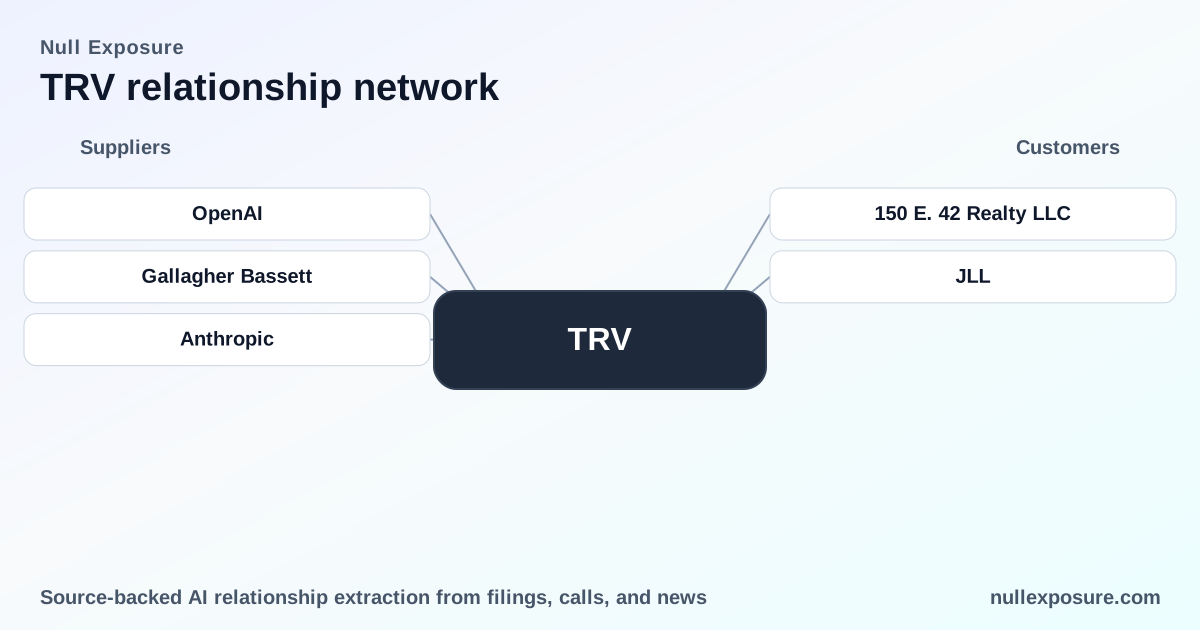
Travelers (TRV): Supplier relationships, operating posture, and what investors should price in
Travelers is a diversified property & casualty insurer that earns money by underwriting premiums and investing float, while managing tail risk through reinsurance and third‑party service providers. The company supplements underwriting economics with technology-driven efficiency initiatives — including newly announced AI claims tooling — and protects capital with short-term reinsurance treaties and government backstops where applicable. For investors, the core trade is between durable underwriting returns (ROE ~20.7%) and operational leverage from automation that can expand margin without proportionally increasing loss exposure. Learn more at https://nullexposure.com/.
Primary takeaways up front: Travelers runs a capital‑efficient P&C model, contracts short‑term reinsurance for catastrophe protection, outsources key processing functions, and is actively deploying third‑party AI to cut claims handling costs.
Why the supplier map matters for TRV
Travelers’ supplier relationships are not peripheral procurement details — they influence loss recognition timing, claims expense, and capital consumption. The company-level signals are clear from filings and press coverage:
- Contracting posture is short-term and renewal-driven. Company disclosures reference treaties that explicitly cover calendar-year periods (January 1–December 31, 2026), so reinsurance capacity and pricing reset annually and directly affect capital and loss volatility.
- Government counterparty is material for certain programs. Travelers participates in terrorism reinsurance programs that provide an 80% reimbursement by the federal government after an insurer deductible, subject to annual caps; that creates a finite backstop for political‑risk exposures.
- Geographic protection is layered (regional and international). The firm uses reinsurance and catastrophe bonds to protect Northeastern U.S. weather and earthquake exposure while also maintaining excess‑of‑loss treaties specific to international operations.
- Third-party service providers perform critical functions. Filings state the company has outsourced technology and business processes to external vendors, and that catastrophe reinsurance treaties are executed with unaffiliated reinsurers — indicating operational dependence on suppliers that is currently active.
These company-level constraints drive an operating model characterized by annual renegotiation of risk transfer, concentrated catastrophe protections regionally, and an ongoing shift toward third‑party tech to compress claims costs and underwriter time.
How the recent AI and outsourcing moves change the thesis
Travelers is actively embedding third‑party AI into claims handling. That initiative is strategic: cutting underwriter handle time materially improves loss adjustment expense and can scale without adding capital.
- Efficiency lever. Travelers reported an agentic claims program built using external AI capabilities that executives attribute to meaningful reductions in handling time and expense.
- Supplier risk. Reliance on large model providers transfers operational dependency to outside AI vendors and increases vendor management and data governance requirements.
Operational metrics support the economic case. The company posts operating margin around 25.9% and a profit margin near 12.9%, reflecting underwriting discipline and investment income that stand to benefit from lower claims processing costs if automation performs as advertised.
Supplier relationships investors need to know about
OpenAI
Travelers launched an “AI Claim Assistant” built using OpenAI model capabilities and APIs to automate aspects of auto claims processing, a move the company frames as reducing underwriter handle time and accelerating settlement. According to press coverage in February 2026, the offering uses OpenAI technology to power claims workflows and decision support. (Sources: SahmCapital, Feb 2026; Bitget news summary, Feb 2026.)
Anthropic
Travelers has been reported to partner with Anthropic as part of a broader program of agentic claims processing; industry commentary credits the Anthropic integration with contributing to a structural efficiency advantage and material reductions in handling time. (Source: Tikr analysis, March 2026.)
Gallagher Bassett
In litigation reported in early 2026, Travelers tendered defense duties for certain insureds through third‑party administrator Gallagher Bassett to Old Republic, asserting that Gallagher Bassett received additional insured tenders that went unanswered, which led Travelers to sue Old Republic over the handling of coverage tenders. This episode highlights third‑party administrator reliance and counterparty dispute risk in claims outsourcing. (Source: Insurance Business Magazine, March 2026.)
What those relationships imply for risk and concentration
- Short-term reinsurance contracting creates renewal risk. Annual treaties mean pricing and capacity shifts will pass quickly to Travelers’ loss‑bearing position if market hardening occurs. This is a company-level signal supported by treaty language for 2026 coverage.
- Government backstops cap extreme terror losses but are limited. The federal reimbursement program covers 80% of subject losses after a deductible with annual caps, reducing tail risk but leaving residual exposure that must be priced and reinsured at market rates.
- Outsourced tech and third‑party administrators are critical. The company’s strategy to outsource tech and business processes increases operational efficiency but introduces concentration and vendor‑management risk; the Gallagher Bassett tender dispute exemplifies counterparty operational friction.
- Geographic concentration in the Northeast for catastrophe exposure. Travelers maintains reinsurance and catastrophe bonds targeted at Northeastern U.S. weather and seismic risks, while separate treaties protect international portfolios — a hybrid approach that influences capital allocation decisions.
Diligence checklist for investors and operators
- Confirm renewal cadence and pricing sensitivity for the 2026‑period treaties and how much catastrophe protection is ceded to third parties and capital markets.
- Validate vendor SLAs, data governance, and exit mechanics for AI and claims‑processing providers; scenario test the operational impact of vendor interruption.
- Quantify net retained exposure after the federal terrorism reimbursement and reinsurance recoverables: stressed capital models should incorporate the stated government cap.
- Monitor litigation and tender disputes involving third‑party administrators as indicators of control weaknesses in claims workflows.
For a deeper look into how supplier signals move market exposures and where to prioritize contractual protections, visit https://nullexposure.com/ — our analyses map the supplier layer that underpins public financials.
Bottom line: how to position around TRV
Travelers is a capitalized, operationally modernizing P&C insurer with strong ROE and operating margins that benefit from automation and disciplined underwriting. The new AI claims initiatives, executed with prominent third‑party model providers, represent a clear path to lower claims expense and faster cycle times, but they also concentrate operational risk in external vendors and require rigorous vendor controls. Reinsurance is deliberately short‑term and regionally focused, which provides flexibility but also forces Travelers to manage renewal cycles actively.
For investors, the thesis is straightforward: price in durable underwriting quality and incremental margin upside from automation, while discounting for renewal volatility and third‑party operational risk. For operators, the priority is governance: secure contracts, run vendor resilience tests, and align catastrophe capital across treaty expiries.
Explore our supplier-risk framework and related company reports at https://nullexposure.com/ to integrate these supplier signals into your TRV diligence and portfolio construction.