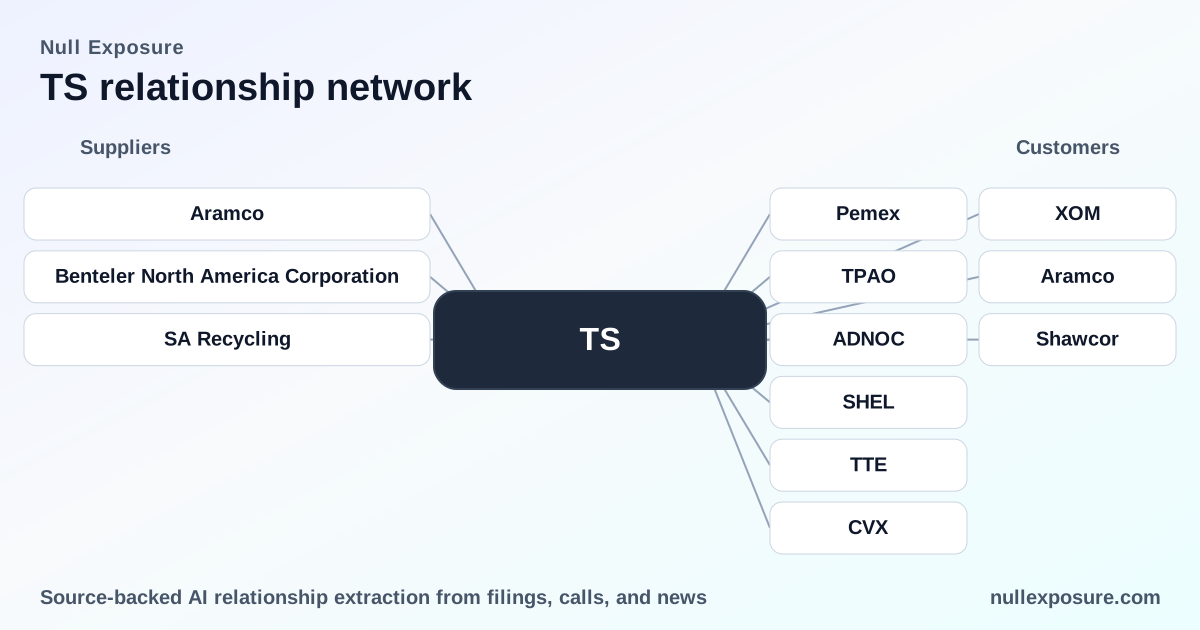
Tenaris (TS) as a Supplier: Structural Positioning and Commercial Stakes
Tenaris manufactures and sells welded and seamless tubular steel (primarily OCTG) and related services to the oil & gas industry and other industrial users, monetizing through product sales, services contracts, and selective asset acquisitions that strengthen local manufacturing and scrap supply chains. Revenue is driven by OCTG volumes, integrated production assets, and strategic M&A, while margins benefit from vertical control of raw material flows and scale in key geographies. For a deeper supplier-risk perspective and comparable profiles, visit https://nullexposure.com/.
How Tenaris’ economics work and what buyers pay for
Tenaris operates as an integrated industrial supplier: manufacturing capacity + localized assets + aftermarket services. Financials underscore that operating profile — trailing revenue of roughly $11.98B and EBITDA near $2.82B (FY-TTM), delivering an operating margin around 18.5% and a profit margin around 16.1% (company figures through 2025). The stock trades at a trailing P/E of 14.7 with a dividend yield of 3.31%, signaling a cash-return orientation alongside capital-intensive operations.
From an operating-model perspective, key company-level signals:
- Contracting posture: Tenaris commonly supplies through long-term and transactional contracts for OCTG; its direct supply to large national oil companies implies negotiated volume and quality commitments rather than purely spot sales.
- Concentration: Exposure is concentrated in energy-related tubular products, and a small share of institutional ownership (PercentInstitutions ~6.8%) indicates a shareholder base that is not dominated by large passive holders.
- Criticality: OCTG supplied to major operators is mission-critical to drilling operations; customers dependent on continuous tubing supply treat Tenaris as a strategic vendor.
- Maturity: The business is mature and capital intensive, with stable margins and recurring cash generation, supported by geographically distributed assets and recent acquisitions that enhance local presence.
Supplier relationships that shape Tenaris’ operational footprint
Below are every supplier or commercial relationship called out in the results set, summarized in plain English with source context.
Aramco — direct OCTG supply to a national oil champion
Tenaris stated in its 2025 Q4 earnings call that it supplies OCTG for Aramco’s drilling operations, confirming direct commercial supply to one of the world’s largest oil producers (Tenaris 2025 Q4 earnings call, disclosed March 7, 2026).
Benteler North America Corporation — acquisition of Shreveport OCTG facility
Tenaris completed an acquisition of Benteler’s Shreveport, Louisiana OCTG manufacturing facility for $460 million, reflecting an asset-led strategy to expand domestic OCTG capacity (Eurometal report on the FY2022 transaction, reported March 10, 2026).
SA Recycling — purchase of a regional scrap-processing yard
Tenaris announced that its subsidiary, Steel Recycling Services, acquired the Beaver Falls scrap-processing yard from SA Recycling, signaling vertical integration into scrap supply to stabilize raw material inputs (Pittsburgh-area business coverage of the FY2025 transaction, reported December 2025 / cited March 10, 2026).
What these relationships imply for investors and operators
Each relationship demonstrates a deliberate industrial strategy: direct supply to large producers (Aramco) confirms high criticality contracts; acquisitions of manufacturing and scrap assets (Benteler Shreveport, Beaver Falls yard) indicate increased vertical control and local capacity. These deals reduce exposure to third-party manufacturing constraints and raw-material volatility while increasing capital intensity and integration risk.
Midway note: to compare these supplier dynamics against peers and assess counterparty risk, review additional supplier profiles at https://nullexposure.com/.
Risk factors to price and negotiation levers for counterparties
Operational and financial risks are straightforward and actionable:
- Customer concentration risk: Supplying national oil companies creates revenue stability but exposes Tenaris to large-buyer negotiation leverage and industry cyclicality.
- Integration and execution risk from acquisitions: Large asset purchases (e.g., $460M Shreveport) increase capex and integration demands that investors should monitor via cash flow and EBITDA trends.
- Supply-chain control vs. capital intensity: Acquiring scrap yards and plants reduces commodity exposure but increases fixed-cost base and calls for disciplined utilization.
- Market and commodity cyclicality: Revenue and margins track drilling activity and steel/commodity prices; institutional ownership and dividend policy show a blend of income and industrial exposure.
For counterparties, negotiation priorities are clear:
- Secure long-term volume agreements and transparent price-pass mechanisms tied to steel indices.
- Insist on quality, delivery windows, and local-content commitments in regions where Tenaris has made recent investments.
- Require integration milestones and performance guarantees when contracts coincide with newly acquired facilities.
Practical takeaways for investors and operators
- Tenaris is a strategically integrated OCTG provider with direct supply relationships to blue-chip producers and an M&A-led approach to capacity and feedstock control.
- The company’s financials support a stable cash-return profile, but acquisitions increase the need to watch free cash flow and capex discipline.
- Operational criticality is high for customers like Aramco, which strengthens Tenaris’ negotiating position on reliability and quality but also concentrates exposure to oil & gas cycles.
For a supplier-risk scorecard and to model counterparty exposure by facility and contract, explore the full supplier intelligence catalog at https://nullexposure.com/.
Bottom line
Tenaris combines industrial scale, direct commercial relationships with major oil producers, and targeted asset acquisitions to control production and raw-material inputs. Investors should value the premium applied to mission-critical supply while discounting integration and cyclical demand risks; operators should prioritize contractual protections around volume, quality, and delivery tied to newly acquired assets. For a deeper dive into Tenaris’ supplier network and comparable counterparties, see the supplier profiles at https://nullexposure.com/.