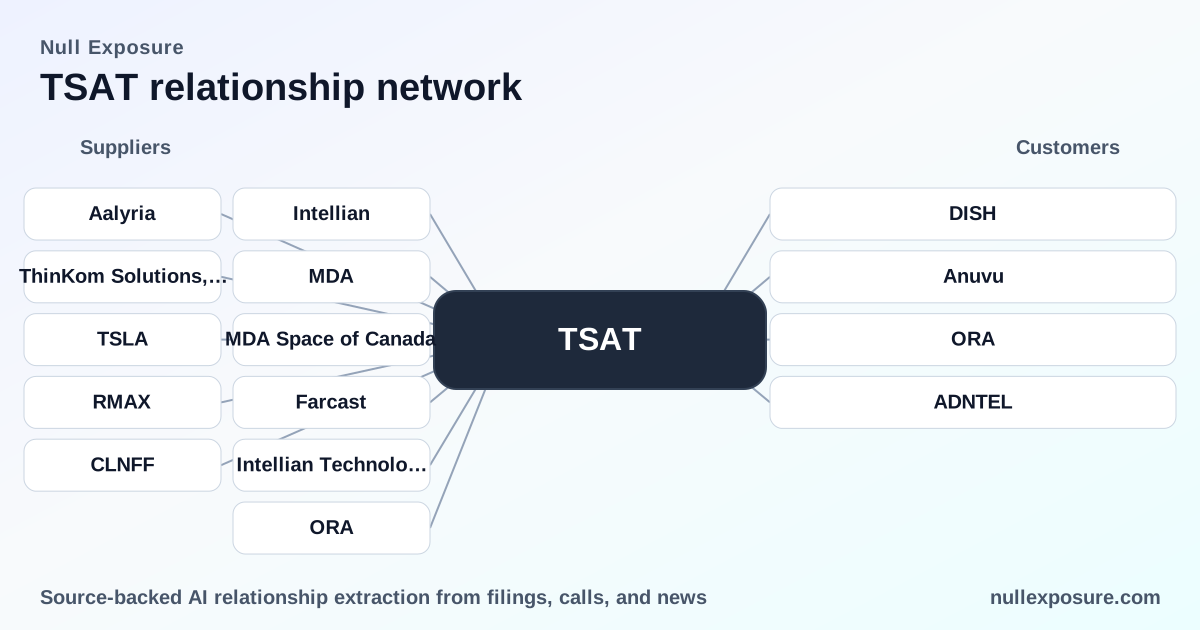
Telesat (TSAT) supplier map: who builds Lightspeed and what it means for investors
Telesat operates and monetizes a global satellite connectivity business by selling capacity and managed services to wholesale and enterprise customers while building scale in low‑earth orbit (LEO) via the Lightspeed constellation. Revenue is derived from long‑term ground and space contracts, hosted teleports and backhaul partnerships, and terminal and gateway hardware tied to the Lightspeed launch and operations cadence. For investors, supplier relationships are the operational spine — they convert capital into deployed capacity and lock customers into serviceable routes. Explore more supplier intelligence at https://nullexposure.com/.
Why the supplier roster matters now
Telesat’s execution risk is concentrated in a handful of manufacturing and ground‑segment providers; those relationships determine build schedule, unit economics, and time‑to‑revenue. Lightspeed’s commercial thesis hinges on three pillars: satellites built to spec, gateways deployed on schedule, and user terminals that enable volume adoption. Supplier selection shows a mix of large prime contractors, specialized antenna and software partners, and regional telecom hosts — a pragmatic blend that balances scale, capability, and market reach.
Key company‑level operating signals
- Contracting posture: Telesat contracts primes and systems vendors under multi‑year commitments; the company has publicly announced prime manufacturer and gateway suppliers, indicating a traditional programmatic procurement model rather than one‑off sourcing.
- Concentration and criticality: Manufacturing (prime satellite contractor) and gateway deployments are highly critical to Lightspeed timelines; a small number of suppliers carry outsized schedule risk. This is a company‑level signal rather than a note about any single supplier.
- Vendor maturity and capability: The supplier pool mixes incumbents with aerospace pedigree and specialized newcomers in FPA terminals and traffic orchestration software — a deliberate trade between proven scale and innovative cost reduction.
- Commercial leverage: Hosting arrangements with tier‑1 telcos for teleports and PoPs point to pragmatic revenue capture and reduced capital intensity for ground infrastructure.
If you want a map of how these supplier ties translate into commercial exposure, see the company overview at https://nullexposure.com/.
Supplier‑by‑supplier: what you need to know
Intellian (gateway build and integration — earnings call)
Telesat confirms Intellian is contracted to build all of the Lightspeed gateway antennas and is reporting steady progress on installations. This was stated on Telesat’s 2025 Q3 earnings call on March 7, 2026, where management highlighted Intellian’s role in gateway deployment (Telesat 2025 Q3 earnings call).
Intellian Technologies Inc. (127 Gateway Antenna Systems — press reports)
Separately, press coverage documents a contract for Intellian to design, supply, install and integrate 127 Gateway Antenna Systems at Lightspeed landing stations, establishing Intellian as the primary gateway integrator for initial deployments (SatNews and RunwayGirlNetwork, FY2024).
MDA Ltd. (prime satellite manufacturer — company press release)
Telesat named MDA Ltd. as prime contractor to build 198 software‑defined satellites for the Lightspeed LEO program, a decisive manufacturing commitment that secures the physical constellation backbone (Telesat press release, FY2023).
MDA Space of Canada (orders and program detail — industry analysis)
Industry reporting notes the 198 satellites on order with MDA Space of Canada, reinforcing that Lightspeed relies on a single prime for spacecraft production at scale (SpaceIntelReport coverage, FY2025).
MDA Space (prime contractor referenced in Canadian government release)
Canadian government materials and program overviews also identify MDA Space as the prime satellite contractor in the national Lightspeed program context, highlighting the program’s strategic domestic industrial ties (Prime Minister’s Office release, FY2024).
Farcast (user terminals — strategic investment and supply)
Telesat invested US$5 million to accelerate Farcast’s enterprise Flat Panel Antenna (FPA) user terminal development and integration with the Lightspeed modem, aligning terminal supply with Telesat’s service specifications and volume readiness (Telesat press release, FY2025; Globe and Mail coverage, Nov 4, 2025).
Aalyria (network orchestration software)
Telesat selected Aalyria’s Spacetime networking software to orchestrate customer traffic across the Lightspeed constellation, a partnership intended to optimize throughput and customer experience across LEO links (Telesat blog post, FY2024).
ThinKom Solutions, Inc. (airborne antenna certification partnership)
Telesat expanded development to certify ThinKom’s ThinAir Ka2517 antenna for Lightspeed, supporting airborne mobility and aero connectivity opportunities for the fleet (RunwayGirlNetwork coverage, FY2024).
Orange (teleport hosting and ground connectivity)
Telesat signed a multi‑year partnership with Orange to host a Lightspeed landing station at Orange’s teleport in Bercenay‑en‑Othe, with backhaul into Orange’s Paris PoP over wholesale private line — a strategic European hosting and transport arrangement (Orange and Telesat press releases / GlobeNewswire, FY2025; earnings call mention, 2025 Q3).
SpaceX (commercial customer mention in earnings call)
During the 2025 Q3 earnings call Telesat referenced a book of business including SpaceX, indicating commercial conversations and competitive/complementary footprint considerations with other LEO operators and service providers (Telesat 2025 Q3 earnings call).
Calian (operational data platform for Lightspeed)
Telesat expanded its relationship with Calian to develop a resilient operational data platform for Lightspeed operations, signaling investment in ground‑side operational resilience and systems integration (GlobeNewswire coverage, Sept 29, 2025).
What this roster says about execution and investor risk
- Execution is supplier‑driven. The program relies on a concentrated set of prime and systems suppliers to hit launch and service milestones; delays or quality issues at that level directly translate into revenue slippage. MDA’s role as prime and Intellian’s gateway mandate are examples of single points of operational leverage.
- Commercial distribution is deliberate. Hosting teleports with incumbents like Orange and certifying terminals with multiple antenna vendors create distribution and go‑to‑market optionality that reduces pure hardware dependency.
- Technology and software partnerships (Aalyria, Calian) indicate a layered approach to margin expansion: optimize traffic, reduce opex, and improve customer SLAs post‑launch.
For deeper supplier exposure analysis and supplier‑financial crosswalks, visit https://nullexposure.com/ to see the full picture.
Bottom line and investor action points
Telesat has assembled a credible supplier ecosystem combining an aerospace prime, gateway integrators, terminal developers, telemetry and orchestration software, and telecom hosts. The Lightspeed revenue inflection will follow the delivery and integration rhythm of these suppliers — investors should monitor contract milestones and published deployment progress as leading indicators.
If you want to track supplier progress and tie it back to revenue realization, start your supplier diligence at https://nullexposure.com/.
Key near‑term monitoring items: satellite delivery schedule from MDA, gateway deployment cadence with Intellian, user terminal availability from Farcast and ThinKom certification, and hosted teleport service activations with Orange. These are the events that will turn Lightspeed’s capital expenditure into recurring revenue.