Timberland Bancorp (TSBK): Counterparty and Supplier Snapshot for Investors
Timberland Bancorp (TSBK) is a regional bank holding company that monetizes core banking activities—net interest income from lending and investing, deposit spreads, and fee income—while maintaining a modest dividend and capital base consistent with community banking. Liquidity is managed through limited borrowings and sizeable secured borrowing lines from systemic facilities, giving the bank near-term flexibility to fund balance-sheet growth and absorb shocks. For investors evaluating supplier and counterparty exposure, the practical takeaway is straightforward: TSBK runs a traditional community-bank operating model supported by large, system-level credit lines and third‑party operational vendors. Learn more about supplier intelligence at https://nullexposure.com/.
How the numbers frame the counterparty story
Timberland reported revenue TTM of roughly $83.7 million, a profit margin of 36%, and a market capitalization near $300 million; valuation metrics include a trailing P/E of 9.9 and a price-to-book around 1.11. The bank’s balance-sheet posture—only $20 million in borrowings at the reported quarter-end with secured borrowing capacity in the high hundreds of millions—is the single most important operational backstop when assessing supplier and funding risk.
Key supplier and counterparty relationships you need to know
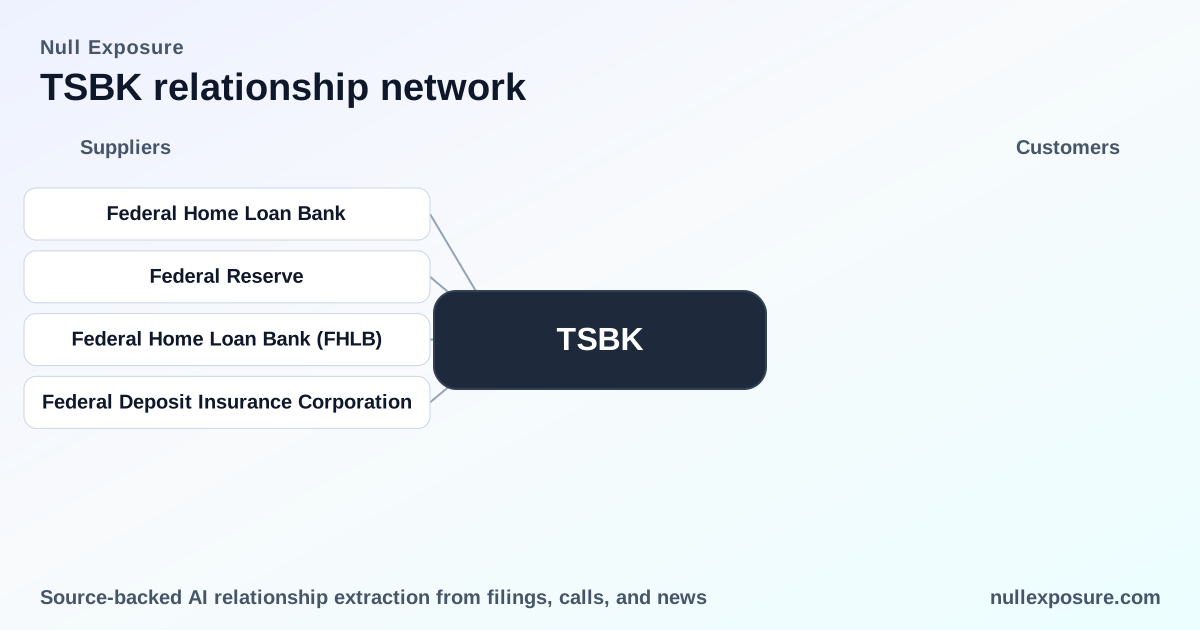
Federal Home Loan Bank (FHLB)
Timberland discloses a material secured borrowing line with the Federal Home Loan Bank, which expands its liquidity runway well beyond current borrowings; the company reported $761 million of available secured borrowing capacity through the FHLB and the Federal Reserve as of December 31, 2025. According to the company’s fiscal-first-quarter release (GlobeNewswire, Jan 26, 2026), this capacity is a core element of Timberland’s liquidity management and funding contingency planning.
Federal Reserve
The Federal Reserve is reported as a secondary secured borrowing source alongside the FHLB; Timberland explicitly cites capacity available through the Federal Reserve in its liquidity disclosures. The same fiscal-quarter communication (reported on Yahoo Finance and GlobeNewswire, Jan 26, 2026) lists access to Fed facilities as part of the bank’s secured borrowing line totaling $761 million at year-end 2025.
Federal Deposit Insurance Corporation (FDIC)
Timberland’s filings reference FDIC insurance in its disclosures on deposit coverage and bank reporting (GlobeNewswire fiscal-year disclosure, Oct 30, 2025). The filing includes an FDIC insurance line item that reflects routine regulatory reporting of insured deposit amounts and related metrics, underscoring standard deposit-protection frameworks for depositors and counterparties.
What these relationships imply about Timberland’s operating model
- Contracting posture: Timberland leverages formal, system-level liquidity arrangements rather than ad hoc market borrowing; the bank relies on the FHLB and Fed as structured counterparties for secured credit. This posture reduces short-term funding risk but introduces standard collateral and covenant disciplines associated with those facilities.
- Concentration vs. diversification: Counterparty concentration is concentrated at the institutional level (FHLB/Fed) for liquidity, which is appropriate for a community bank; operational vendor reliance is a separate vector of concentration that the company acknowledges.
- Criticality: Access to FHLB/Fed lines is critical to funding resilience; losing that access would materially increase funding risk. FDIC insurance is a regulatory and depositor-protection backbone that preserves deposit stability.
- Maturity and terms: Relationships with the FHLB, Fed, and FDIC are institutional and mature, anchored in statutory/regulatory frameworks rather than bespoke private contracts, which improves predictability of terms under stress.
Supplier constraints and controls — what the company discloses
Timberland states that it relies on third-party vendors for significant data processing and operational functions, and that those vendors’ systems and controls operate outside the bank’s direct oversight. That disclosure is a company-level signal that operational risk and vendor control oversight are material governance issues for investors and counterparties evaluating resiliency. The bank’s contracting posture implies standard vendor relationships—critical for operations but externally controlled—so diligence should prioritize vendor concentration, service-level terms, and incident response capabilities.
Strategic implications and investor takeaways
- Liquidity buffer is a strategic asset. With only $20 million in borrowings at quarter end and $761 million in secured borrowing capacity, Timberland maintains a clear funding cushion to support lending and absorb idiosyncratic shocks (GlobeNewswire/Yahoo Finance, Jan 26, 2026).
- Counterparty risk is concentrated but institutionally anchored. The FHLB and Federal Reserve are system counterparties with established terms; dependency is manageable but operational vendor reliance introduces a separate pool of operational risk that requires active governance.
- Regulatory backstops matter. FDIC insurance disclosures reflect stable deposit protection that supports franchise value and mitigates depositor-run risk in stressed scenarios (GlobeNewswire fiscal-year filing, Oct 30, 2025).
For deeper visibility into Timberland’s supplier exposures and to benchmark these counterparty relationships against peers, visit https://nullexposure.com/ for tailored supplier intelligence.
Actionable recommendations for investors and operators
- Prioritize monitoring of secured borrowing utilization and any changes to FHLB/Fed collateral or access terms in quarterly filings.
- Request disclosure on vendor concentration and service-level agreements during management calls; the company’s own filings highlight third-party operational reliance.
- Track FDIC-related reporting for deposit composition and insured/uninsured ratios that influence liquidity stress scenarios.
For a practitioner-grade view of where supplier risk matters most across the banking sector, explore the full platform at https://nullexposure.com/.
Closing summary: Timberland Bancorp runs a conservative, relationship-driven funding model supported by institutional liquidity facilities and standard regulatory backstops; the principal vendor risk is operational and requires active oversight. Investors should treat the FHLB/Fed lines as the bank’s primary liquidity defense and escalate vendor-control diligence where third-party processing is significant.