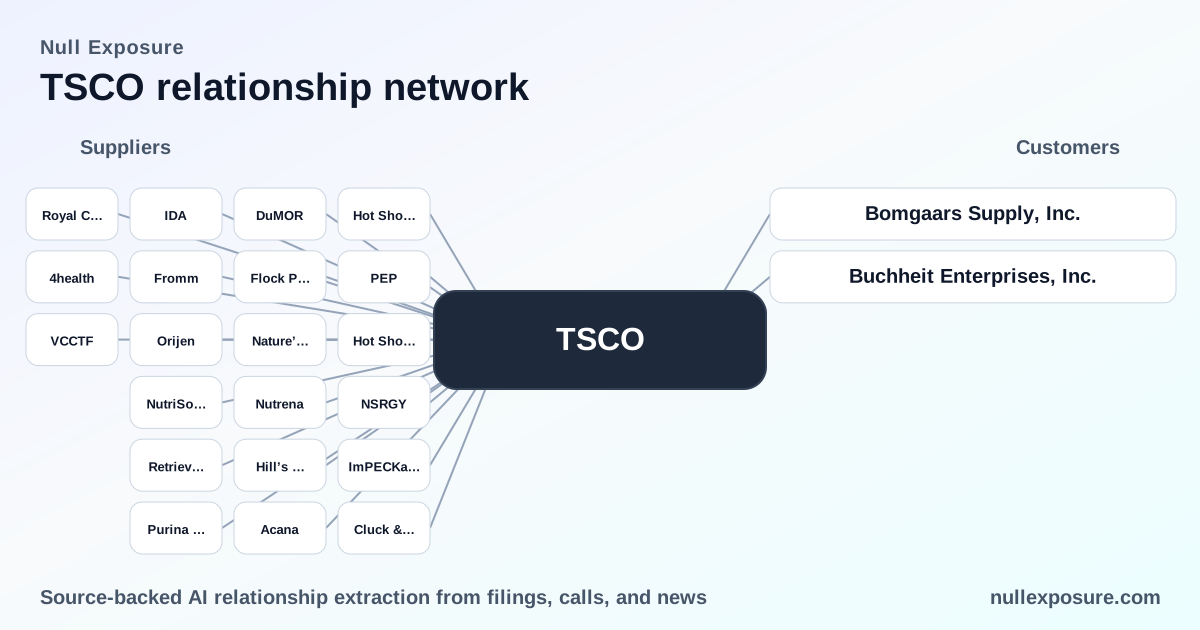
Tractor Supply (TSCO): Supplier Relationships That Drive the Farm-and-Home Platform
Tractor Supply Company operates a dual retail model: a core Tractor Supply store network that sells national and private-label products for agriculture, lawn & garden, livestock and pet care, plus a specialty pet banner (PetSense). The company monetizes through high-frequency in-store retail sales, private-label margin capture, and event-driven promotions and vendor co-marketing that boost foot traffic and loyalty — producing roughly $15.5B of annual revenue and mid-single-digit operating margins. For investors evaluating supplier exposure, the important signal is a broad, low-concentration vendor base that supports private-brand manufacturing and national-brand merchandising while enabling tactical promotional partnerships.
Learn more about supplier intelligence and how these relationships move the P&L at https://nullexposure.com/.
What Tractor Supply’s supplier posture tells you about resilience and leverage
Tractor Supply’s public disclosures and the recent relationship activity generate three clear operating signals for investors:
- Sourcing is global but diversified. Management states products are sourced domestically and internationally and vendors must meet a company code of conduct, which supports a distributed supply base rather than single-country dependence (company filing language).
- Concentration is low and procurement leverage is high. Tractor Supply purchases from more than 1,000 vendors and no single vendor represented over 10% of purchases in FY2024 — a sign that counterparty concentration risk is immaterial at the company level.
- Supplier roles are mixed: national-brand vendors, contract manufacturers for private brands, and third-party service providers. The company explicitly uses vendors to manufacture exclusive private labels and also engages third parties for service functions such as customer feedback measurement.
Together these constraints imply a contracting posture where Tractor Supply has meaningful negotiating leverage, limited single-vendor criticality, and a mature supplier base that supports both margin capture on private labels and promotional partnerships.
The relationships — who Tractor Supply is working with, and what each connection means
Below are the supplier and partner names mentioned in recent coverage. Each entry includes a plain-English summary and a short source citation.
-
Hot Shot’s Secret — Tractor Supply expanded distribution of Hot Shot’s Secret fuel and oil treatments nationwide, increasing shelf presence for a fast-growing specialty lubricant brand. (Press release coverage, The Destin Log / Courier-Journal, March 10, 2026 — https://www.thedestinlog.com/press-release/story/31035/hot-shots-secret-announces-major-expansion-in-tractor-supply-company-nationwide/ and https://www.courier-journal.com/press-release/story/132252/hot-shots-secret-announces-major-expansion-in-tractor-supply-company-nationwide/)
-
PepsiCo, Inc. (PEP) — PepsiCo is a community sponsor of Tractor Supply’s Animal Days and committed $120,000 in local animal shelter donations as part of Farm Bash activations; this is a promotional/sponsorship relationship that supports foot traffic and local goodwill. (Local coverage, FCFreePressPA / Folsom Times, March 10, 2026 — https://fcfreepresspa.com/tractor-supply-announces-a-flock-of-animal-friendly-festivities-launching-this-month/)
-
Purina — Purina brands are active in in-store sampling and promotional activity across events at Tractor Supply and PetSense, reinforcing the retailer’s role as a primary grocery channel for pet nutrition products. (Local press, Folsom Times and corporate event copy, March 2026 — https://folsomtimes.com/animal-chick-days-bring-family-fun-to-local-tractor-supply/)
-
ImPECKables — Named among sponsors for Farm Bash-style events, ImPECKables provides branded offers that support event merchandising and category activation. (FCFreePressPA event coverage, March 10, 2026 — https://fcfreepresspa.com/tractor-supply-announces-a-flock-of-animal-friendly-festivities-launching-this-month/)
-
Cluck & Co — Listed as an event sponsor in Tractor Supply promotions, Cluck & Co participates in co-branded merchandising and customer sampling. (FCFreePressPA, March 10, 2026 — https://fcfreepresspa.com/tractor-supply-announces-a-flock-of-animal-friendly-festivities-launching-this-month/)
-
DuMOR — DuMOR appears as a sponsor in Tractor Supply’s event lineup, indicating placement in the company’s poultry and livestock product set. (FCFreePressPA, March 10, 2026 — https://fcfreepresspa.com/tractor-supply-announces-a-flock-of-animal-friendly-festivities-launching-this-month/)
-
Flock Party — A promotional partner providing offers for Tractor Supply’s consumer-facing animal events and seasonal programs. (FCFreePressPA, March 10, 2026 — https://fcfreepresspa.com/tractor-supply-announces-a-flock-of-animal-friendly-festivities-launching-this-month/)
-
Nature’s Best Organics — Part of the sponsored lineup for pet/poultry programming at Tractor Supply, supporting organic positioning in relevant categories. (FCFreePressPA, March 10, 2026 — https://fcfreepresspa.com/tractor-supply-announces-a-flock-of-animal-friendly-festivities-launching-this-month/)
-
Nutrena — Included among sponsored brand offers for in-store animal events; Nutrena supports feed and nutrition assortments at Tractor Supply. (FCFreePressPA, March 10, 2026 — https://fcfreepresspa.com/tractor-supply-announces-a-flock-of-animal-friendly-festivities-launching-this-month/)
-
Retriever — Noted in promotional doorbuster deals (e.g., $1 jumbo tennis ball promotions), signaling participation in value and traffic-driving tactics. (FCFreePressPA, March 10, 2026 — https://fcfreepresspa.com/tractor-supply-announces-a-flock-of-animal-friendly-festivities-launching-this-month/)
-
Hill’s Science Diet — Listed as one of multiple nationally recognized pet brands carried by Petsense, reinforcing Petsense’s role as a national-brand pet specialty channel. (Corporate Tractor Supply news release, March 2026 — https://corporate.tractorsupply.com/newsroom/news-releases/news-releases-details/2026/Petsense-and-Allivet-Announce-Formation-of-National-Pet-Expert-Advisory-Council/default.aspx)
-
Acana — Acana is among the premium pet food brands carried in Petsense assortments. (Corporate release, March 2026 — https://corporate.tractorsupply.com/newsroom/news-releases/news-releases-details/2026/Petsense-and-Allivet-Announce-Formation-of-National-Pet-Expert-Advisory-Council/default.aspx)
-
Idaho Power (IDA) — Idaho Power was credited with enabling the on-lineing of a Tractor Supply distribution warehouse in the region, indicating local infrastructure and utility partnerships in distribution expansion. (Earnings call summary, InsiderMonkey transcript referencing Q4 2025, March 2026 — https://www.insidermonkey.com/blog/idacorp-inc-nyseida-q4-2025-earnings-call-transcript-1699689/)
-
Fromm — Named in the Petsense product roster as a national brand supplier for premium pet food categories. (Corporate release, March 2026 — https://corporate.tractorsupply.com/newsroom/news-releases/news-releases-details/2026/Petsense-and-Allivet-Announce-Formation-of-National-Pet-Expert-Advisory-Council/default.aspx)
-
Orijen — Orijen appears in the Petsense brand list, underscoring premium dry-food assortments. (Corporate release, March 2026 — https://corporate.tractorsupply.com/newsroom/news-releases/news-releases-details/2026/Petsense-and-Allivet-Announce-Formation-of-National-Pet-Expert-Advisory-Council/default.aspx)
-
NutriSource — Included among the nationally recognized brands stocked by Petsense. (Corporate release, March 2026 — https://corporate.tractorsupply.com/newsroom/news-releases/news-releases-details/2026/Petsense-and-Allivet-Announce-Formation-of-National-Pet-Expert-Advisory-Council/default.aspx)
-
4health — Active in in-store and event tastings for dogs and horses, supporting sampling-led conversion strategies. (Folsom Times and FCFreePressPA event coverage, March 2026 — https://folsomtimes.com/animal-chick-days-bring-family-fun-to-local-tractor-supply/)
-
Purina Pro Plan — Specifically named in Petsense assortments, reinforcing that Tractor Supply’s pet channels carry tiered national-brand portfolios. (Corporate release, March 2026 — https://corporate.tractorsupply.com/newsroom/news-releases/news-releases-details/2026/Petsense-and-Allivet-Announce-Formation-of-National-Pet-Expert-Advisory-Council/default.aspx)
-
Royal Canin — Another national pet brand included in PetSense assortments, useful for retention of premium pet customers. (Corporate release, March 2026 — https://corporate.tractorsupply.com/newsroom/news-releases/news-releases-details/2026/Petsense-and-Allivet-Announce-Formation-of-National-Pet-Expert-Advisory-Council/default.aspx)
-
Victor (VCCTF) — Listed among pet brands carried by Petsense and Tractor Supply, supporting specialty and performance pet categories. (Corporate release, March 2026 — https://corporate.tractorsupply.com/newsroom/news-releases/news-releases-details/2026/Petsense-and-Allivet-Announce-Formation-of-National-Pet-Expert-Advisory-Council/default.aspx)
If you want detailed counterparty exposure analytics or to monitor changes in distribution and sponsorship activity, visit https://nullexposure.com/ to see how supplier-driven revenue risks and opportunities are tracked in real time.
Investment implications: margin upside with bounded supplier concentration risk
- Operational upside: Private-label manufacturing and national-brand placement create both margin capture and traffic synergies; recent expansions (Hot Shot’s Secret distribution) and event sponsorships (PepsiCo donations, multiple pet brands) translate to in-store conversion gains and higher basket values.
- Risk profile: Supplier concentration is low — no single vendor >10% of purchases in FY2024 — which reduces counterparty default risk; however, private-label suppliers are strategically important for merchandising and margin, so operational disruption at a manufacturer could be disruptive in a localized way.
- Capital and distribution considerations: New distribution infrastructure (regional warehouse activations with local utility coordination) improves logistics efficiency and supports store growth, reinforcing the company’s mature supply-chain posture.
Explore how these supplier signals interact with revenue and margin drivers for public retailers at https://nullexposure.com/.
Tractor Supply’s supplier ecosystem is deliberately broad and promotional — a mix of national brands, specialty suppliers, and contract manufacturers that together support a resilient, scale-driven retail model. For investors, the takeaway is clear: low concentration reduces supplier-related tail risk while supplier-driven promotions and private brands remain central to margin expansion and traffic growth.