Taysha Gene Therapies (TSHA): supplier posture, contractual levers, and what third‑party ties tell investors
Taysha Gene Therapies is a clinical-stage developer of adeno-associated virus (AAV) gene therapies focused on monogenic central nervous system disorders. The company operates by outsourcing core manufacturing and many development functions to third parties while retaining clinical and regulatory leadership, intending to monetize through clinical progress, eventual product commercialization, and licensing/partnering. Investors should view TSHA as a high‑conviction, asset‑centric biotech where supplier relationships and facility leases underpin near‑term execution risk and the pathway to revenue. For a structured view of these supplier ties and operational constraints, visit https://nullexposure.com/.
What the balance sheet and scale say about supplier dependence
Taysha’s public financial profile shows small current revenue (TTM $6.31M) versus market capitalization in the low‑billions, negative operating margins and negative EBITDA—typical of development‑stage biotechs where value is forward‑looking and execution‑dependent. Institutional ownership is extremely high at roughly 99.9%, and insiders hold about 11%, indicating a stable investor base focused on clinical readouts and value events.
These financials amplify the importance of suppliers: when clinical progress and future commercial manufacturing are the sole value drivers, contract certainty, CMO capacity, and infrastructure stability become material to valuation. Investors should therefore weigh counterparties, contract tenure, and the risk of interrupted services as central to downside scenarios.
Supplier and partner map — relationships that matter
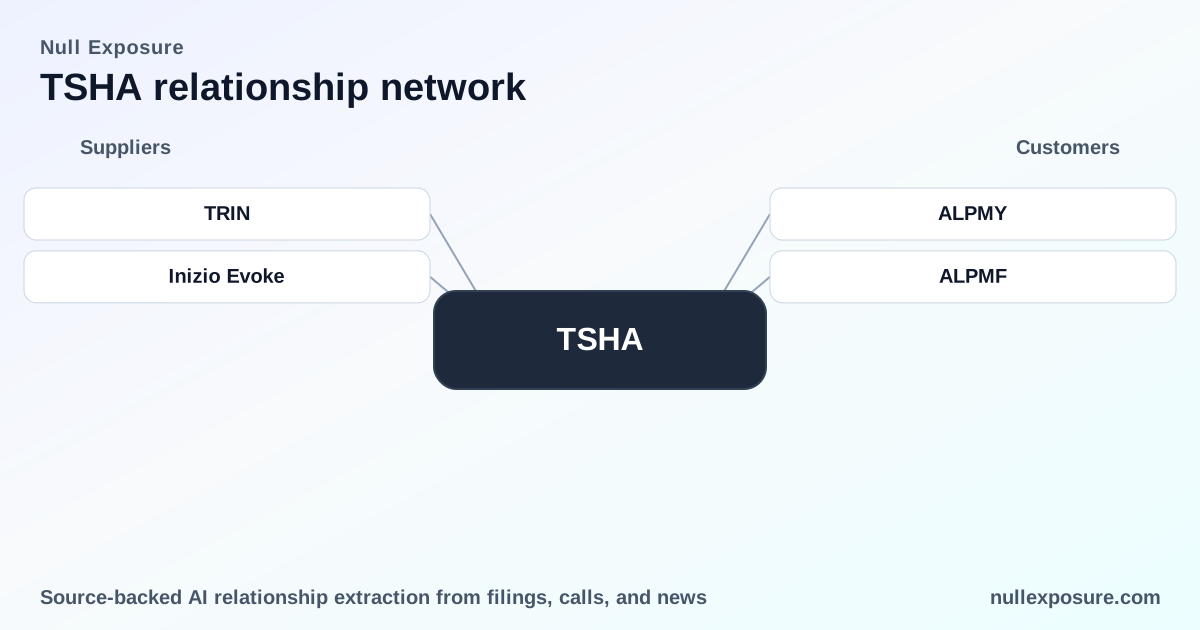
Taysha’s disclosed supplier relationships fall into two functional buckets: manufacturing / CMOs and service providers (including PR and media agents). Below are the named relationships surfaced in public materials and what they imply.
Trinity Capital — lender and refinancing counterparty
Taysha refinanced an existing loan and security agreement with Trinity Capital; the company recorded debt issuance costs related to that refinancing in general and administrative expense. According to Taysha’s Q3 2025 financial results reported on InvestingNews, the refinancing generated approximately $0.4M of incremental costs that were recorded under the fair value option. This relationship is credit‑focused: Trinity functions as a financing counterparty rather than a clinical supplier, and its engagement affects cash‑management and financing costs. (Source: InvestingNews Q3 2025 press release.)
Inizio Evoke — external communications / media agency
Inizio Evoke is listed as a Taysha media contact in the company’s press materials announcing regained rights to the TSHA‑102 program. A GlobeNewswire press release (October 16, 2025) identifies Inizio Evoke in that communications role, indicating Taysha uses external PR agencies for media strategy and stakeholder communications. This is a non‑technical service relationship that supports market perception and investor communications rather than R&D execution. (Source: GlobeNewswire press release, Oct 16, 2025.)
Contracting posture and operational constraints investors should internalize
Company disclosures and filing excerpts reveal a clear operational model: a mix of long‑dated infrastructure leases, cancelable R&D contracts, reliance on CMOs, and outsourced infrastructure services. These are company‑level signals rather than attributes of any single supplier, and they shape risk and execution timelines.
- Long‑term real estate commitments: Taysha disclosed a lease for 15,000 sq ft of administrative space commencing May 2021 with an approximately 10‑year term, and a separate manufacturing facility lease in Durham, NC (approximately 187,500 sq ft) that runs through September 2036. These long leases signal significant fixed‑cost commitments and strategic intent to support in‑house operations or controlled manufacturing capacity (company filings).
- Short‑term, cancelable R&D contracts: Research and development agreements with institutions and CROs are generally cancelable and recorded as R&D expense as incurred. This gives Taysha operational flexibility for trial activities but also creates variable spend and milestones that can accelerate cash burn (company filings).
- Manufacturing reliance on third parties: Taysha explicitly uses CMOs—including Catalent—to manufacture clinical‑grade and cGMP materials. The company expects to rely on CMOs for the foreseeable future, which makes CMO performance and capacity a critical execution dependency (company filings).
- Infrastructure and data processing third parties: Taysha outsources cloud infrastructure, hosting, and other IT functions; filings highlight the material risk from data privacy/security failures, which could interrupt trials or lead to regulatory consequences. Data processing and hosting providers are therefore functionally critical to parallel regulatory and operational timelines (company filings).
- Active supplier relationships: The company records accruals for ongoing research costs and treats many supplier engagements as active and ongoing, consistent with a company currently conducting multiple clinical programs.
What these signals mean for investors — execution, concentration, and criticality
- Execution hinge: With limited revenue and negative operating margins, TSHA’s valuation is tied to clinical and regulatory milestones. Supplier continuity—particularly CMOs—directly impacts the probability and timing of those milestones.
- Cost structure and leverage: Long operational leases increase fixed obligations that reduce runway sensitivity to financing cycles; however, cancelable R&D contracts provide some spend flexibility. The financing relationship with Trinity Capital underscores the company’s need to manage liquidity and borrowing costs.
- Operational criticality: Outsourced infrastructure for data and hosting creates non‑clinical failure modes (privacy/regulatory interruption) that are explicit material risks in filings. This elevates the importance of vendor governance, compliance audits, and contingency planning.
- Concentration and governance: Extremely high institutional ownership narrows the shareholder base and aligns focus on near‑term catalyst delivery; it also amplifies market reactions when supplier or operational issues emerge.
If you want a systematic supplier risk profile and dynamic monitoring of counterparties, explore our platform for ongoing supplier signal tracking: https://nullexposure.com/.
Bottom line and action checklist for investors
Taysha is a classic development‑stage gene therapy platform: value is forward‑looking and execution‑dependent, and supplier relationships are not ancillary — they are strategic levers that determine timing, cost, and regulatory readiness. Key investor takeaways:
- Monitor CMO performance and capacity (Catalent and others) as the single most consequential supplier risk.
- Track financing arrangements and debt costs (e.g., Trinity Capital refinancing impacts) because they influence runway and dilution decisions.
- Review lease commitments and infrastructure outsourcing terms to assess fixed‑cost exposure and data/privacy risk mitigation.
- Watch communications cadence and PR engagements (Inizio Evoke) for narrative control around catalysts and setbacks.
For deeper supplier intelligence, including contract duration flags and operational dependency scoring, visit https://nullexposure.com/.