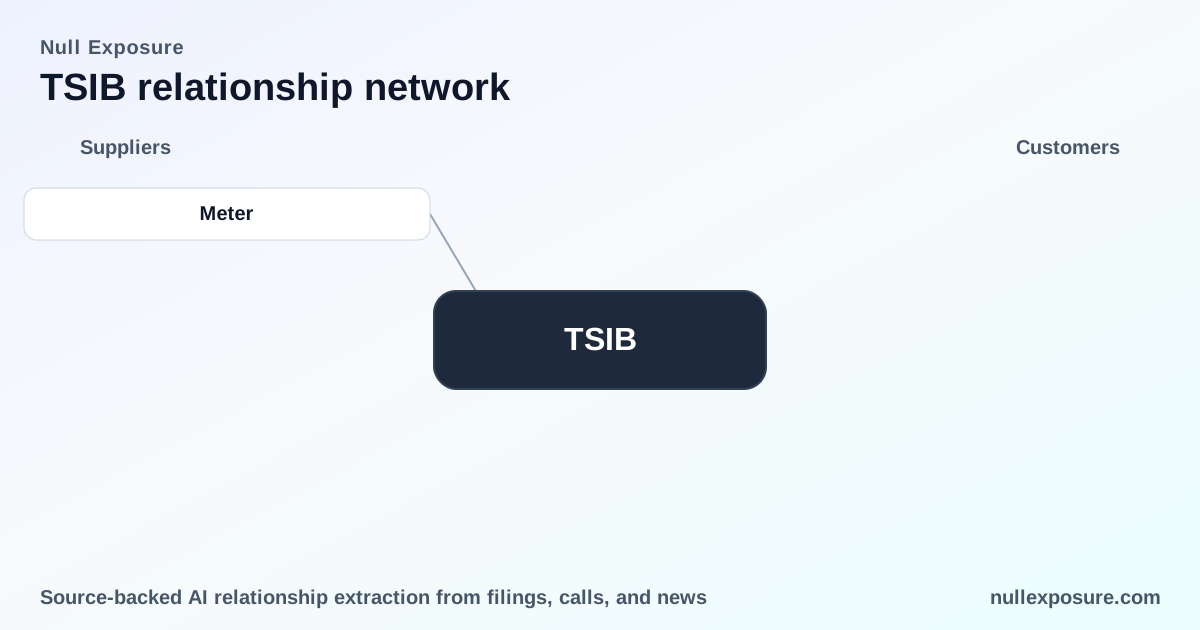
TSIB’s supplier footprint: the Meter investment and what it signals for investors
TSIB operates its supplier relationships through strategic, equity-backed engagements that convert vendors into integrated service partners across property portfolios. The company monetizes this posture by seeding or acquiring stakes in technology suppliers whose services — from connectivity to building systems — are deployed in TSIB-managed assets, capturing both service economics and upside from appreciation in partner valuations. For investors, the core takeaway is that supplier relationships are not purely procurement contracts but hybrid commercial-equity arrangements that shift counterparty risk and create optionality.
If you want a concise tracker of TSIB’s supplier relationships and strategic posture, see the full platform at https://nullexposure.com/.
What the Meter tie-in actually shows
A Propmodo feature covering Tishman Speyer’s proptech fund documents that TSIB (through its investment activity) invested in Meter — a company that initially proposed providing Wi‑Fi services for office spaces, converting a vendor pitch into a capital-backed supplier relationship. According to Propmodo (first reported March 10, 2026), the investment came out of the proptech fund’s FY2022 activity and highlights TSIB’s preference for partners that can be rolled into its property operations. Source: Propmodo, “Behind Tishman Speyer’s new proptech fund” (March 10, 2026).
How this single data point frames TSIB’s operating model
With the Meter example as a visible instance, several company-level characteristics are clear:
- Contracting posture: TSIB prefers strategic investments over purely transactional supplier contracts, using equity to secure preferential access and deeper operational alignment. This indicates a willingness to take ownership stakes to secure critical services rather than negotiating commodity procurement agreements.
- Concentration and criticality: The recorded relationship involves a core operational service — connectivity — which is operationally critical for tenant experience and digital building systems. When TSIB funds suppliers in these categories, those suppliers become high-priority partners within its portfolio.
- Maturity and cadence: The relationship is investment-driven and therefore reflects a propensity to incubate or accelerate relatively young proptech vendors rather than relying solely on mature, large incumbents. That signals a growth-and-integration posture rather than purely risk-averse outsourcing.
- Disclosure posture: There are no supplier constraints or additional supplier-level disclosures recorded for TSIB in the available public signals, which itself is a company-level signal about limited public supplier reporting and a preference for negotiating and structuring relationships privately.
These are company-level operational signals extracted from the public relationship evidence and the absence of formal supplier constraints. They should be interpreted as structural traits of TSIB’s supplier strategy rather than as provenance on any single vendor.
Every supplier relationship on record
Below is the complete list of supplier relationships surfaced in the reviewed public coverage and what each implies for investors and operators.
- Meter — TSIB invested in Meter, which originally pitched itself as a Wi‑Fi provider for office spaces; the investment converts a vendor pitch into a strategic, equity-backed supplier relationship. According to Propmodo, the investment was discussed in coverage dated March 10, 2026, referencing the proptech fund’s FY2022 activities. Source: Propmodo (March 10, 2026).
This is the full set of supplier relationships captured in the available public reporting for TSIB. For an ongoing, consolidated view of supplier ties and investment-backed partnerships, visit https://nullexposure.com/.
What investors and operators should prioritize
The Meter case delivers crisp implications for portfolio allocation, vendor risk, and operational playbooks:
- Risk reduction through alignment: Equity stakes reduce counterparty misalignment; a vendor with TSIB equity has incentives to prioritize integration and service reliability in TSIB buildings.
- Integration and vendor lock-in: The tradeoff for alignment is potential lock-in and concentration risk if multiple operational layers (connectivity, building management, tenant services) are routed through a small set of equity-backed vendors.
- Valuation upside and exit dynamics: Investments in vendors used operationally create a path for upside through portfolio synergies and eventual exit, but valuation gains depend on vendor scale and adoption beyond TSIB properties.
- Operational dependency on nascent tech: Investing in younger tech suppliers accelerates innovation adoption but raises short-term operational resilience concerns compared with contracting with established incumbents.
If you manage tenant experience or procurement for properties tied to TSIB, align contract terms around service-level guarantees and clear migration plans. For investors, stress-test scenarios where a supplier like Meter is critical to tenant retention and model the financial impact of service disruption or vendor consolidation.
Practical next steps
- For investor diligence: require clarity on ownership percentage, governance rights, and exclusivity provisions when TSIB invests in operational suppliers.
- For operators: negotiate firm SLAs and transition playbooks even when the supplier is equity-backed; preferential access does not eliminate service failure risk.
- For governance: board-level reporting should track supplier concentration across critical services (connectivity, building ops, tenant platforms) and measure replacement cost and time-to-recover.
Learn more about tracking supplier relationships and investment-backed vendor risk at https://nullexposure.com/.
Bottom line
TSIB’s publicly visible supplier footprint is currently narrow in the record but meaningful in strategic design: the company uses equity investments to convert vendor relationships into integrated supply channels, prioritizing operational alignment and upside capture over commodity supplier bidding. That posture reduces some counterparty risks while introducing concentration and integration risks that require active diligence from both investors and operators. For a running audit of these supplier-investment dynamics and their portfolio implications, see https://nullexposure.com/.